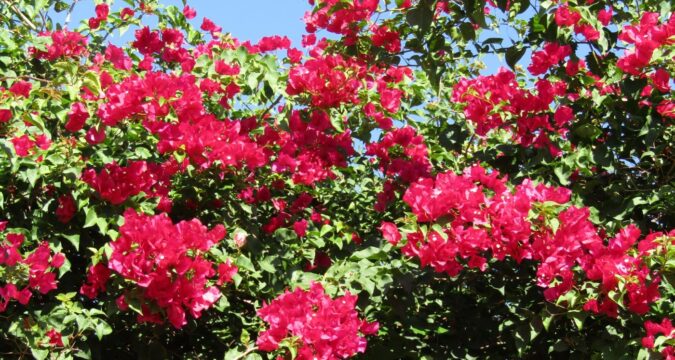
Question: Many bougainvilleas are in full bloom in our neighborhood, but ours is good and green and only has a few flowers scattered among the plant. How do we obtain more blooms?
Answer: Maybe too much care is the cause of your bougainvillea’s lack of blooms. The plants seem to enjoy the luxury of lots of fertilizer and water but it often causes them to grow and skip flowering. Some of the most attractive bougainvilleas have been found on old homesites receiving little or no care. Benign neglect seems the best way to bring your bougainvillea into bloom. Start the care by fertilizing in the spring, and maybe early summer, with a slow-release landscape product. Then only water during the dry times. Let your plant grow. Too much trimming keeps bougainvilleas in a more juvenile state with fewer blooms. Complete the minimal pruning needed by midsummer. Also make sure your bougainvillea receives lots of light. Full sun is best.
Q. Globs of white cottony substances are on our pittosporum stems and some of the leaves are turning black. What is happening to our shrubs and is there something we can do?
A. Looks like a large population of cottony cushion scale has found a home on your pittosporum as identified in an email photo. These are piercing, sucking insects that produce sap and excreta on which the sooty mold fungus grows. If left to continue, cottony cushion scale kills stems and eventually the plant. Obtain control with a natural horticultural oil spray. The spray has to coat the insects and sooty mold to be effective. A repeat application is likely to be needed in three to four weeks following label directions. Oil sprays for landscape plants are usually found at independent garden centers and hardware stores. Gardeners also find systemic insecticides applied to the soil beneath the pittosporum can give control too. When the infestation is heavy, you might apply both the oil and systemic insecticide.
Q. Seed pods are hanging on our crape myrtles. Should they be trimmed off now that the blooming season is over and our tree has lost most of its leaves? Will new ones form next year if we leave them?
A. Removing all the little seed pods sounds like tedious work to me. Right now there should be no pruning that would encourage new growth. Crape myrtles are entering a dormant phase that should last until February or March. Stimulating growth could make the tree and shrub forms more susceptible to cold. During late winter feel free to remove the ends of branches with seed pods to make the plants a bit more tidy looking. Removing or leaving ends of branches and seed pods should not effect future flowering.
Q. A couple of our crown of thorns plants are about 4½ feet tall and I need to cut them back to about 2½ feet tall. I usually cut them back before now but I forgot to do it this fall. Is now an OK time?
Plant Doctor: On a budget? Petunias make sense, can save dollars in your garden
A. While there is probably nothing wrong with cutting the crown of thorn plants back during the fall, there is not going to be much growth due to cool weather and short days. If your plants don’t look that bad it might be best to enjoy them for a few more months and cut them back in late winter or early spring. The plants are also cold sensitive and cold be injured by a frost or freeze if not growing in a protected area.
Q. I have vegetable and flower seeds in my refrigerator, some of which are five years old. Are these capable of germinating?
A. Most likely a portion of each type of seed is viable if they have been kept cool and in a sealed container or plastic bag. It’s amazing how long seeds can last. If any are seeds normally sown directly in the ground test a few by placing them between layers of moist paper towels and keeping them in a plastic bag in a warm location. After a few days you can check for the germination to help you decide whether to sow the seeds. Seeds to sow for transplants can be started in shallow containers of potting soil or germination mix. Scatter the seeds and cover lightly with one of these mixtures. Keep them moist and in a few days to a week you may find seedlings to grow on as transplants.
Q. A vine on our wall has produced pearlike fruits. What is the vine and are the fruits edible?
Creeping fig are a reasonable wall covering but don’t eat the fruit they bare. (Courtesy of Tom MacCubbin)
A. Consider this vine a reasonable wall covering but not one to bear an edible fruit. The vine is the creeping fig that firmly attaches to all structures. Like ivies and Asiatic jasmine, it could over time encourage the decline of cement holding walls together. Also, if you want to remove the vine it sticks tight and is difficult to loosen. The pear-shaped green fruits that develop on mature plantings are a curiosity but considered inedible. The plant sap is toxic to some people and causes skin irritation.
Q. One of our viburnum hedges has grown too tall for the landscape. Can it be pruned way back now or should I wait until spring?
A. Most of our common hedge plants — including viburnum, ligustrum, anise and podocarpus — are cold resistant but every so often are affected by freezes. Most gardeners would take a chance and prune them to the desired size even as winter approaches. But if you want to be safe, enjoy the green foliage a little longer and around mid-February give the planting the needed pruning.
Tom MacCubbin is an urban horticulturist emeritus with the University of Florida Cooperative Extension Service. Write him: Orlando Sentinel, P.O. Box 2833, Orlando, FL. 32802. Email: TomMac1996@aol.com.