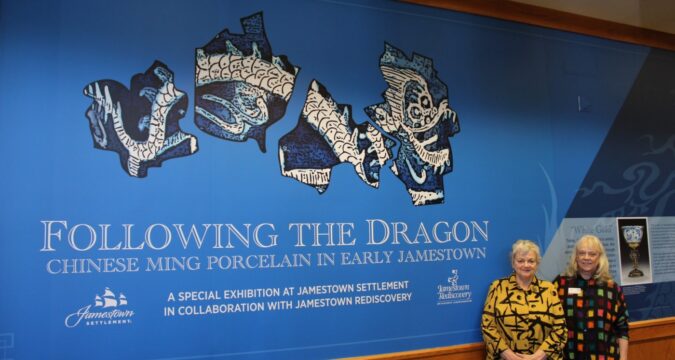
JAMESTOWN — A new special exhibition at the Jamestown Settlement museum bridges histories and provides a new insight into the lives of early American colonists.
“Following the Dragon” features 31 of the more than 100 Chinese Ming porcelain vessels discovered in archaeological excavations of the 1607-1625 fort at Historic Jamestowne.
This exhibition, which will be open until July 12, 2026, displays James Fort sherds — the technical term for pottery shards — alongside intact pieces from museums and private collections across the world to show the comparison.
“Dragon Bowl,” the name of two blue-and-white bowls, is both the first display case in the gallery and the central piece of the exhibition. The matching set — one from Jamestown and the other, discovered in Bantam, Java, on loan from a private collection — is originally from Jingdezhen, China. Jingdezhen is recognized as the center of Ming porcelain production.
“Following the Dragon” is the first collaborative exhibit between the museums at Jamestown Settlement and the historic fort, which is overseen by Jamestown Rediscovery. Beverly Straube, the senior curator at the settlement, and Jamestown Rediscovery senior curator Merry Outlaw are longtime friends who said they had been dreaming of this for years.
Part of the exhibit “Following the Dragon” at Jamestown Settlement. (Jamestown-Yorktown Foundation/Jamestown Rediscovery)
“We hatched this little dream, which we didn’t think would come true, which was to combine our resources,” Straube said. With this exhibit, she said, the two “were able to bridge the divide between the two Jamestowns.”
Chinese porcelain, nicknamed “white gold” among the English elites, was often regarded as a symbol of status and worldliness. Its presence at Jamestown, the first permanent English settlement in North America, challenges the perception of the colony as a “muddy, military settlement rife with bouts of starvation, disease and high mortality,” according to a news release.
The exhibit attempts to trace the porcelain to Jamestown through personal chests of merchants and mariners of trading companies, including the East Indian Co. and the Virginia Co., both led by London merchant Sir Thomas Smythe. Private collections are another avenue through which porcelain may have arrived in Jamestown.
Most of the pieces in this collection, including both “Dragon Bowls,” are painted in the signature blue-and-white porcelain that was prized in the first period of Ming rule. The blue color comes from cobalt oxide, which traders sourced from Central Asia, primarily Persia.
Over time, porcelain decoration became more elaborate: 16th century designs featured red, blue, yellow and green paints. A porcelain bottle from the collection of King Charles III, on loan for the first time, is painted in these more varied colors. Green and red motifs decorate the surface of the large bottle, and a gilt bronze inlay lines the rim.
Beside the bottle are matching sherds, bearing the same distinct swirls and colors. Though both curators named this one of their favorite pieces in the exhibition, loaning a work from Buckingham Palace was no easy feat.
“It took permission from the king himself to display this piece,” Outlaw said.
On loan for the first time from the Royal Collection and usually displayed at Buckingham Palace is a Ming bottle with gilt-bronze mounts that features a fenghuang, a mythical bird representing the Chinese empress and symbolizing joy, peace and sincerity. One of only three examples known to exist, the Ming bottle will be displayed near archaeological fragments of a bottle uncovered at Historic Jamestown. (Royal Collection Trust)
Other works on display include cups, bowls, plates and boxes, many featuring similar motifs of flowers, dragons, birds and flowing lines often drawn from Daoist symbolism for life and prosperity, such as a bowl decorated with peonies, the Chinese symbol for spring and renewal.
Finding the matching pieces to display alongside the Jamestown Settlement’s sherds “took a lot of research,” Outlaw said.
“One piece can tell a whole story. As you go through you’ll see — our little fragments tell a story,” she explained.
Placing the Jamestown sherds beside their matching pieces connects the struggling 17th century English colony with imperial China.
Outlaw recently published a book based on the exhibit: “Following the Dragon: Late Ming Porcelain from James Fort, Jamestown, Virginia,” which she said doubles as an exhibit catalog.
Jamestown Settlement is hosting a series of events, programs and workshops in tandem with the exhibition, including the Winter Lantern Festival that is concluding Jan. 11. The festival features artisan-crafted lanterns depicting Chinese myths, legends and zodiacs. On Jan. 24, the museum is hosting a Chinese tea ceremonies program and a talk on the history and culture of Chinese tea.
Lelia Cottin-Rack, lcottinrack@gmail.com
If you go
What: “Following the Dragon”
Where: Jamestown Settlement
When: Through July 12
Tickets and information: The special exhibition is included with daytime admission: $20 for adults, $10 for youth and free for children 5 and under. Residents of James City County, York County and Williamsburg, including William & Mary students, receive free admission with proof of residency. jfymuseums.org/following-the-dragon
https://www.pilotonline.com/2026/01/04/porcelain-exhibit-links-jamestown-colony-with-imperial-china/