Florida lawmakers are navigating a political minefield: whether to radically reshape or even eliminate property taxes that cities and counties use to pay for critical services, including police and fire-rescue.
“This is a shift in the paradigm,” state Rep. Griff Griffitts, a Panama City Beach Republican, said as lawmakers wrapped up two days of in-depth hearings on the issue. “We have to figure it out, doing (so) in a very conscientious way.”
What, if anything, to do around property taxes involves a thicket of complicated policy questions:
— How to pay for services — including public safety and schools.
— Whether some property owners are paying too much in property taxes.
— Trying to determine if local governments are wise stewards of tax money or profligate spenders.
— What taxes could be increased if property taxes are reduced.
The late-September hearings, held in the state Capitol by the House Select Committee on Property Taxes, were serious and polite. Still, lawmakers and policy experts often talked past each other. And some legislators either didn’t understand, or chose to overlook, intricacies in the way the property tax system operates.
“I felt like at the end of it, people came with preconceived ideas and left with those ideas — and didn’t allow themselves to be swayed with any of the information that was presented,” said state Rep. Kelly Skidmore, a Palm Beach County Democrat.
There are major crosscurrents with political and policy implications that could mark political careers and upend much of Florida government and what people get for their money.
Possibilities
Property taxes could, in theory, be eliminated in Florida.
Given that property taxes provide the bulk of the money for everyday operations of cities, towns, villages, counties and school districts, that would leave a yawning budget hole that could be filled by reducing services, increasing other taxes and fees, or a combination.
Gov. Ron DeSantis started 2025 talking about elimination of property taxes, but more and more politicians are now talking about doing something that increases the already substantial property tax benefits enjoyed by residential homeowners.
Total value of all property, including residential and commercial, in Florida in 2025 is $5.39 trillion, documents provided from the Department of Revenue to the tax committee showed. Taxable value was reduced $889.1 billion by Save Our Homes and $249.7 billion from homestead exemptions.
Currently the taxable value of owner-occupied homes is reduced by two $25,000 homestead exemptions for a combined total of up to $50,000. Residential homeowners also have Save Our Homes protection, which limits increases in taxable value of their homes from going up more than 3% or the rate of inflation each year, whichever is lower.
Several policymakers have floated the idea of big increases in the combined $50,000 in homestead exemptions — as much as $700,000 or $1 million. Removing that much value from taxation would mean local governments would have to cut services, increase other taxes, shift more of the burden to commercial and business property that isn’t owner-occupied homes, or some combination.
Whatever the Legislature decides, changes in the property tax system would have to go before the voters in November 2026 in the form of a referendum that would change the Florida Constitution.
Threading the needle will be difficult, Griffitts said, so that, “we, the (Legislature), don’t put something on the ballot in ’26 that is going to have devastating effects and long-term impact in cities and counties. I don’t think any of the 160 of us (representatives and senators) up here want to have that on our shoulders when we leave.”
State Rep. Anna Eskamani, a Democrat who is running for mayor of Orlando, said people want conflicting things. “We heard today that folks don’t love taxes, but we love our public safety officers.”
Related Articles
Activist who argues 2020 election was stolen from Trump runs for Florida Legislature
Dozens of Broward Democratic leaders endorse David Jolly for governor
Redistricting push from DeSantis and Trump creates uncertainty for Florida congressional candidates
Florida DOGE starts hunt for wasteful spending. Will it brandish a machete or wield a pencil?
DeSantis launches Florida DOGE plan for local governments. Broward is first.
Politics
The politics might be even more complicated than the policy.
DeSantis factor: The idea of eliminating property taxes started with the governor. He is looking to do something big in 2026 before term limits force him to leave office after the next election and as he looks for ways to sell himself to voters in other states while contemplating a second run for president.
DeSantis allies: The property tax issue has been embraced by DeSantis allies, especially Blaise Ingoglia, appointed by the governor to fill a vacancy of state chief financial officer. Ingoglia is running to retain the job in next year’s election, and he’s also campaigning across the state touting property tax relief and accusing local governments of wild overspending.
Donalds perspective: Congressman Byron Donalds, so far the leading candidate for the Republican nomination for governor next year — he’s been endorsed by President Donald Trump — has been cautious. He has acknowledged the appeal of eliminating or drastically reducing property taxes, but has expressed reservations about the fine print. He’s publicly said that eliminating the property tax could force the state to double the sales tax.
DeSantis is not supporting Donalds as his successor. Whoever is elected will have to preside over the implementation.
Legislative leadership: Republicans have huge majorities in the Florida House and Florida Senate, and their leaders can push through what they want — or block what they don’t. Even though House Speaker Daniel Perez appointed the special committee to study the issue, he and DeSantis were arch enemies during the 2025 legislative session. Perez’s ultimate intentions are unknown. And Senate President Ben Albritton hasn’t given any indication of what he’ll allow in the Senate.
Rank-and-file: Plenty of senators and representatives come from the ranks of local governments — and some want to run for local offices once they’re forced out of the Legislature by term limits — and could be disinclined to completely upend the way communities raise and spend money.
State Rep. Chip LaMarca, a Broward Republican, for example, is a former Lighthouse Point city commissioner and former county commissioner, and has said that he might someday run for mayor of Fort Lauderdale. State Rep. Peggy Gossett-Seidman, a Palm Beach County Republican, is a former Highland Beach commissioner.
Democrats: It’s unclear whether Democrats, vastly outnumbered by Republicans in the Legislature, will have any influence on the outcome. Skidmore credited the House committee’s Republican co-chairs for orchestrating hours of hearings that allowed a wide range of questions and opinions and didn’t devolve into partisan sniping.
Seven Democratic senators and representatives from Broward and Palm Beach counties are former county commissioners, School Board members or city commissioners.
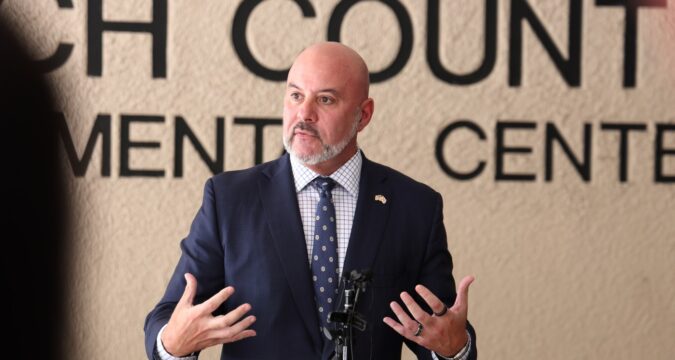
Todd Bonlarron, chief deputy administrator for Palm Beach County, discusses county government’s taxing and spending during testimony before the Florida House Select Committee on Property Taxes at the state Capitol in Tallahassee on Tuesday, Sept. 23, 2025. (Florida Channel)
Problem?
“People like the idea of paying less because they’re crunched everywhere they go,” said state Rep. Christine Hunschofsky, a former Parkland mayor. “Everything has become less and less affordable.”
Hunschofsky, who becomes House Democratic leader after the 2026 elections, and many other Democrats have portrayed the DeSantis-Republican focus on property taxes as a diversion from the cost issue their constituents raise much more often: property insurance.
Property taxes, she said, are “one of the smallest parts of the affordability crisis that I’m getting feedback on.”
Skidmore said the top cost concerns she hears from people she represents are property taxes and groceries. State Rep. Marie Woodson, D-Hollywood, said constituents most often voice worry about property and car insurance costs.
Ingoglia, on his stops around the state, emphasizes property taxes.
“Local governments are taking your money and they are wasting it. They’re wasting it to a point where everyday families are starting to feel it and housing affordability is being one of the big issues that we face in the state right now,” Ingoglia said Thursday in Alachua. “Local governments are taking this money and expanding local governments beyond anyone’s wildest dreams.”
“I felt like at the end of it, people came with preconceived ideas and left with those ideas — and didn’t allow themselves to be swayed with any of the information that was presented,” state Rep. Kelly Skidmore, a Palm Beach County Democrat, said after two days of hearings by the Florida House Select Committee on Property Taxes. (Florida House of Representatives/Courtesy)
Wasteful — or prudent?
DeSantis and Ingoglia said property taxes are being driven by excessive and inappropriate spending. They said that means property taxes are higher than they should be and could easily be cut if unneeded spending is eliminated.
“Property taxes have skyrocketed,” Ingoglia said, rejecting the idea that reducing property taxes will degrade services people need. Arguments that police and fire protection will suffer are “absolute garbage.”
“They’re making every excuse in the book and (using) scare tactics to try to keep their big bloated budgets and the gravy train of revenue coming in so they can spend their money and expand government,” Ingoglia said. “When governments say that they cannot cut, they’re lying. They can cut. They just don’t want to.”
Local government officials and associations representing them described their tax revenue and spending obligations differently.
“As a local government, we are very responsible. We look very carefully at the bottom line. We look very carefully at some of those revenues, and we want to make sure that we do right by the taxpayers,” Todd Bonlarron, chief deputy Palm Beach County administrator, told House lawmakers.
Bonlarron and city and county officials pointed to the combined effects of inflation in recent years and increases in population as drivers of spending.
The influx of new residents and businesses has brought “some very high-wage and high-value jobs, and with those people coming in, they have some very unique and high demands of things that they would like and particularly things that they would like their government to fund,” Bonlarron said.
One effect is heightened competition for employees with the private sector, he said. “It’s why we have a record number of vacancies right now in our county.”
And, Bonlarron said, in 2020 it cost $300 a square foot to build an office facility. “In 2025, that number is $650 a square foot. Five years ago to build a fire-rescue building, it was $400 a square foot. Today that number is $900 a square foot.”
County and city officials also said much of what they’re required to pay for is largely out of their control — such as costs for sheriff, property appraiser; and tax collector offices, which are operated by independent elected officials.
DeSantis and Ingoglia have partnered on an effort to DOGE local governments in Florida, something skeptics see as a way to generate talking points in support of the push to change the property tax system. So far the DOGE teams have visited 12 cities and counties, the governor’s budget and policy director told lawmakers. Most have been Democratic communities.
The program gets its name from the federal effort to end programs and fire employees that President Donald Trump and billionaire former adviser Elon Musk dubbed the Department of Government Efficiency.
In Florida, DeSantis and Ingoglia have floated a different name, Florida Agency for Fiscal Oversight, and have used its acronym, FAFO. The polite version of FAFO is “fool around, find out,” with the most common usage employing a vulgar word instead of “fool.”
Political writer Anthony Man can be reached at aman@sunsentinel.com and can be found @browardpolitics on Bluesky, Threads, Facebook and Mastodon.