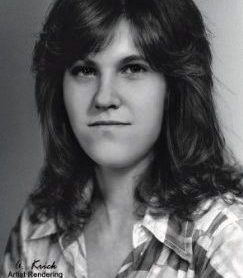
Debra Ann Bogan didn’t know where her younger sister ended up when she disappeared from their hometown of Harrisonburg, Virginia, close to 50 years ago without a goodbye. She thought that Patsy Falls Ritchie may have avoided keeping in touch but was still out there alive somewhere.
Then, she said, a detective called her last month and told her that skeletal remains found west of Boca Raton around the same time period had been identified as those of her sister. Ritchie had likely been murdered around when she disappeared, when she was in her early twenties, detectives say.
“I was shocked when they told me they found her,” Bogan told the South Florida Sun Sentinel on Friday. “It just tore me to pieces.”
Ritchie’s bones were first discovered on Jan. 18, 1978, about a year after Bogan last saw her, when a bulldozer operator clearing land in the area of Camino Real and Powerline Road for a Boca Del Mar project uncovered them buried underneath heavy brush, the Boca Raton News reported at the time. Investigators believed they belonged to a woman who had been dead between one and three years, the newspaper reported.
The name of the woman remained unknown until December 2025, when DNA testing by the private, Texas-based laboratory Othram identified her as Ritchie, the Palm Beach County Sheriff’s Office announced recently.
Ritchie was last seen in 1976 or 1977, getting into a truck with someone at a truck stop in Harrisonburg, detectives said. Born Dec. 3, 1953, she would have been 23 or 24 in those years, according to the Sheriff’s Office.
Ritchie was the youngest of four siblings. She and Bogan were only a year apart, and had a close relationship growing up, her sister recalled, playing house and exchanging clothes. Eventually, both sisters got married and Bogan moved away, while Ritchie stayed in Harrisonburg.
Ritchie had seemed troubled around the time she left, Bogan said. She would disappear often and hang out at truck stops. She and her husband had gotten divorced and her seven-month-old son had been taken into foster care. Bogan did not know why her son entered foster care.
The last time the two sisters saw each other was in 1977.
“Patsy, what’s the matter?” Bogan remembered asking.
“I just don’t feel happy anymore,” she recalled Ritchie saying.
Ritchie hugged her and told her she loved her, and Bogan told her she loved her, too. She never saw her sister again.
It remains unknown who Ritchie got into the truck with before she disappeared and how she ended up in South Florida. The Sheriff’s Office has not released details about its investigation from the time the remains were discovered leading up to the recent DNA testing.
Thanks to advanced Forensic Investigative Genetic Genealogy, we’ve made a breakthrough in identifying previously unidentified remains found in January 1978.
On January 18, 1978, construction workers discovered partially buried skeletal remains in a wooded area in unincorporated… pic.twitter.com/kMeKEM9Rtj
— PBSO (@PBCountySheriff) February 10, 2026
DNA testing cracks case
An advanced form of DNA testing allowed investigators to identify Ritchie nearly 50 years after her bones were first discovered.
Her remains were submitted to Othram, the lab, in 2024. The lab uses a more advanced method of DNA testing called Forensic-Grade Genome Sequencing and has worked on numerous cases with the Sheriff’s Office and other South Florida police agencies in recent years.
In 2024, human remains found in a remote wooded area near South Bay in 1984 were identified as those of Joseph W. Newman, originally from Toms River, New Jersey, who was last seen alive in the spring of 1983. That year, Othram also helped PBSO identify a suspect in the 1983 murder of Gayla Ann McNeil. In 2022, the lab’s work led to identifying a victim whose remains were found in the woods in Palm Beach County in 1985 as Terry Ketron, originally from Kentucky.
In many cases submitted to Othram, the main challenge can be having to rely solely on significantly old remains, as in Ritchie’s case, or other pieces of evidence that have degraded over time, Othram’s CEO David Mittelman told the South Florida Sun Sentinel.
Depending on what evidence exists decades later, Othram can work with clothing or jewelry recovered from a crime scene — even a cigarette butt, one strand of hair or a slide from an autopsy with a minute amount of tissue, he said, in order to build a person’s DNA profile.
“In this case, it was just very old skeletal remains,” Mittelman said.
Using Ritchie’s bones, Othram built a DNA profile of the woman, then provided the Sheriff’s Office with leads of distant relatives, he said.
PBSO cold case detectives collected DNA from relatives around the country in September 2025, the Sheriff’s Office said. The remains were confirmed to be Ritchie’s on Dec. 2.
Bogan said that a detective first called her to let her know remains had been found that were possibly her sister’s but they didn’t know for sure. Investigators came and collected her DNA, and it matched. They called her back and told her they had confirmed the remains were her sister’s.
The news shocked Bogan, who had prayed that the remains would not belong to her sister. She is still struggling with knowledge that Ritchie is dead and likely had been killed.
“I just am having a hard time adjusting,” she said. “I’m glad they found her, but I wish she was still alive. At least I know that they found her.”
PBSO detectives want to hear from anyone who knew Ritchie or encountered her in the years before her murder. Authorities ask anyone with information to call Crime Stoppers at 800-458-8477 or PBSO investigator William Springer at 561-688-4013.