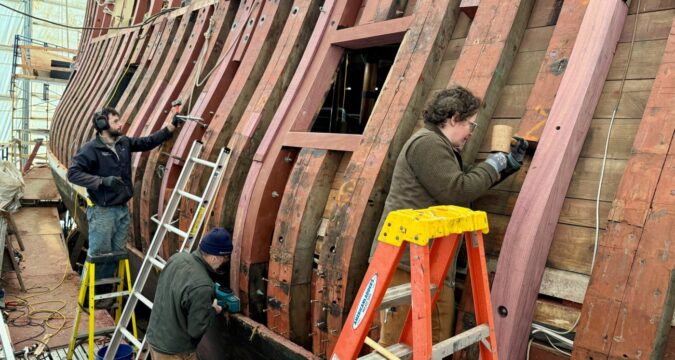
Repairs and refurbishment of the largest of the three recreated 17th century vessels at Jamestown Settlement are well on their way to being completed by next summer.
The Susan Constant, which has been at the Mystic Seaport Museum shipyard since June, is at the stage now where completion of planking on the port and starboard sides is nearly finished, as shipwrights continue work caulking the hull.
That is part of the status report provided earlier this week by Eric Speth, longtime director of maritime operations for the Jamestown-Yorktown Foundation. Speth spends about two weeks each month at the Connecticut shipyard supervising the $4.7 million renewal project.
The Susan Constant is housed inside a massive tent, referred to as the “mailbox,” to allow work to continue year-round during the restoration. New cap rails, framing, decking and bulkheads can be seen looking forward from this perspective on the ship’s quarterdeck. (Eric Speth/Jamestown-Yorktown Foundation)
“We’re on schedule and currently within our budget,” he said. Work on the vessel is scheduled to be completed in June, ending the two-year project, “and it should be back in the water and back at Jamestown later in the summer.”
Still, when the 120-ton Susan Constant returns to its Jamestown dock along the James River, there will still be work to be done. Though the lower masts will be in place, Jamestown staff will need to put up the upper masts and install riggings and sails.
Without the upper masts and sails, the Susan Constant will travel home using its two diesel engines to provide the power, Speth said.
This is the first major restoration for the Susan Constant even though the vessel, a reproduction built in 1990, has been drydocking nearly every other year for cleaning, repainting and other minor repairs. Every part of the process is being taken with care.
In the caulking process, a traditional caulking mallet and caulking iron will be used to drive a loosely twisted rope of cotton fibers into a hull seam. These are “similar tools and techniques used when Susan Constant was originally constructed in the early 17th century,” Speth said.
A Virginian shipwright working at Mystic Seaport Museum Shipyard uses a hand plane to put the finishing touches on the last wale, a heavy structural plank made from purpleheart wood, before it’s installed on the ship’s hull. (Eric Speth/Jamestown-Yorktown Foundation)
A modern caulking compound that includes synthetic properties will be applied over the cotton in the seam to waterproof the hull and give it an extended service life. The caulking product should double the normal cycle as it needs to be occasionally refurbished; work can be done by staff and volunteers at Jamestown.
The re-created ship was showing the effects of its busy lifespan when it arrived at the Henry B. du Pont Preservation shipyard in Mystic.
“More than 18 million visitors toured Susan Constant during its first 35 years of service,” Speth explained. “Nine deck planks from high traffic areas were replaced. The entire deck will be re-caulked to create a weatherproof surface to prevent future wood deterioration of the structure under the deck area.”
In the upcoming winter months, work will include installation of the remaining hull planking and continued work on caulking the hull, fabrication and installation of the gunports. Repairs will start on the mast caps and tops, along with mechanical repairs to include new engine mounts, the propeller shaft, new water tanks and other system work, Speth said.
Blacksmiths fabricate a new steel strap used to surround wooden deadeyes that support the Susan Constant’s masts and standing rigging. (Eric Speth/Jamestown-Yorktown Foundation)
Other important areas of refurbishment include the fabrication of two new wooden catheads supporting the anchors on the port and starboard sides of the bow. “These heavy structural timbers project away from the hull to lift and handle the ship’s heavy anchors that weigh up to 900 ponds,” he said. In all there are five anchors of different sizes.
Shipyard blacksmiths have worked on various parts of the vessel, often making patterns from which wooden pieces are later fabricated. In one case, a steel strap was formed to be used to surround wooden deadeyes that support the Susan Constant’s masts and standing rigging.
“When we entered into the project, we tried to do the best we could in accessing what needed to be accomplished,” Speth said. “We did find some additional areas that needed to be repaired, but they were not unexpected and had been projected into our budget.”
Since October 2024, the vessel has been under a large tent-like structure to protect it from the elements. “The massive tent is called the mailbox by Mystic shipwrights because of the way it looks — it has an opening at one end. I remember one cold night, there was ice from a rain. I looked inside and there she was, secure and dry inside, and yes, it did look like a mailbox.”
In the late 1980s, when plans were being designed for the construction of the ship, it was emphasized that natural, durable domestic woods and hard woods would be used in the reproduction. “We can see from this project that it was a successful plan,” Speth stressed. “We’re working on the same scale today. We’re building good for its future service life.
“We believe the Susan Constant will have another 35 years in the future.”
A shipwright uses a traditional caulking mallet and caulking iron to drive a loosely twisted rope of cotton fibers into a hull seam. Similar tools and techniques were used when the Susan Constant was originally constructed in the early 17th century. (Eric Speth/Jamestown-Yorktown Foundation)
The current ship, 166 feet in length, is the second modern reconstruction of the 17th century English vessel that brought the first colonists to Jamestown in May 1607. The first version was built in 1956 at a Portsmouth, shipyard along with the two other vessels, Godspeed and Discovery, to be the focal point in 1957 at Jamestown Festival Park (now Jamestown Settlement) for the 350th anniversary of the colonists’ landing at Jamestown Island.
In the 1980s, it was determined that the ship had deteriorated and a new vessel was needed to continue the tradition.
These days, when he is not at the Mystic shipyard checking on the progress of the repairs, Speth is at Jamestown handling the Godspeed and Discovery, the other two reproduction vessels, and other marine work for the Jamestown-Yorktown Foundation, the state agency that operates the Jamestown Settlement.
This winter the Godspeed will be in drydock for its regularly scheduled maintenance. Solicitation for bids is underway, he said, and a decision on the shipyard will be made soon.
Wilford Kale, kalehouse@aol.com