This year looks like it will be a “major” one for floating seaweed, known as sargassum, researchers at the University of South Florida’s College of Marine Science say. And they’re honing in on what’s fueling the blooms.
Huanmin Hu, one of the USF researchers, said the measurements for sargassum in the Atlantic last month were “scary. I have never seen this. It’s a record.”
The researchers use satellite data to measure the amount of floating sargassum in the Atlantic Basin each month.
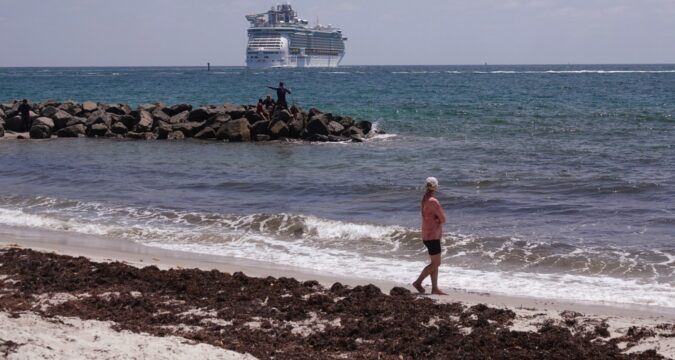
The seaweed, which is a form of algae, washes up on shorelines in South Florida, impeding swimmers and stinking up the beach. It starts out thousands of miles away, providing habitat for an array of sea life — including sea turtles — and often traveling across the Atlantic and washing ashore in the Caribbean, Yucatan and Florida.
The amount of sargassum that has washed up on beaches in Florida has spiked tremendously in the last dozen years, bringing frustration to beachgoers and causing real economic damage in the Caribbean.
Hu said last month’s levels were the highest he’s ever seen for December. “The biomass is just so high … but more than that, there are two large masses, well separated and coherent … They just keep growing. It’s too early to say whether that will be a new record year, but it’s a major year, ” meaning levels are larger than 75% of the previous years.
SFU teamed with the Max Planck Institute in Germany to release a study on what is fueling the bloom fluctuations since 2011.
Prior to 2011, the sea weed usually bloomed in the Sargasso Sea, a large area off the east coast of the U.S. But the blooms occurred farther south in 2011, along the equator in the tropical Atlantic.
December 2025 data revealed two massive swaths of sargassum already forming in the tropical Atlantic. (Courtesy University of South Florida College of Marine Science)
The large blooms, spanning several thousand miles, became known as the Great Atlantic Sargassum Belt, and are the “largest interconnected floating biome on Earth” according to the study.
So, what fuels these blooms? Like terrestrial plants, sargassum needs nitrogen, phosphorus and other nutrients.
Large rivers such as the Amazon and Congo are potential sources of nutrients, but the plumes from those rivers only extend 200 miles offshore, while the sargassum blooms are occurring 500 or more miles away.
Saharan Dust can also provide iron to the sea weed, but those don’t occur until the summer months.
The study found that natural upwellings in the middle of the Atlantic provide both nitrogen and phosphorus for the blooms. Upwellings occur when strong winds push surface water sideways, pulling cold, nutrient-rich water up.
A key finding in the study was that phosphorus was in particular abundance in the upwellings, meaning nitrogen was the limiting factor in sargassum growth.
Meanwhile, there’s plenty of nitrogen in the atmosphere. Cyanobacteria in the sea weed can convert that atmospheric nitrogen into a form that seaweed can be used for growth. “That makes additional nitrogen to fully use the upwell phosphorus,” said Hu.
Other studies suggest that nitrogen in the atmosphere has increased due to fossil fuel emissions, and that that nitrate can fall into the ocean and supply more nitrogen to the sargassum.
“Humans have greatly altered the nitrogen cycle on the planet,” said Brian Lapointe of Florida Atlantic University, who has worked on previous sargassum nutrient studies.
The dark areas represent the Great Atlantic Sargassum Belt, a relatively new phenomenon where sargassum growth has spiked in the tropical Atlantic. (Courtesy University of South Florida College of Marine Science)
“We’ve more than doubled the amount of reactive nitrogen. It’s likely that we’re seeing the results of that in this GASB (Great Atlantic Sargassum Belt),” said Lapointe.
Hu said there’s a high correlation between the strength of upwellings and the size of sargassum blooms. “In general, higher winds would cause stronger upwelling,” he said.
“The future of Sargassum in the tropical Atlantic will depend on how global warming affects equatorial Atlantic upwelling and the climatic modes that control it,” said the study.
Related Articles
Stinky seaweed has spiked tremendously. Here’s why summer blooms now grow so huge.
The ocean can actually get too hot for sargassum. Its ideal range is between 73 to 82 degrees, said Hu. Though summer sea surface temperatures in the tropics can get too hot, warmer winter and spring temperatures can fuel earlier blooms.
As for the remainder of 2026, Hu and his peers at USF are calling for another “major” sargassum year. Whether loads of it wash up in South Florida depends on daily wind patterns that are too far off to predict.