Another year, another Chicago Symphony season opening without a music director on the continent.
The years-ahead planning tempo of the world’s biggest classical music organizations means Klaus Mäkelä, the CSO’s incoming chief, and Riccardo Muti, its outgoing, have been tied up for opening nights for two years now. But when one sees the very busy Gustavo Dudamel — also bearing the “designate” tag at the New York Philharmonic — happily raise the curtain at his orchestra-to-be this month, it’s hard not to feel like the ugly stepchild.
But just as Andrés Orozco-Estrada engagingly stepped in last season, Danish conductor and violinist Nikolaj Szeps-Znaider was a smart pick for both the season-opening cycle on Sept. 18-19 and the CSO’s annual Symphony Ball gala, the latter of which demands a certain crowd-ready charisma.
The CSO podium has been especially hospitable to Szeps-Znaider in recent seasons. (Case in point: He’ll be back in May to conduct Martin Helmchen in Brahms’ Piano Concerto No. 1.) Szeps-Znaider made his orchestra debut a decade ago, doing the same double-duty as his subsequent appearances here: as violin soloist for part of the program, and conductor for the rest.
He took the same tack on Mozart’s Sinfonia Concertante, stepping in as violin soloist to CSO principal Teng Li’s viola soloist. A double concerto in all but name, the 1779 piece is often envisioned as a collegial “dialogue” between friends. This performance fashioned it into a lively group discussion. Szeps-Znaider and Li sometimes led their respective sections by lightly playing along to the orchestral parts. And when his instrument was down, Szeps-Znaider didn’t beat strict time, instead offering light and evocative gestures. Sometimes, nudging is all Mozart really needs.
Today, violists find themselves at a fork in the road when playing this work. They could play the piece as-is. Or, they could follow a suggestion by Mozart himself to tune the viola a half step higher — playing as though in D major, when the resulting sound is actually in the home key of E-flat major. That way, the viola’s highest string resonates sympathetically against the middle strings, creating a brighter, more brilliant sound which carries easily.
According to the program book, Li tried Mozart’s method for the first time in these performances. That meant she had to relearn her entire left-hand placement for the piece — a labor of love if there ever was one — but you wouldn’t have known from this performance, impassioned and noble.
Li’s musicianship proved more memorable than the tuning scheme. On modern instruments, and in Orchestra Hall’s very 21st century acoustic, the brightness that would have cut through an ensemble in Mozart’s day came out sounding rather samey on Friday afternoon. What makes the viola captivating is its slight gruffness, a voice rumbling within a warm chest. Here, the higher tuning just nudged the sound of Li’s instrument closer to violin-land, losing that delicious contrast between herself and her treble colleagues.
Szeps-Znaider himself has a glossy, commanding tone. (He plays the late, great Fritz Kreisler’s Guarneri, as in-your-face an instrument as there is.) Together, both brought a certain big-boned Romanticism to the piece, which bled into the ensemble. This wasn’t a transparent Mozart, and often, those soloistic airs overrode the candor and fragility of the writing.
Their encore, the Adagio from Mozart’s Duo for Violin and Viola, K. 423, finally found that sought-after vulnerability. Li adjusted her viola back to its usual earthy hue, then the musical conversation began — a true one, without airs, like a couple talking freely together once their dinner guests have all gone home.
After intermission, the concert lingered in E-flat major a while longer for Edward Elgar’s Symphony No. 2. This symphony rarely gets any play — the CSO last played it in 2010 — but Szeps-Znaider led the little-heard behemoth with ardor and intention. Even more impressively, he conducted from memory, as he would nearly all weekend.
Elgar’s symphony needs champions of Szeps-Znaider’s caliber. At an hour long, the piece tests the stamina of audiences and musicians alike, with a fakeout ending after the third movement that opens into nearly 15 more minutes of music, much of it fitfully tamed. (On Friday, some audience members made for the exits at that juncture.)
With the CSO, however, Szeps-Znaider argued that this piece is deserving of the grace we grant Bruckner or Wagner, for whom throat-clearing is a feature, not a bug. Or, at the very least, he suggested that the symphony’s issue may not be so much its span but its structure, spinning off in detours rather than sticking to a route.
Saturday’s Symphony Ball was a different story entirely. The see-and-be-seen event trades demanding symphonies, like Elgar’s, for breezy crowdpleasers, performed with no intermission.
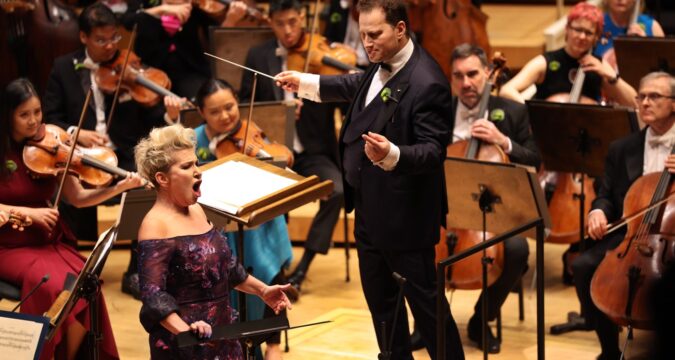
But this year’s also (literally) rolled out the red carpet for leading mezzo-soprano Joyce DiDonato, appearing for the first time as the CSO’s new artist in residence — the third to hold the position since it was created in 2021, and the first singer in the role. Prior to her appointment, DiDonato came to Chicago relatively sporadically, usually alongside Muti or in local recitals. Though securely in the Met’s Rolodex, she hasn’t sung on the Lyric Opera’s main stage since 2014.
So: smart move, CSO. DiDonato’s many projects—collaborations with prison inmates, à la Muti, and a lullaby initiative for new mothers — follow the citizen-musician approach blazed by the CSO’s first resident artist, violinist Hilary Hahn. And onstage, her genial magnetism was a perfect fit for the Ball audience. She offered up a hammy “Habanera” from “Carmen” — shimmying along, leaning into nasal, pungent patches of French, and rakishly leaning on Szeps-Znaider’s podium, who teasingly responded.
This wasn’t just pops-adjacent froth. DiDonato started with three songs by Richard Strauss that also presented her as an ideal musical match for the orchestra. From the sheer opening bars of “Wiegenlied” (“Lullaby”) to the bejeweled richness of “Zueignung” (“Devotion”), in Robert Heger’s orchestration, her decadent mezzo both matches and floats above the orchestra in any sheen.
Between them, “Morgen!” (“Morning”), as ever, was the show-stopper. Concertmaster Robert Chen’s solo was tranquil and still, with an expressive twinge where it counted. DiDonato entered like an exhale to the orchestra’s inhale. It all vanished like an interrupted dream.
The timeless quality of it all owed much to Szeps-Znaider’s empathetic leadership. That gentleness first appeared in his expansive, atmospheric opening to Carl Maria von Weber’s “Oberon” overture — an opera later riffed upon by Mendelssohn in his “A Midsummer Night’s Dream,” whose Scherzo and Wedding March also became part of the festivities.
But the overture to “Tannhäuser” surpassed greatness to become something truly special. The opening statement by horns, bassoons and clarinets seldom sounds so smooth yet remote. Inner string voices sounded unified, as though one instrument. Near the end, with a gentlemanly gesture, Szeps-Znaider brought out a leaping horn countermelody that is too often buried—a thrilling moment of arrival.
“Tannhäuser” also pulled focus to the CSO trombone section, now officially under new leadership: Former San Francisco Symphony principal trombone Tim Higgins won Jay Friedman’s former seat after trial weeks with Mäkelä in the spring.
The section indeed already shows glow and focus, especially in “Tannhäuser’s” trombone soli. Intra- and inter-section leadership may still be gelling—some bluntly balanced trombone chords jutted out in the Elgar symphony, with passing discordances in the Mendelssohn march — but with such a secure tone quality right out of the gates, the sky’s the limit for Trombones 2.0.
The CSO season continues Sept. 25-28 with pianist Alice Sara Ott in Ravel’s piano concertos; Mikko Franck conducts in Orchestra Hall at Symphony Center, 220 S. Michigan Ave.; tickets $49-$245 and more information at 312-294-3000 and cso.org
Hannah Edgar is a freelance critic.
The Rubin Institute for Music Criticism helps fund our classical music coverage. The Chicago Tribune maintains editorial control over assignments and content.
https://www.chicagotribune.com/2025/09/21/review-cso-opening-weekend-2025/