If you’re a fan of “Derry Girls,” Lisa McGee’s brilliant sitcom about teens growing up in Troubles-era Northern Ireland, you’ll probably enjoy “Saving Myself” by Subtext Studio Theatre Company, a world premiere presented by Destinos, the Chicago International Latino Theater Festival. This new play by María Arreola strikes a similar tone, using irreverent humor and colorful characters to explore decidedly unfunny aspects of adolescence: loneliness, shame and sexual confusion.
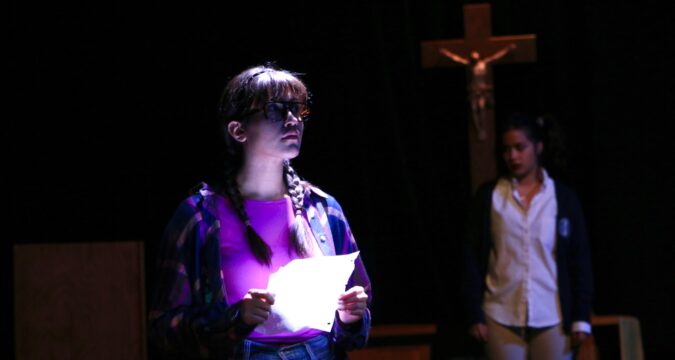
Directed by Omar Vicente Fernández, a spirited trio of actors plays three teenage girls attending a Catholic youth retreat, each restless with their respective secrets under the watchful gaze of a large crucifix. On the set designed by Harrison Ornelas, candles and religious iconography — including a portrait of Pope Leo XIV — surround a simple altar and the type of refreshments table you’d find in a typical church basement. When the group’s adult leader fails to show up, the night devolves into feisty arguments, youthful pranks and, occasionally, heartfelt chats.
Liam Bouza Díaz plays Elena, a devout rule-follower who idolizes the virgin martyrs of the Catholic canon and judges any peers who don’t toe the line of premarital celibacy. The character might sound dull on paper, but Díaz’s performance is both hilarious and vulnerable. Raquel “Rocky” Nguyen is a strong foil as Hana — stifled by her mom, angry at Elena and fed up with Catholicism. Hana’s dark lipstick and winged eyeliner starkly contrast with Elena’s straight-laced, baby-faced look. There’s history between these two classmates that causes intense clashes throughout the play.
Angelina Dávila rounds out the cast as newcomer Idalia, who learns about the retreat through a flyer that she interprets as a sign from God. Naïve but perhaps not as inexperienced as she seems, Idalia is eager to please and quick to trust people. When she confides in Hana about a nice boy that she likes, Hana asks whether he’s actually nice or “wants to sleep with you” nice. Idalia innocently responds, “There’s a difference?”
Those who were raised with the doctrine of abstinence in lieu of comprehensive sex education will likely see themselves in one or more of these young women: the devotee who’s both repressed and isolated, the iconoclast who’s unfairly shamed and the ingenue who’s in danger of being taken advantage of. All three characters are written and performed with nuance, and although a few developments are predictable, they still make for dynamic arcs.
Maybe it’s because I’m already quite familiar with these issues, but I’d like to see the play go even deeper into the religious themes. Hana has several pithy one-liners about Catholicism’s negative effects — its propensity for public shaming, the way its teachings encourage people to hate their bodies — but these are delivered as truisms rather than examined in more detail.
I’d also like to see more development of the backstory between Elena and Hana, who are at each other’s throats for much of the play. Their animosity is explained through a few specific details, but too much is shrouded in hazier hints, along with one bombshell revelation presented with little context. The arc of their relationship would be more satisfying if we knew a little more about what brought them to this point. Meanwhile, Adalia, as the new arrival who stirs the pot, tends to get overshadowed by the back-and-forth between the other two girls.
But this show is a comedy, after all, and largely a successful one. Fernández makes use of physical comedy without veering into slapstick, and sound designer Irma Gualpa employs dramatic music such as Carl Orff’s “Carmina Burana” to maximize the more over-the-top moments. Bodily humor, including some well-timed fluids, nods to the absurdity of being an adolescent girl. All three actors have strong comedic instincts that make their characters distinctive but not cartoonish, with Hana’s deadpan wit, Idalia’s wide-eyed gullibility and Elena’s earnest but easily flustered demeanor. I suspect this ensemble will get even funnier with more time in front of audiences.
“Saving Myself” is one of the opening productions of the eighth edition of Destinos, a signature program of the Chicago Latino Theater Alliance. Running through early November, the 2025 festival features more than a dozen productions across the city, including world and national premieres, though the number of artists traveling from abroad has notably diminished compared to recent years. As CLATA’s executive director Jorge Valdivia acknowledges in the festival’s introductory letter, this is a difficult time for Chicago’s Latino community. I find it heartening to see Destinos persevere with engaging new work by young, local artists such as Arreola and Fernández, and I hope that fellow Chicagoans will show up in support over the next month.
Emily McClanathan is a freelance critic.
Review: “Saving Myself” (3 stars)
When: Through Oct. 19
Where: Subtext Studio Theatre Company at UrbanTheater, 2620 W. Division St.
Running time: 1 hour, 15 minutes
Tickets: $14.50-$50 at clata.org
https://www.chicagotribune.com/2025/10/07/review-saving-myself-destinos/