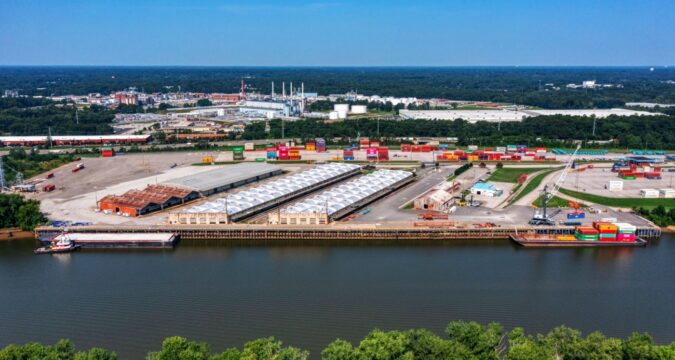
The cattle pens that were once a mainstay for Richmond’s port are long gone. The ships that once brought aromatic tobacco for the Philip Morris cigarette plant’s secret blends are gone, too, as are the freighters to load the Virginia apples that Icelanders loved so much.
But the Richmond Marine Terminal is busier than ever, with barges coming up the James River from Norfolk every other day. And beginning this month, as shipments of soybeans via barge to seagoing vessels loading at Norfolk for Asian markets and stores stock up on goods for the holiday shopping season, it’s about to get a lot busier.
While a 12-hour trip up the winding James River no longer seems worth it to shipping lines, it turns out that the two-step ship-to-barge move for imports and barge-to-ship for exports is making a lot of sense to companies eager to shorten over-the-highway trips to and from notoriously traffic-choked Hampton Roads for their cargoes. It’s one reason logistics firms, truckers and warehouses have been popping up along Commerce Road in South Richmond.
“It’s a lot easier to drive two miles down the road than to make a long haul,” said Joe Harris, spokesman for the Virginia Port Authority, which took over operations at the Richmond terminal in 2016.
The state agency runs the three barges that ply the James between Norfolk and Richmond, usually taking 12 hours in Norfolk to load and unload containers, making the 12-hour run to Richmond and taking 12 hours to unload and load containers here.
The Virginia Port Authority runs the three barges that ply the James between Norfolk and Richmond, usually taking 12 hours in Norfolk to load and unload containers, making the 12-hour run to Richmond and taking 12 hours to unload and load containers here. (The Virginian-Pilot File)
In Richmond, there’s a lot of thought that goes into where each new shipment goes among the five-high stacks of 40- and 20-foot shipping containers. On a sunny October day, a week before the soybean harvest rush, Mike Balsom was finishing unloading more than 100 containers from a barge that had arrived the evening before. Nearby, a second barge waited its turn at the downriver end of the wharf.
It’s precise work: get the angle of the giant Liebherr crane’s 157-foot long beam wrong, misjudge the wind or the weight of a truck-trailer sized container, which can reach 70,000 pounds, and a deadly accident could result.
“We’re about safety first,” said Timmy Hall, a three-decade veteran at the terminal.
Once Balsom carefully sets a container on the ground, it’s up to the dock-men and a cargo checker on the wharf to see where the day’s operating plan says the box is to go — in which stack and how high up — so a trucker can find it.
“You don’t want the trucker to come and say he needs that container that’s in there 14 deep,” said Christina Saunders, the terminal manager.
That’s why she and her colleagues have set up what she calls a semi-automated system of notifications to customers — unusually for a port operator, she sees those customers as the companies awaiting imported goods or the firm eager to speed exports on their way. Bigger ports tend to leave such notification to shipping lines, freight forwarders or customs house brokers, but the two-step ship-and-barge dance up the James River risks notifications getting lost in the shuffle.
“I tell customers, look, you can ignore 99% (of her email notices) but there’s gonna be the one that makes them all worthwhile,” she said. “We’re a small port, sure, but we can be very personalized.”
Saunders is looking forward to more changes, now that The Scoular Company’s three silvery grain elevators stand at the southern end of the terminal where the cattle pens used to be.
Using the port makes life a lot easier for Scoular’s customers — soybean and grain growers across much of Virginia — said Colby Eymann, the company’s leader of container exports for grain and oilseeds.
It’s not as long a haul, and the traffic’s not as bad as Hampton Roads, he said.
“It works fantastic,” he said.
It also helps that Richmond gets a steady supply of empty containers. “Containers come full of imported goods, and when they’re empty they come back to the port,” Eymann said.
Loading empties at the port makes things easier for Scoular, too. The company operates a grain-loading facility in Windsor, too, but there it has to haul empty containers some 30 miles from Norfolk.
Next on the port’s list of projects after the elevators is lighting, allowing the port to operate at night. Richmond is getting $30 million of the Port of Virginia’s $350 million fund to replace its diesel equipment — cranes, truck-tractors, top-loaders — with electrically powered alternatives.
In addition, the port is looking to revamp an aging section of its wharf so that it can work two barges at the same time.
Saunders recently renegotiated a contract with the tugboat firm that brings the barges back and forth, too. Instead of paying one fee for each trip, the port now pays a higher weekly fee.
“I watch the budget, and so when you’re paying for one barge to move, you’re going to tend to wait till the barge is full. But paying for weekly service means we might move a barge with maybe 40 containers, instead of making a customer wait another day or two,” she said.
Speeding cargo is why the Port of Virginia has been working to convince shipping lines to write bills of lading — the basic documentation for a cargo shipment — to specify Richmond, rather than Norfolk, where their ships actually dock, as the destination or origin of a shipment.
It’s also why it opened its “drop-yard” — and why there aren’t shipping containers parked along Deepwater Terminal Road anymore. The drop yard is a place where customers moving several containers at a time can stage them to move them off the terminal quickly, in case they can’t get a trucker to them all during the day, or can drop their several containers when they arrive in Richmond at different times, so they can all move in a block to the barge.
“I think that even if our customers don’t necessarily see cost savings, they like that it’s easy to get on and off the terminal,” Saunders said. “It’s important to be able to move fast.”
https://www.pilotonline.com/2025/10/23/richmonds-port-is-booming-and-its-about-to-get-busier/