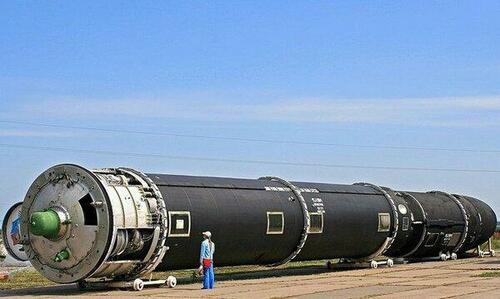
Russia Successfully Tests Troubled SATAN II, Will Enter Combat By Year’s End
Russia on Tuesday announced that it has successfully completed a test of the “Sarmat” intercontinental ballistic missile (ICBM), a new ‘doomsday’ weapon which has had a troubled roll out and development, but which has not yet been fully deployed as part of Russia’s military arsenal.
While in 2023 the cutting edge heavy missile was reportedly put on ‘combat alert’ – according to some headlines at the time – the following year saw at least one test deemed unsuccessful and a failure. This was seen as delaying its full combat deployment.
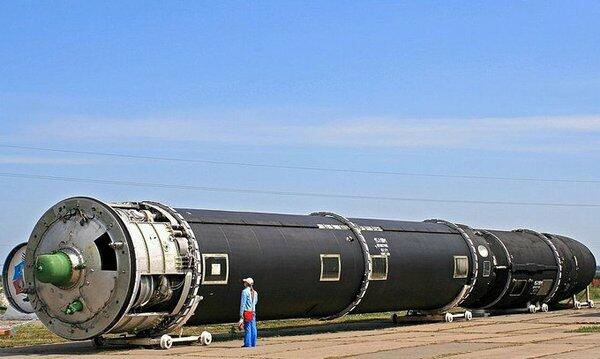
Interfax was the first to report Tuesday’s new Sarmat test, with Russian President Putin in follow-up remarking that its range could exceed 35,000. And Reuters has followed with:
Russia has successfully tested its new Sarmat intercontinental ballistic missile, Sergei Karakayev, the commander of the strategic missile forces, told Russian President Vladimir Putin on Tuesday. Putin said that Russia planned to put the Sarmat on combat duty by the end of this year.
The nuclear-capable Sarmat ICBM was previously touted by President Putin as being capable hitting “any target on Earth” – and is widely believed to be by far the longest-range missile in Russia’s arsenal (or in the world for that matter). It’s been nicknamed by NATO the “SATAN II”.
The Sarmat, which is in a “superheavy” class of missiles, has a short initial boost phase which gives it better ability to elude all conventional anti-missile defense systems, given this results in a much smaller window of time to track it. By design, its super long-range gives it the ability to reach targets thousands of missiles away in the United States or Europe.
According to its specifications, it’s by far the heaviest missile Russia possesses – at over 200 tons – and heavier than all foreign competitors:
This allows it to carry around 15 warheads, up to 750kt. (The bomb US dropped on Hiroshima was 15kt.)
This would be enough to wipe out a country the size of France. It can also carry hypersonic missiles, rendering most missile defense systems ineffective.
It has long been in development – since 2009 – and has been in testing phase for many years, some test flights of which may have failed. The Sarmat has been touted as being able to reach speeds of nearly 16,000 mph.
Putin early in the program described: “The new complex has the highest tactical and technical characteristics and is capable of overcoming all modern means of anti-missile defense. It has no analogues in the world and won’t have for a long time to come.”
❗️ President Putin Receives Report on Successful ‘Sarmat’ Intercontinental Missile Test – Kremlin
The successful launch will allow the first regiment to be put on duty by the end of the year, according to the commander of the Strategic Missile Forces.
📹: Russian MoD pic.twitter.com/6euvdKssds
— RT_India (@RT_India_news) May 12, 2026
But despite this rosy presentation of the Sarmat’s purported capabilities, it has faced an uphill battle from the start, and there were manufacturing problems being reported even nearly a decade ago. For example:
The heavy, liquid-fueled Sarmat ICBM is being developed as a replacement for Russia’s older R-36M missile (NATO Reporting name: SS-18 Satan). The Sarmat’s large payload will allow for up to 10 heavy warheads or 15 lighter ones, or as many as 24 hypersonic Yu-71 glide vehicles (Sputnik News, June 11, 2016). Production of the new missile and its prototype was entrusted to the Krasnoyarsk Machine Building Plant (Krasmash), which suffers from serious equipment depreciation issues—in 2010, fewer than 20 percent of machines at its fabrication facility were less than 20 years old (T. V. Yankova, A. M. Ragozina, “Techno-Economic Justification of Equipment Modernization at Krasmash,” Actual Problems of Aviation and Cosmonautics, No. 6: 2, 2010). The quality and lead time of the order will depend on the modernization of the production facilities at Krasmash. Efforts toward this end have already started: more than 16 billion rubles ($274 million) will reportedly be invested by 2019. And Defense Minister Sergei Shoigu has taken a personal interest in making sure these modernization goals are met.
But by now the Kremlin is stressing that prior troubles have been resolved and smoothed out, and that this nuclear-capable beast is set to be the heavy ballistic long-range missile of Russia’s future defense.
Tyler Durden
Wed, 05/13/2026 – 02:45