Saudi Arabia’s $5 Oil Detour Is Expensive… But Worth It
Authored by Leon Stille via OilPrice.com,
Rerouting Saudi crude to Asia via Yanbu, Egypt’s SUMED pipeline and the Cape of Good Hope may add around $5 per barrel and up to four weeks to a voyage.
That premium is small compared with the economic damage caused by losing access to Hormuz or Bab el-Mandeb altogether.
Saudi Arabia’s alternative export infrastructure is not a temporary workaround but a strategic asset—although it cannot replace the kingdom’s wider need to diversify beyond oil.
The latest Saudi oil route looks absurd on a map.
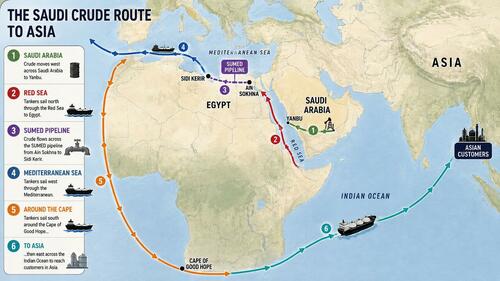
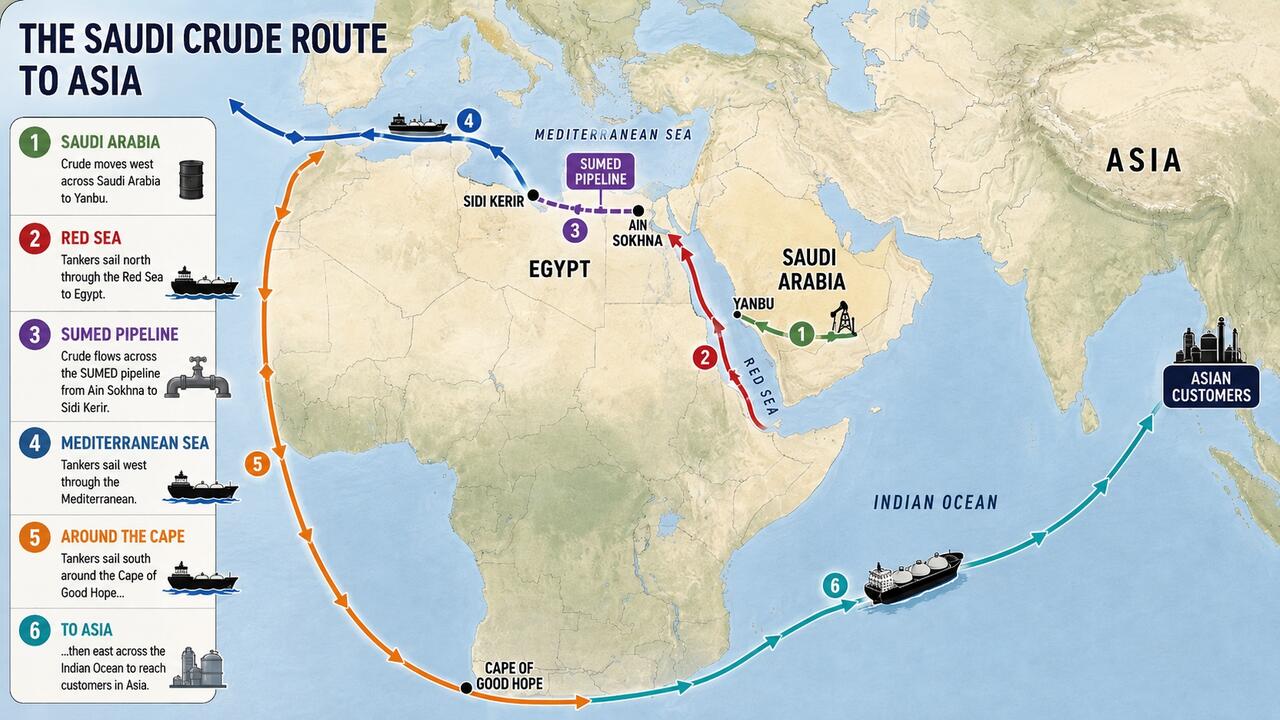
Crude moves west across Saudi Arabia to Yanbu, north through the Red Sea to Egypt, across the SUMED pipeline from Ain Sokhna to Sidi Kerir, then west through the Mediterranean before tankers sail around the Cape of Good Hope to reach customers in Asia.
Oil that started relatively close to Asia first travels thousands of kilometres in the opposite direction.
The detour reportedly adds around $5 per barrel once extra freight, fuel, insurance and pipeline charges are included. For a two-million-barrel cargo, that approaches $10 million. Aramco is therefore considering a separate pricing mechanism for crude loaded from Egypt’s Mediterranean port of Sidi Kerir, because its normal Asian official selling price no longer reflects the logistics.
The immediate conclusion is that avoiding Hormuz has made Saudi oil structurally more expensive.
That is true. But it misses the more important point.
Five dollars per barrel is not only the cost of disruption. It is the price of having another option when two of the world’s most vulnerable shipping chokepoints can no longer be treated as permanently available.
Two chokepoints turned one contingency route into another
Saudi Arabia’s first line of defence against disruption in the Strait of Hormuz is its East-West Pipeline. It carries crude from the kingdom’s producing region in the east to Yanbu on the Red Sea, avoiding Hormuz completely.
That system has proved its value. Aramco says it ramped the pipeline up to its maximum capacity of 7 million barrels per day during the first quarter of 2026. Around 2 million barrels per day feed western refineries, leaving roughly 5 million barrels per day of export capacity.
However, moving oil to Yanbu solves only the first geographical problem. Asian buyers would normally take those cargoes south through the Red Sea and exit via Bab el-Mandeb. Houthi threats and attacks have made that route unreliable as well.
The newer workaround therefore does not avoid the Red Sea entirely, as some viral descriptions claim. It uses the northern Red Sea between Yanbu and Ain Sokhna, but avoids the Houthi-exposed Bab el-Mandeb passage by moving through Egypt and into the Mediterranean.
From there, the ship still faces a remarkable journey. It must leave the Mediterranean through Gibraltar, sail around Africa and cross the Indian Ocean back towards Asia.
Reuters calculated that the journey to Asia can increase from about 19 days to 48 days. Fuel costs for a tanker can rise from approximately $1.26 million to $2.87 million, before adding around $1 million in Suez Canal fees. Fully laden very large crude carriers may also need to discharge part of their cargo into the SUMED pipeline before transiting the canal and reload it at Sidi Kerir.
None of this is cheap or efficient.
But the relevant alternative is not the old route operating normally. It is a delayed cargo versus no cargo.
The $5 premium is smaller than the risk it insures
Oil markets are accustomed to treating infrastructure efficiency as a question of cents per barrel. Under stable conditions, that makes sense. Producers compete on transport costs, crude quality and refinery margins, while buyers optimise routes aggressively.
Geopolitical resilience follows different economics.
An extra $5 on an $85 barrel is a material cost increase, but it is small compared with the price spikes, refinery shortages and lost export revenues caused by a major supply interruption. Saudi exports were down by around 2.4 million barrels per day year-on-year during the recent disruption, while Gulf exports fell to only 36% of pre-war levels.
Even more importantly, the risks do not disappear the moment both straits formally reopen.
Iran does not need to close Hormuz permanently to influence shipping. Mines, drone attacks, seizures or even credible threats can raise insurance premiums and persuade shipowners to wait. The Houthis have demonstrated a similar ability to disrupt Red Sea traffic with relatively inexpensive weapons.
A reopened chokepoint is therefore not the same thing as a dependable chokepoint.
That changes how the detour should be valued. The additional route is comparable to spare generation capacity in an electricity system or a second supplier in an industrial supply chain. It may look expensive when everything works. Its value becomes obvious only when the primary route fails.
Saudi Arabia has maintained this kind of optionality better than many producers. Despite the severe regional disruption, Aramco reported 98.4% supply reliability in the second quarter, supported by the East-West Pipeline, storage, alternative terminals and its international logistics network.
The $5 premium is part of the cost of preserving that record.
Redundancy is becoming part of the barrel
The important shift is that Aramco may now need different pricing formulas for the same crude depending on where it is loaded and how it reaches the buyer.
Official selling prices, or OSPs, are the monthly differentials that producers apply relative to regional crude benchmarks. They normally reflect grade quality, market conditions and destination. A separate Sidi Kerir formula would make logistics resilience an explicit component of the barrel’s price.
That is not necessarily permanent for every cargo. If Hormuz and Bab el-Mandeb become reliably navigable again, the longest route will lose its commercial appeal. Asian refiners will not voluntarily pay millions more for an unnecessary voyage.
But the infrastructure should not be viewed as stranded the moment normal shipping resumes. Saudi Arabia is already considering expanding its east-west pipeline capacity by as much as 2 million barrels per day. Yanbu is being repositioned from a secondary outlet into a strategic export hub. SUMED, Suez, Mediterranean storage and flexible tanker arrangements add further options.
The lesson of 2026 is that relying on a single efficient route can be more expensive than maintaining several imperfect ones.
This will influence investment decisions well beyond Saudi Arabia. Pipelines, terminals and storage assets previously judged as underutilised may acquire a resilience premium. Buyers may accept higher costs for supply contracts with genuine routing flexibility. Insurers and lenders will increasingly distinguish between producers that have contingency infrastructure and those whose exports depend on one exposed waterway.
The result is a higher structural logistics cost for some barrels, even if benchmark oil prices fall.
Better oil logistics do not solve Saudi Arabia’s larger problem
There is, however, a danger in celebrating resilience too much.
Saudi Arabia can spend billions making oil exports harder to interrupt, but it cannot make global oil demand permanent. Electric vehicles, efficiency, alternative fuels and climate policy will gradually erode demand growth. The kingdom ultimately needs business models that do not depend on exporting ever-larger volumes of crude.
Riyadh understands this. According to its Vision 2030 annual report, non-oil activities accounted for 55% of real GDP in 2025, while non-oil government revenue had risen substantially since 2016. Investment in tourism, logistics, mining, manufacturing, technology and renewable energy is intended to reduce the economy’s exposure to oil.
Those figures should not be confused with completed diversification. Oil remains central to exports, fiscal capacity and the financing of many non-oil investments. Some flagship projects are expensive, and turning state-led spending into self-sustaining private activity remains difficult.
Yet this is not an either-or choice.
Saudi Arabia needs to protect the oil revenues it still earns while using those revenues to build an economy that will eventually need them less. More flexible export infrastructure supports the first task. Vision 2030 is supposed to deliver the second.
The Cape route may add $5 per barrel. That is the visible cost.
The invisible value is that Saudi Arabia can still sell the barrel when the shortest routes become unusable.
In an oil market shaped increasingly by drones, missiles and maritime chokepoints, redundancy is no longer wasted infrastructure.
It is part of the product.
Tyler Durden
Fri, 08/07/2026 – 13:20
https://www.zerohedge.com/energy/saudi-arabias-5-oil-detour-expensive-worth-it