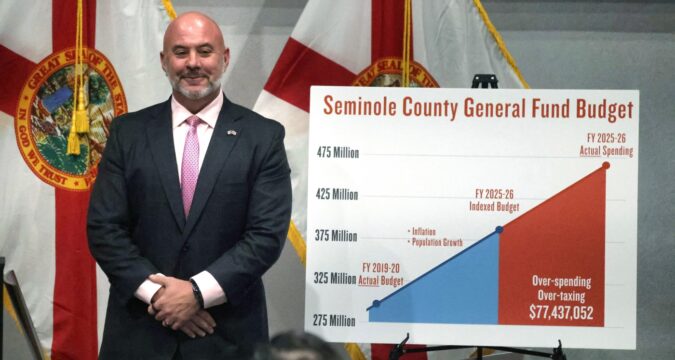
Seminole County is firing back at Florida’s Chief Financial Officer over his accusations the county is overspending by $120 million annually, alleging that the county’s budget has risen primarily because of mandates from state government.
Seminole found itself in CFO Blaise Ingoglia’s crosshairs earlier this month after its board of county commissioners voted to raise its property tax rate, at a time when the CFO and Gov. Ron DeSantis are campaigning to abolish the tax, a major funding source for cities and counties.
Commissioners have also hiked the county gas tax by five centers per gallon sold and increased its public service tax on water and electric bills in the unincorporated areas from the current 4% to 10% starting Jan. 1.
Ingoglia, a Republican, bashed the county for excessive spending, which he said was proof his crusade wasn’t partisan. All five Seminole County Commissioners are Republicans.
Board of County Commissioners Chair Jay Zembower sent a letter to Ingoglia last week contending that the CFO’s “analysis of our County budget presents an incomplete picture of our local government operations.”
“Your analysis assumes that local government expenditures should rise only by the combined rate of population growth and the Consumer Price Index (CPI),” he wrote. “While that assumption may work in theory, it overlooks state-imposed mandates; essential service demands; and community-supported programs that drive legitimate cost growth well beyond population and inflation.”
As examples, Zembower said that $121.5 million of the county’s general fund can be attributed to things the state requires Seminole to fund. That includes $73 million on jail operations, $19.3 million in court support, $10.8 million on Medicaid, the Medical Examiner, Health Department and Veteran Services , $7.8 million on SunRail, $6.7 million on state retirement contributions and $3.9 million on other mandated services.
Such expenses have gone up by 74% since 2020, Zembower wrote.
Further, he wrote, commissioners are required to fund the county’s constitutional officers, including the sheriff, tax collector, property appraiser and clerk of the court.
Those offices have seen a 50% increase in budget since 2020, with most of that coming from the Seminole County Sheriff’s Office. That agency, like others across the region and state, is in what Zembower described as an “arm’s race” to pay competitive wages for law enforcement.
“Sheriff’s Office deputy pay has increased 60% since 2020 to remain competitive in a constrained labor market. Police cruisers now cost 56% more than five years ago,” he wrote. “These are not luxuries; they are essential tools of governance and public protection.”
At Ingoglia’s Oct. 7 news conference in Sanford, the CFO said he ran Seminole’s top-line spending into a formula he’s used to gauge overspending in cities and counties across the state. The equation includes the growth of a government’s general fund since 2019 as well as data from the Consumer Price Index and population growth.
“The question you have to ask is: Is an extra 25,000 people in the county worth an increase of $137 million?” he said. “Just because you have more people moving into a city or a county, does not mean that you have a blank check to grow the government exponentially.”
But Zembower argued that’s a flawed formula, He said county staff used the same method dating back to 2011 – the last time prior to this year when the property tax rate was raised – and found using that formula Seminole’s tax rate should be $6.90 per $1,000 in taxable value, as opposed to $5.30.
“The reason it isn’t … is because this county commission has been fiscally responsible,” he said. “What’s more fiscally conservative: raising the tax rate only when you need it? Or before you need it?”
Ingoglia did not respond to Zembower’s letter Monday.