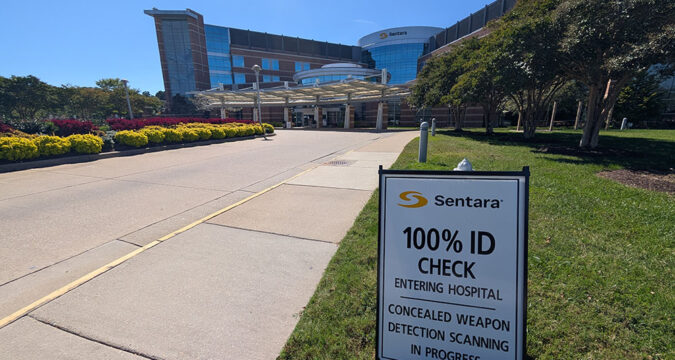
Responding to a rising rate of physical and verbal assaults on health care workers locally and nationwide, Sentara has added a weapons detection system to the main entrance of its Williamsburg hospital.
The equipment is part of Sentara’s commitment to install the technology at the entrances of all 12 of its hospitals by early next year. Sentara Williamsburg Regional Medical Center, which is located in York County just outside the city, has had detectors at its emergency department entrance since fall 2024.
All visitors, patients and staff at Sentara Williamsburg now must walk between approximately 4-foot-tall pillars equipped with magnetic sensors and artificial intelligence that can spot guns, knives and other concealed weapons.
One or two Sentara security officers, armed with firearms and tasers and certified by the Virginia Department of Criminal Justice Services, are staffing the new system. If the sensors detect a potential weapon, the officers can do a secondary screening with a wand.
“Due to an increase in verbal abuse and physical altercations in recent years, Sentara wanted to take a stand to be proactive and help keep things from escalating,” said Kenneth Sullivan, regional security manager for Sentara Williamsburg and Sentara CarePlex Hospital in Hampton. “It has been very well received by both our staff and the community.”
Since the system’s installation last month, Sullivan said, security has intercepted “quite a few” weapons — most of them knives that people said they’d forgotten they had — and, in one case, a firearm legally carried by a man with a concealed weapons’ permit.
Told the hospital was private property that restricted guns, the man willingly returned the weapon to his car and went through screening successfully, Sullivan said.
Health care workers are five times more likely than any other type of worker to be physically attacked and sometimes seriously injured, according to the Bureau of Labor Statistics. Studies have cited medical staff shortages, extended waiting times and patients who are experiencing stress, pain, confusion, fear and anger or a mental health or substance abuse disorder.
Data shows that the problem has only intensified since the COVID-19 pandemic, when visiting restrictions further frayed nerves. For hospital staff, the risk is not only physical harm but a raised risk of anxiety, post-traumatic stress disorder and burnout.
Virginia does not have a statewide law that criminalizes carrying weapons into all of its hospitals, although individual facilities can have policies to ban them. In Hampton Roads, hospitals have found people with handguns, machetes, box cutters, axes and crossbows, among other potentially dangerous items.
In response, more hospitals have installed metal detectors and advanced weapons detection technology. Riverside Regional Medical Center in Newport News, for example, added metal detectors at its emergency room entrance after a nurse was stabbed by a patient in 2021.
The systems are on top of visitor badging requirements, which typically require people to show a photo ID and wear a date-stamped badge while in the building.
Sentara now has armed security officers and concealed weapon detection at all of its 17 emergency rooms — 12 of them at hospitals and five freestanding — and at the main entrances of its hospitals in Hampton, Norfolk, Elizabeth City and now Williamsburg.
“We are completing a phased rollout at all hospital main entrances, and these four hospitals are the first to be completed,” Sentara spokesman Clancy McGilligan said.
Many health systems, including Riverside, also have added workplace violence prevention programs with initiatives such as streamlined forms for staff to report violent threats or incidents, along with alerts that flag patients with a history of physical aggression or verbal harassment within electronic medical records systems and outside inpatient rooms.
In addition, hospital protection officers across Hampton Roads have trained on deescalation techniques and how to recognize and handle signs of mental illness.
In a news release, Beth Cumbie, director of nursing and patient care services at Sentara Williamsburg, agreed with Sullivan that feedback from patients and visitors on increased security has been positive: “We’re doing everything we can to create a safe, healing environment at Sentara. Our consumers comment that they appreciate and understand the need.”
Alison Johnson, ajohnsondp@yahoo.com