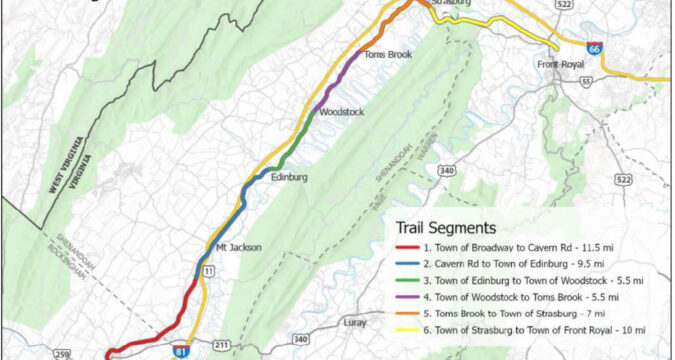
A plan to convert a 49-mile stretch of overgrown rail line into a recreational trail in the Shenandoah Valley is heading down a different track in the last weeks of Gov. Glenn Youngkin’s term in office, as a state transportation board plans to vote this week on a proposal to pursue the potential restoration of freight and passenger train service alongside a new trail.
A study by the Virginia Department of Transportation estimated in November that a “rail with trail” option — restoring the discontinued Norfolk Southern B Line and building a recreational trail beside it — would cost $687 million, or four times as much as building only a recreational trail from Broadway in Rockingham County to Front Royal in Warren County.
But the Commonwealth Transportation Board is expected to vote Tuesday on whether to transfer $35 million in state funding for the trail to the Virginia Passenger Rail Authority to pursue the rail-with-trail option. The authority board of directors has already agreed to amend its budget to accept the money, which the private, federally chartered Shenandoah Valley Battlefield Foundation plans to use to purchase the rail right-of-way from Norfolk Southern Corp. for the possible restoration of train service, as well as the construction of a recreational trail.
The switch has ignited opposition by longtime advocates for converting the discontinued Norfolk Southern line to a regional trail, including the mayors of nine towns along it, who called the new proposal “an alarming surprise to us.” They cited the restoration of the popular Virginia Creeper Trail, a rail trail in Southwest Virginia, which was badly damaged by the remnants of Hurricane Helene more than a year ago.
“We, too, have been looking forward to welcoming trail visitors into our towns and communities,” the mayors said in a letter to the board last month. “However, we are concerned that transferring this project to the (passenger rail authority) will jeopardize those benefits.”
The towns are part of the Shenandoah Rail Trail Exploratory Partnership, which also includes three counties, two regional planning district commissions and three nonprofit organizations.
“We’ve played by the rules,” Chairman Don Hindman told the transportation board after the Youngkin administration unveiled its plan Dec. 9. “The truth is that our vision for the trail, when implemented, will provide the most economic and health benefits to the largest number of Virginians for the least capital investment in the shortest time.”
The proposal has divided the valley’s General Assembly delegation, but a number of business organizations publicly support it, as well as some local elected officials.
“The best solution in my mind is the ‘Rail WITH Trails’ model,” said Josh Stephens, chairman of the Shenandoah County Board of Supervisors.
Secretary of Transportation Shep Miller said the “rail with trail” proposal would allow the battlefield foundation, which has experience in building trails, to purchase the rail corridor while beginning work on the recreational trail.
“To me, everyone can win here,” Miller said Friday. “We can get it done faster. We can do it cheaper than (the Virginia Department of Transportation) could do it. And we keep the corridor open.”
State officials are discussing plans for a “rail with trail” from Broadway in Rockingham County to Front Royal in Warren County.
The administration is pushing the plan now, with less than two weeks in Youngkin’s term, because it wants to secure the rail corridor before the planned merger of Norfolk Southern and Union Pacific Corp. It said the state would supply $23 million for the battlefield foundation to acquire the corridor. The state could acquire the corridor “at no or nominal cost” if the foundation did not meet its obligations to build the recreational trail and restore the rail line for potential passenger trains, including recreational excursions, and freight service.
The passenger rail authority will hold public hearings on the “rail with trail” plan, but a former legislator on its board of directors sees the state money being used primarily to purchase the rail corridor to preserve the option of restoring train service on the discontinued line.
“Why would they send it to the VPRA if they did not want it to be used for rail?” said former Sen. John Watkins, R-Powhatan. “We’re not in the trail business.”
Miller, a Virginia Beach businessman who served on the Commonwealth Transportation Board before Youngkin appointed him secretary in 2022, said most of the state money would go to purchasing the corridor, with the rest reserved for building a trail, as the General Assembly specified in budgeting the money in 2023.
“They can’t spend a nickel of this money on anything other than a trail,” he said. “Anything they spend on rail has to be raised from other sources.”
DJ Stadtler, executive director of the passenger rail authority and a former Amtrak official, said the restored corridor ultimately could allow commuter rail service from Northern Virginia to Harrisonburg, but probably not for decades.
“We see a future where that corridor could be used for passenger rail,” Stadtler told his board in a virtual meeting Dec. 16. “I want to be very clear, that future is not 2032. That future is probably not 2042.”
Meanwhile, longtime advocates for a Shenandoah rail trail fear that the proposed deal with the battlefield foundation would undermine the trail project.
“This is just going to set the whole project back for years,” said Heather Richards, state director of The Conservation Fund, which has been working with the community partnership to advance the rail trail.
Advocates say the state transportation study showed that the “rail with trail” proposal isn’t economically viable.
The VDOT study estimated that building a trail along a revived rail line would cost $382 million, or more than double the price of a trail alone, because of the additional right-of-way, retention walls, bridges and protective fencing that would be required. Restoring the rail line, which now has trees growing between the ties, would cost an additional $305 million, for a total of $687 million.
Kate Wofford, executive director of the Alliance for the Shenandoah Valley, said raising money for the rail trail — without the rail option — is much more realistic.
“It’s a big lift, but it’s doable,” Wofford said Friday.
https://www.pilotonline.com/2026/01/04/shenandoah-valley-rail-to-trail-project/