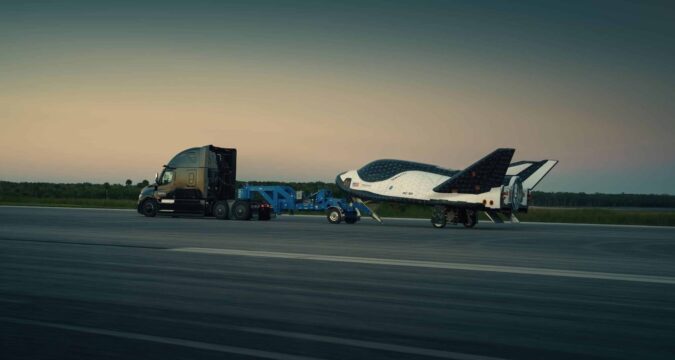
No, what looks like a little space shuttle was not broken down when it was being hauled down the runway at Kennedy Space Center.
Sierra Space’s Dream Chaser spacecraft Tenacity was undergoing tests when it was hooked up to a Freightliner Cascadia and sped down the former space shuttle landing strip now part of Space Florida’s Launch and Landing Facility, according to a company press release last week.
The black-and-white spacecraft, about one-fourth the size of the space shuttle, was testing out landing operations including its ability to navigate a touchdown autonomously as the company preps for its first launch in 2026.
Teams then performed a post-landing recovery rehearsal to demonstrate making the cargo spacecraft safe to allow access to payloads returned from low-Earth orbit.
It was part of a battery of tests the spacecraft has undergone since its arrival on the Space Coast last year. Those have included electromagnetic interference and electromagnetic compatibility testing at KSC’s Space Systems Processing Facility. The company also was able to use NASA’s Tracking and Data Relay Satellite System network to successfully communicate to the spacecraft from its mission control center in Louisville, Colorado, where the company is headquartered.
“Each milestone we achieve is a testament to the resilience, innovation and dedication of the Sierra Space team, and represents another significant step forward in ensuring Dream Chaser’s success as a versatile, reusable spacecraft,” said the company’s executive chair Fatih Ozmen. “We are excited to see Dream Chaser progressing steadily toward its inaugural flight to support the nation’s most pressing space priorities.”
While originally planning a landing at KSC on its first mission, Sierra Space said it is now aiming for a runway touchdown at Vandenberg Space Force Base in California.
The final steps before readying for launch include more acoustic testing at KSC in December. The company said it would also look into modifying the spacecraft for some sort of national security demonstration capacity, although it’s unclear if it would need to return to Colorado for any changes before finally getting prepped for launch.
Tenacity was originally aiming to launch atop United Launch Alliance’s new Vulcan rocket as its second ever mission in late 2024, with a plan to dock with the International Space Station as a new cargo service provider.
But its testing regime begat needs to troubleshoot issues with the spacecraft, which has led to NASA and Sierra Space modifying plans so its first launch won’t come until late 2026, and then only as a free-flying demonstration mission that won’t dock with the ISS.
The updated contract doesn’t guarantee any flights to the station, but NASA could opt to give Sierra Space task orders if successful. The company had originally won the NASA’s Commercial Resupply Services 2 contract back in 2016 with Dream Chaser awarded seven cargo flights to the space station joining previous commercial contract winners SpaceX with its cargo Dragon and Northrop Grumman, formerly Orbital ATK, with its Cygnus spacecraft.
The uncrewed, 30-foot-long vehicle can deliver up to 12,125 pounds of supplies and can remain attached to the ISS and become an extension of the workable space. The roadmap calls for a crew version configuration with room up to seven crewmembers and supplies.
Sierra Space had initially tried to win a contract for a human-rated version of Dream Chaser, but NASA opted to give those commercial contracts to SpaceX for Crew Dragon and Boeing for its Starliner.
The company still aims to develop a human-rated version of the vehicle that could be used to fly to any of the commercial space stations in development that look to replace the ISS once it’s decommissioned.
Unlike SpaceX, which has Dragon landings in the water, and Cygnus, which burns up in Earth’s atmosphere after the station is done with it, Dream Chaser is designed to land back on Earth in the same way the space shuttle orbiters did.
The spacecraft has been in the works for more than 15 years.
The vehicle to date has only made successful drop tests outside of Florida from high altitudes to show its ability to land safely. In 2024, it completed months of testing at NASA’s Neil Armstrong Test Facility in Ohio before it made its way to Florida.