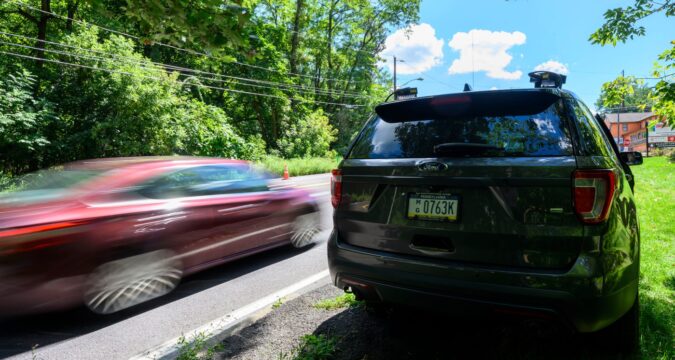
Keeping one eye on the traffic and the other on a timer, Sgt. Bryan Losagio reminisced Tuesday afternoon about the king of speeders — a driver he clocked going 112 mph on South Pike Avenue last year.
“I think the record before that was 99,” said Losagio, a 24-year veteran of the Salisbury Township Police Department who caught the epic violation on something called an ENRADD, for electronic non-radar device. It uses a pair of yard-apart infrared tripwires beamed between four roadside sensors to measure speed, calculating how long it takes a car to travel the 3 feet.
State police in Pennsylvania can use radar guns but local police can’t, so speed enforcement at the municipal level is usually done this way, with one police officer manning the timer and others waiting a little farther along the road to stop any flagged vehicles.
Pike Avenue — Route 145 between East Rock Road to the south and the Allentown line to the north — is the most notorious township road for speeding, despite running past the police headquarters. Officers call it the Pike Avenue 500, a drag strip where drivers open up on the straightaway or try to outrace each other where it narrows from two lanes to one.
With schools back in session, Tuesday was as good time as any for an enforcement detail, paid for with a PennDOT aggressive driving grant. Losagio took timer duty, setting up on the shoulder near a Mexican restaurant and radioing officers a little way south any time someone exceeded the posted 40 mph limit by more than 10 mph. In Pennsylvania, the 10 mph cushion is granted in under-55 mph speed zones.
It wasn’t long before Losagio, who set up the timing mechanism at noon, clocked drivers going well in excess of 51 mph.
“Black GMC SUV coming up in the left lane at 57,” he radioed to patrol Officers Jay Vasilik and Michael Palansky, who waited out of sight beyond a hill.
Moments later: “58 on a dark-colored Jeep SUV.”
And so on. A red Buick. A gray Honda. A white Corvette, so sleek it might tempt the most safety-minded motorist to test the speed limit.
It would be nice to have radar, the sergeant said. Despite perennial legislative pushes to change the law, Pennsylvania remains the only state in the country where local police can’t use it.
ENRADD isn’t nearly as accurate as radar, and it’s expensive. The units cost $4,000 to $5,000 and are always in danger of being damaged because they are placed so close to the road.
“Two or three a year get run over,” Losagio said. “We had two get run over in one day.”
Repairs take time, and soon won’t be possible because the company that makes ENRADD is winding down production of the devices. The other timing option is the less-reliable VASCAR — Visual Average Speed Computer and Recorder — which relies on a stopwatch and measured sections of road to calculate speed.
As Losagio marked the speeders, a robotic voice from a license plate reader mounted on a roadside pole periodically reported expired registration or inspection stickers.
Fake or altered inspection stickers are another common violation. During the last enforcement detail, a dozen drivers were caught with those.
“They don’t get to keep them,” Vasilik said, after using a screwdriver to scrape a fake inspection sticker off one car. The driver had no license, either. He was allowed to pull off the road and wait for a licensed driver to come get the vehicle. It would have been towed otherwise.
Vasilik could have had it towed anyway, but chose not to.
“We’re not looking to punish people,” he said.
For the most part, drivers who get pulled over are polite and cooperative, said Losagio, who spent three years on traffic enforcement at one point in his career.
“I’d say about 2% of people are going to argue no matter what the circumstances are,” Losagio said.
Some offer excuses, or what they consider to be excuses.
“A couple of years ago we had young lady who said she was checking her social media so she wasn’t paying attention to her speed,” Losagio recalled. “The officer asked if she wanted to take a selfie with her ticket. She didn’t.”
It was a light-hearted anecdote but Losagio said speeding is a serious matter and a factor in most of the 40,000 fatal crashes recorded annually in the country.
Plenty of drivers are quick to accuse police of using speed enforcement to generate revenue, but no, Losagio said. Officers drive on the same roads on and off duty and want them to be safe.
“The goal isn’t to write tickets,” he said. “It’s to get people to slow down.”
The detail ended with 87 citations issued, about the number Losagio predicted at the outset. The three highest recorded speeds were 78, 74, and 73 mph. Apart from speeding, offenses included registrations that were suspended for lapsed insurance or having excessive unpaid tolls.
Morning Call reporter Daniel Patrick Sheehan can be reached at 610-820-6598 or dsheehan@mcall.com