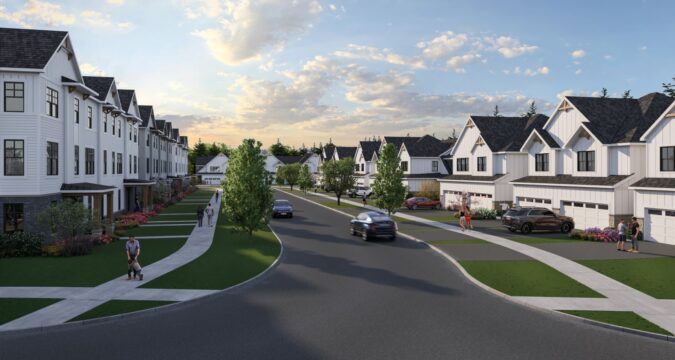
Two residential developments approved by the Naperville City Council this week will add 82 new homes to south Naperville when complete.
Everly Trace is a 68-unit townhome/rowhouse development to be built by M/I Homes on land on 111th Street, next to the Crone Middle School’s athletic fields.
The development received unanimous support from the Planning and Zoning Commission in June, despite opposition voiced by neighboring residents and an online petition with hundreds of signatures. Council members sided with the commission, approving an annexation agreement for the 10-acre site.
“While this is located in the very southwest section of town, there’s some very nice resources in the area that make this a very attractive location for development,” Russ Whitaker, an attorney for the developer, said in a presentation prior to the council vote.
Everly Trace’s 42 three-story rowhomes and 26 two-story townhomes are to be built on property currently occupied by SiteOne Landscape Supply. With the company’s lease expiring, the business plans to vacate the site in early 2026.
This rendering shows the 26 townhomes to be built by M/I Homes on land at 25013 111th St., which is being annexed into Naperville. (M/I Homes)
Two-story townhomes will be built along the south and west portions of the property to serve as a transition from the single-family homes in the Ashwood Creek subdivision, Whitaker said. The larger of the two floorplans being offered is aimed at “move-down” buyers, he said.
“If you get into the comprehensive plan, you see that really most of the attached product, most of the multifamily housing that is attached to those move-down buyers, is located north of 75th Street,” Whitaker said. “So here’s an opportunity to really help diversify product in south Naperville.”
The three-story units are “strategically located” in the center of the Everly Trace site to “diversify, reach a different buyer pool, different market prices,” he said.
Former Naperville Councilwoman Allison Longenbaugh voiced her support for the project at the meeting. A proponent of “visitability,” an inclusive design concept for those with disabilities, Longenbaugh said she pushed the developer to include homes with no-step entries. There will be five as a result, she said.
“Five out of 68 — it’s not 100%, but I think it’s a win. It’s a win for visitability,” said Longenbaugh, who was recently appointed to the city’s Planning and Zoning Commission.
This model home shows what the houses in the proposed Reserves of Saddle Creek subdivision in south Naperville could look like when built. The project won Naperville City Council approval this week. (Overstreet Builders)
Reserves of Saddle Creek
The council also approved the Reserves of Saddle Creek, a housing project to be built at Book Road and Clearwater Lane. Proposed by Overstreet Builders, the development calls for 14 new homes on eight acres of land and an additional eight acres of wooded land, all of which will be annexed into the city.
The houses will be built along an extension of Clearwater Lane that will connect the street from where it dead-ends just west of the site to where it starts again on the east side of Book.
While no one spoke against the project at the council meeting, it did receive some pushback at a Planning and Zoning Commission meeting from two residents concerned about the loss of forestry and privacy.
Part of the development includes the demolition of the John B. Clow farmhouse, a home determined to have historical significance to Naperville. Overstreet Builders contacted Naper Settlement in June and hired Midwest Archaeological Research Services to assess the property, according to a letter from Naper Settlement President/CEO Macarena Tamayo-Calabrese.
The John B. Clow Farmhouse at 10846 S. Book Road in Naperville. The farmhouse has ties to the Clow family, who settled in Naperville in 1844 and held important roles in the agricultural industry in the area. (Jean L. Guarino)
“The eight-acre property upon which the John B. Clow farmhouse is situated has been in the Clow family for six generations and was originally part of a much larger tract of land that was purchased from the public domain by Robert Clow Sr. in 1844,” the research group report said.
The present day farmhouse was built in 1910 by John B. Clow, grandson of Robert Clow Sr., the report said. In August, Naper Settlement retrieved an interior door and two light fixtures from the home to add to their collection, according to Tamayo-Calabrese’s letter.
“The addition of these items to the museum’s collection will help share the story of the Clow family, whose agricultural legacy is inextricably tied to the city’s history,” she said.
cstein@chicagotribune.com
https://www.chicagotribune.com/2025/10/10/naperville-townhouses-council-everly-clow-reserves/