SpaceX Prices Biggest Ever IPO At $135 Per Share
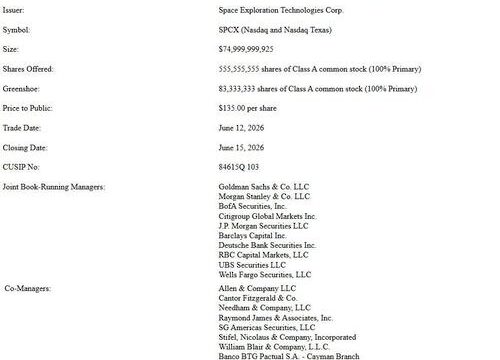
While there was little doubt as to SpaceX’s actual IPO price, which due to its novel structure was always going to be $135, and unlike the proposed IPO price ranges as is customary for other initial offerings, moments ago SpaceX made it official when it filed a free writing prospectus (FWP) which confirmed the company sold 555.6 million shares at $135 each, making history with the biggest-ever IPO, launching it into the top ranks of the largest public companies and putting founder Elon Musk on the verge of becoming the world’s first trillionaire. The SpaceX registration statement was declared effective June 11
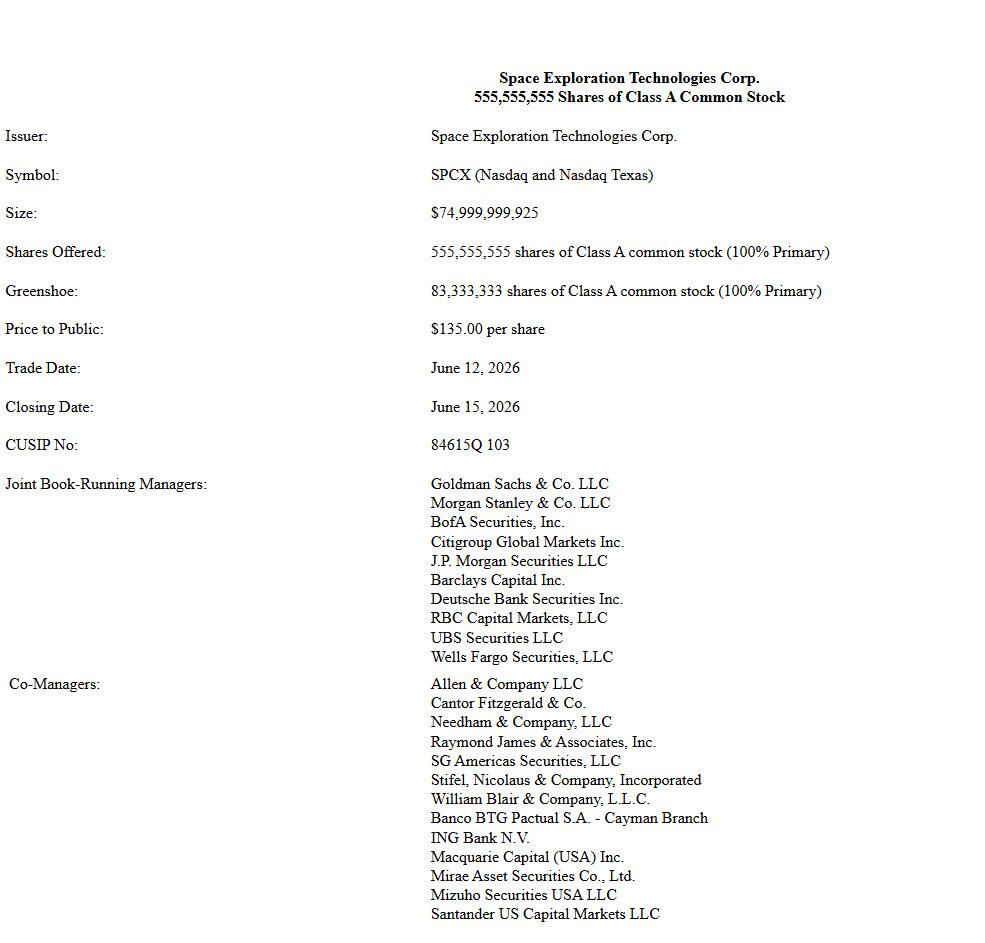
SpaceX’s IPO is more than double the size of the previous largest IPO – Saudi Aramco’s $29.4 billion listing in 2019.
At $135, SpaceX will have a market value of $1.77 trillion. Accounting for employee stock options and restricted share units, the pricing gives it a fully diluted valuation of about $1.8 trillion. SpaceX’s market value will rank it among the top 10 public companies globally, and make it larger even than Musk’s own Tesla Inc
Musk’s fan base in the retail trading community is a crucial component of the deal. They have placed more than $100 billion in orders for the stock, Bloomberg reported, far more than the 20% of shares that had been reserved for them.
Yet not everyone is so excited. Veteran short-seller James Chanos on Wednesday called it “a hopes-and-dreams IPO” driven by enthusiasm for Musk and artificial intelligence rather than the fundamentals of a company that has yet to post a profit.
“The total addressable market for space is infinite,” Chanos, founder of Chanos & Co., said at the iConnections Global Alts conference in New York on Wednesday. “You can build whatever stories you want — colonies on Mars, factories on the moon, data centers in space — to justify the valuation.”
Still, coupled with rule changes that could fast track the stock into benchmark gauges like the Nasdaq-100 Index, demand from passive funds and retail investors unable to buy at the IPO price should set the stage for a solid cohort of buyers for shares of the rocket, satellite and AI company once they start trading.
“It’s probably the most hopeful IPO,” said Kim Forrest, chief investment officer at Bokeh Capital Partners, adding that she doesn’t buy IPOs. Buyers of SpaceX “want to be part of the future,” she said. “And I think that’s oddly hopeful in this time when we’re moving between the poles of greed and fear.”
SpaceX is the first of three major IPOs expected to capitalize on stock investors’ appetite for the leading AI companies, a seemingly insatiable demand that has propelled benchmark US indexes to records this year despite the acceleration in inflation and economic disruption caused by the war in Iran. Anthropic PBC and OpenAI, two of the company’s AI competitors, are expected to go public as soon as this year and could seek valuations of more than $1 trillion each, so the performance of SpaceX’s stock will be as closely scrutinized by Silicon Valley venture capitalists as it is by Wall Street traders. The deluge of public equity, on top of an $85 billion equity offering from Alphabet Inc. and the potential for other big-tech firms to follow suit, is triggering a debate over whether there is enough investor demand to meet the incoming supply.
A successful showing in public markets would make Musk a trillionaire, and his wealth could boom even further if he meets performance-based conditions for awards of as many as 1.3 billion additional class B shares in aggregate, split into tranches. It would be no small feat to earn all those shares. The company’s market capitalization needs to reach $7.5 trillion, it will have to complete non-Earth-based data centers capable of delivering 100 terawatts of computing power per year, and establish a permanent human colony on Mars with at least 1 million inhabitants.
Musk, who won’t be able to sell any shares until a year after the start of trading, is expected to control 84% of the voting power after the IPO. His control over SpaceX’s governance includes effectively being able to choose the board members, which means only he can remove himself as CEO.
Now that the pricing is done, we wait for the actual stock to break for trading tomorrow – with the usual several hour delay – at which point we will see if it was wise for SpaceX to issue such a small float with such a large retail participation. Notably, according to Polymarket, the odds that the IPO closes with a market cap above $2.2 trillion
Tyler Durden
Thu, 06/11/2026 – 15:48
https://www.zerohedge.com/markets/spacex-prices-biggest-ever-ipo-135-share