The AI Race Will Be Won Or Lost On Power Infrastructure
By Amanda Simonian, chief marketing officer at TerraFlow Energy, first published in UtilityDive
Over the past several months, moving between conversations on Capitol Hill, industry conferences, and meetings with operators, developers and policymakers, I have been struck by how often very different discussions keep circling back to the same underlying concern: power. In congressional offices, it comes up through the language of energy security, industrial policy and what it will take to keep infrastructure ahead of rising electricity demand. Across the industry, it surfaces through a more operational vocabulary: interconnection bottlenecks, volatile load growth, transmission constraints and the practical question of where the next gigawatt comes from.
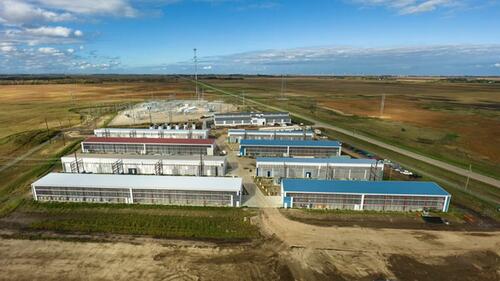
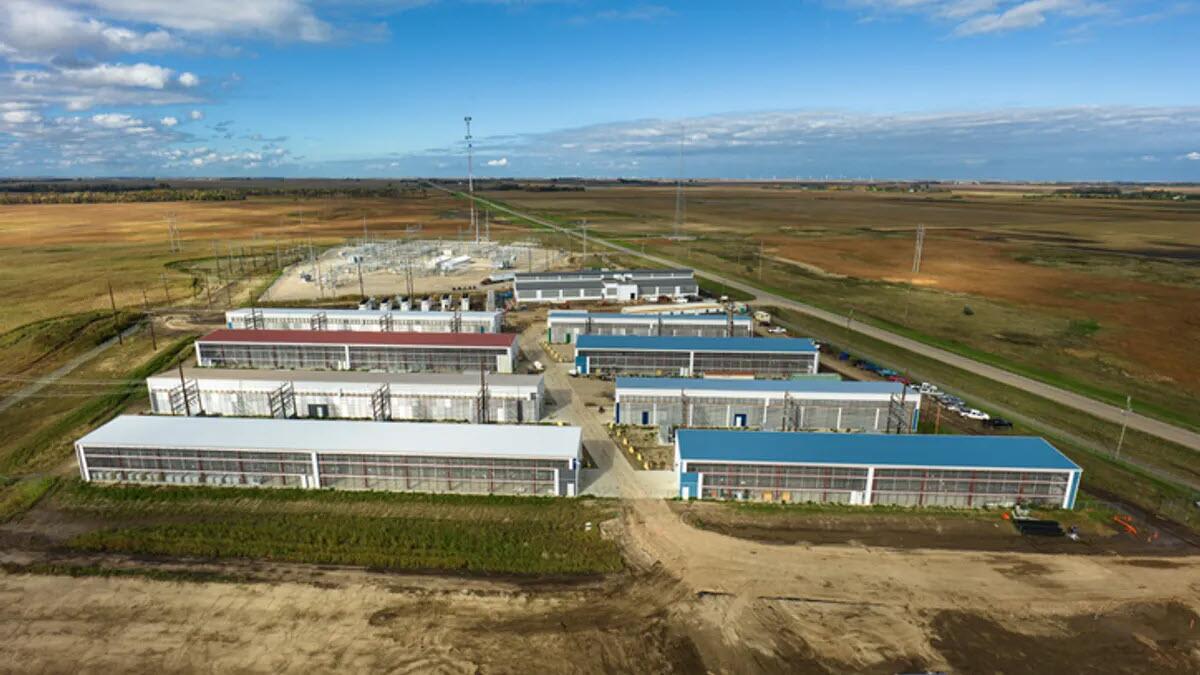
Data centers in Stutsman County, N.D.
What made those conversations interesting wasn’t simply that policymakers and operators were focused on the same issue. It was that many of the proposed answers still seemed rooted in an assumption that deserves more scrutiny. Much of today’s discussion treats AI-driven load growth primarily as a supply challenge. Demand is rising sharply, so the answer must be to build more generation.
That’s true, but only partially.
I’ve come away increasingly convinced the sector may be treating what is fundamentally an infrastructure performance challenge as though it were only a generation problem. Those aren’t the same thing, and the distinction matters. In many places, the strain emerging around rapid load growth isn’t just about whether enough electrons can be produced. It’s about whether the systems carrying, balancing and responding to that power can perform reliably as loads become denser, more dynamic and far less predictable than the grid was originally designed to support.
There are signs of that pressure showing up across the country already. Recent warnings from the PJM Interconnection around reserve margins, rising demand scenarios in the Electric Reliability Council of Texas and analysis from the Electric Power Research Institute projecting major increases in data center electricity consumption all point toward a common reality: this isn’t a regional anomaly, and it isn’t a problem sitting comfortably on the horizon. It is beginning to surface now in ways that challenge longstanding planning assumptions.
That is part of why the “just build more generation” framing feels incomplete. More supply matters, but supply alone doesn’t resolve congestion at constrained nodes, instability caused by volatile load behavior, or the local system stress created when large loads concentrate faster than infrastructure can adapt. In some cases, responding to those pressures primarily through generation additions risks solving for scarcity while leaving unresolved, or even exacerbating, the performance challenges underneath.
That isn’t simply a fuel problem, but a systems problem, and systems problems tend to get harder when they’re diagnosed too narrowly.
Even actions like Executive Order 14156 and subsequent federal actions on grid infrastructure suggest growing recognition that energy systems are becoming a strategic competitiveness issue. But the more important question may not be how quickly infrastructure can be deployed, but whether the infrastructure being prioritized is designed for the character of demand now emerging. Speed matters, but architecture matters too.
If infrastructure performance is becoming a limiting factor, then planning, procurement and policy frameworks need to start valuing flexibility and operational capability alongside megawatts. Resource adequacy models should account not only for how much capacity a resource provides, but also for how effectively it responds to rapid load variability. Interconnection and permitting processes should encourage architectures that reduce stress on local infrastructure rather than simply adding demand. Utilities, regulators and large-load customers should be evaluating infrastructure based on its ability to improve system resilience, absorb volatility and support grid performance under real operating conditions.
As the character of demand changes, the metrics used to evaluate infrastructure likely need to change with it. The question is no longer only whether new resources can produce electricity. It’s whether they help the system operate more reliably as load growth accelerates. That matters because the public debate is still asking a narrower question than the moment demands. We often ask whether the U.S. can build enough electricity to support AI growth. A harder and more consequential question is whether we can build power systems capable of supporting that growth reliably. One is fundamentally about supply. The other is about whether the system itself can hold under stress.
Those are not the same challenge.
Tyler Durden
Thu, 06/25/2026 – 07:20
https://www.zerohedge.com/markets/ai-race-will-be-won-or-lost-power-infrastructure