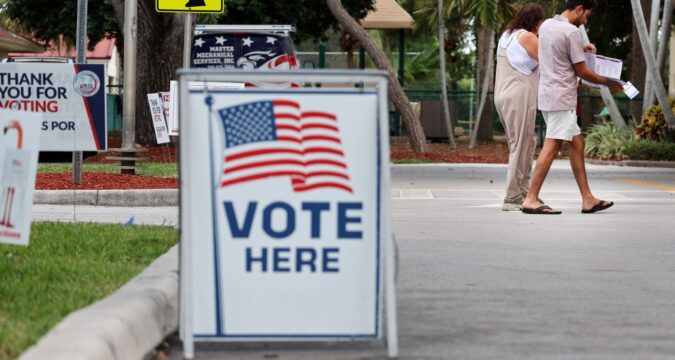
The city of Boca Raton will have to shell out at least $460,000 for a pivotal January election that could significantly alter how the City Council makes decisions and affect the outcome of the city’s general March election.
The council opted to participate in a special primary election on Jan. 13, abiding by a section in the Boca Raton charter that states any proposed amendment should be put to a vote not less than 60 days after petition signatures for the amendment were certified by the city clerk.
According to city documents, the ordinance amendment was certified on Sept. 23 and the charter amendment was certified on Oct. 2.
“In no event shall the charter amendment be voted upon later than three months from the date of certification,” the charter reads.
In this case, the amendments in question are identical charter and ordinance amendments that, if approved, would require the City Council to host elections for the selling or leasing of more than a half-acre of city-owned land.
The amendments were initiated by Save Boca, a group of residents who rallied in response to their opposition of a government-campus redevelopment plan.
The initial proposal included more than 1,100 apartments, a hotel, 250,000 square feet of office space, 85,000 square feet of retail on about 31 acres near the intersection between West Palmetto Park Road and Dixie Highway.
In response to the public’s concerns, the project has seen many revisions. Now, the project proposes 947 residences, more than 85,000 square feet of retail, 120,000 square feet of office space and a hotel that would be consolidated to less than 8 acres near the Brightline Station. The project also includes a police and fire rescue substation, a new community center and city hall, a tennis center with 10 clay courts, three basketball courts and a dedicated Memorial Park.
It was too late for the council to participate in the county supervisor of elections’ special primary election on Dec. 9 to fill the state representative District 90 seat.
Jan. 13 was the first available date the city could get, Mayor Scott Singer said.
Boca Raton’s January election will be held in conjunction with the primary where voters will select a new state representative for House District 87, which includes portions of northern Palm Beach County from Lantana to Juno Beach.
“There was no other opportunity, so we adhered to what the charter required,” Singer said. “This is the first available date, and we’re taking it.”
Boca Raton’s election costs
While the Boca Raton election technically is an expansion of the House District 87 primary, District 87 doesn’t include any part of Boca Raton, so the ballots will be completely separate, Palm Beach County Supervisor of Elections Wendy Sartory Link said.
Because Boca Raton is the sole special election participant in this primary, the rough $460,000 price tag estimate is heftier than what it would be during a general election, when municipalities split the cost, Link said.
According to the city, Boca Raton paid about $67,000 for the March 2024 election. Because that election piggybacked on the presidential preference primary election, Palm Beach County absorbed much of the costs.
Boca Raton’s payment for the upcoming January election goes toward vote-by-mail ballots, printing ballots, equipment delivery, poll worker training and poll worker pay, among other things. And because certain factors are unknown until Election Day — how many voters will participate or request vote-by-mail ballots, for example — the final cost could be higher, Link said.
Attendance for special elections, which influences cost, varies, Link said.
The Jan. 13 Boca Raton election “may be something that people feel strongly about. They could have a larger (turnout),” she said.
“So it’s really a function of who’s on the ballot, whether it’s people that the community can be excited about and get behind, or is it a question that is a hot topic that the people are focused on,” she said.
A spillover effect
The January election could bode well for the Save Boca members who want the referendums to get approved, said Craig Burnett, a professor and the political science chair at Florida Atlantic University.
Save Boca may very well “dominate the polls” because the movement has energy, resources and momentum, Burnett said.
If the proposed amendments were to have instead been tacked onto the March 10 ballot, more residents with either no say or a negative view of the amendments may have shown up to vote against them, he said.
“This is a singular contest, basically,” Burnett said. “For a group that has submitted thousands of petitions at this point, they clearly have the ability to organize, they have the ability to get people excited to do at least something political.
“Signing a petition is often the bigger ask then turning out to vote, so it’s about them getting their people out to the polls, and that’s going be a fairly straightforward goal to reach in January.”
And the January election could actually increase participation in the March 10 election, Burnett said, especially given the heightened civic engagement Boca Raton has seen.
“There will be a spillover effect,” Burnett said. “There is going to be some portion of people who come to vote in January who maybe were never really thinking that much about voting in the March one.”
But then some of those people may decide to vote in March, too, opting to express themselves further after having “done the research,” he said.
“The injection of energy and organization around this issue has already planted the seeds of higher turnout in March regardless of where this referendum landed,” Burnett said.
The general fervor Burnett is referring to has been quite evident in the last few months. Recent city meetings often have overflowed with residents, many eager to air grievances or even lob accusations at the City Council members during public comment.
The frustration is such that some Save Boca members have even decided to run for office and will appear on the March ballot. For example, Jon Pearlman, who is Save Boca’s founder, and Michelle Grau and Stacy Sipple, who both support the Save Boca movement, qualified to run for three different council seats.
“There are people who have shown up to meetings, they’ve seen their elected officials talk, some of those people have listened to what they’ve had to say and decided they don’t like it,” Burnett said. “And they have now decided in a separate way, regardless of what happens to the referendum, they’re going to show up in March because they’ve decided they don’t like some of the people who are representing them right now.”
For the March 10 election ballot, residents will cast votes for a new mayor, council member seats A, B and D, and two referendum questions:
— One question is about whether the city should move forward with the government campus redevelopment project as proposed by Terra and Frisbie, the development firms representing the project.
— Another question is about whether the city should spend $175 million in bond funds on a new police station.
Significant expenses
The January election — and more specifically, the city’s nearly half-million-dollar payment that comes with it — could signal the start of a concern that Singer has expressed about Save Boca’s proposed amendments.
“It is a good deal of money, and I think that we may end up with significant expenses of more special elections in the future for opportunities like getting a new public school that are unplanned,” Singer said. “Those are concerns that voters should bear in mind when they have to evaluate this question.”
Those election expenses could deter future councils from entering into agreements at all, Singer has said.
But Pearlman has said residents will approve projects that bring public benefit. And on a recent Facebook post in the Save Boca page about the upcoming elections, one user commented: “If we can afford to advertise to New Yorkers, in an area frequented by tourists mainly, we can afford this.”