The Quiet Collapse Under The Market’s Surface…It’s Getting Louder
Submitted by QTR’s Fringe Finance
The market is hypnotized by headlines out of the Middle East. Every missile strike, every oil spike, every rumor about escalation with Iran sends volatility dealers and gamma-chasing algorithms into another violent intraday swing.
But beneath the geopolitical theater, a dangerous story continues to deteriorate quietly in the background: multiple areas are cracking in a way that looks increasingly systemic, and almost nobody wants to talk about it. But I won’t shut up about it.
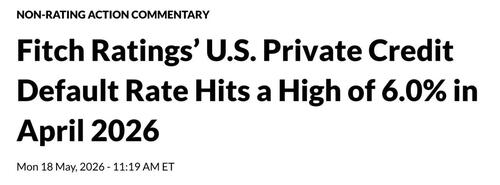
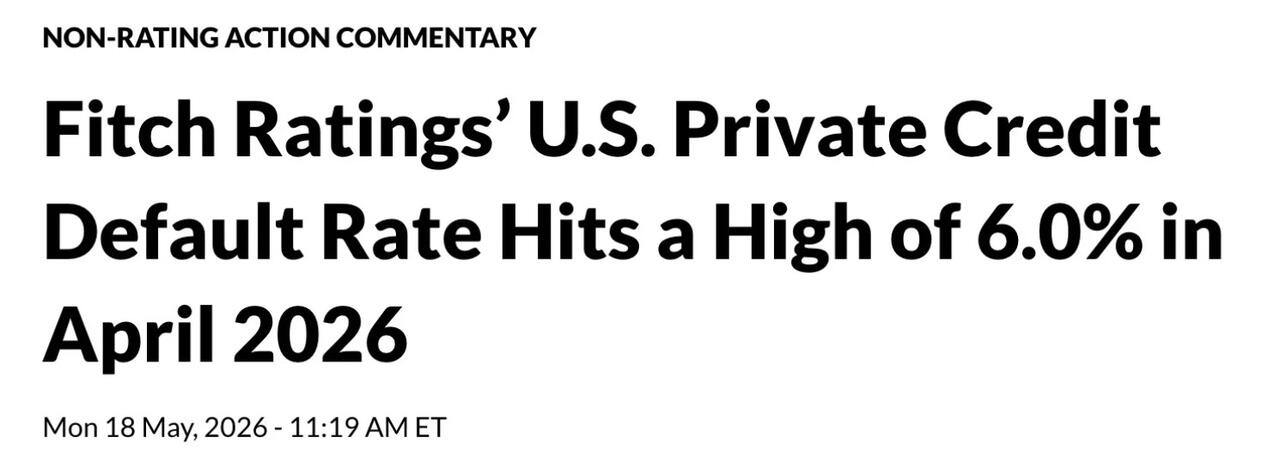
Why? Try this on for size. According to Fitch Ratings, the U.S. Private Credit Default Rate just hit another all-time high. Fitch reported that the trailing twelve-month private credit default rate rose to 6.0% for April 2026, up from 5.7% in March and the highest level since the firm began tracking the data in August 2024.
The model-based default rate climbed to a record 4.8%, while the privately monitored rating default rate remained an astonishing 9.7%. Those are accelerating cracks.
Fitch recorded 10 private credit default events in April alone, heavily concentrated in industrials, manufacturing, and business services. More importantly, the composition of those defaults matters. The majority were not traditional payment misses. Seven involved distressed maturity extensions, lenders kicking maturities one to two years down the road simply to avoid recognizing immediate failure. The remaining defaults largely involved borrowers introducing payment-in-kind interest structures instead of paying cash interest.
This isn’t normal business operations for private credit. Instead it’s like running a triage at an emergency room. Extending and pretending while hoping magic liquidity comes out of nowhere and saves the day is a strategy popular on Wall Street. The only problem is when that liquidity never arrives, the chaos is multiples larger than it would have been if these businesses had done the right thing years prior.
The most alarming detail from Fitch may be this: in the April trailing twelve-month period, Fitch counted 81 unique defaulters generating 99 separate default events — the highest number ever recorded since tracking began. More than half of all default activity came from interest deferrals or PIK structures replacing actual cash payments.

In plain English, companies are increasingly surviving by pretending they are solvent when they aren’t.
Healthcare providers remain among the worst areas, while consumer products posted an extraordinary 11.1% default rate. Industrials and manufacturing surged to a 9.1% default rate, nearly doubling year-over-year. Fitch itself warned that prolonged Iran-related inflation pressure and higher energy costs could further weaken consumer demand and increase rating pressure on industrial issuers.
As I’ve written for the last year (at least), private credit was sold as a superior replacement for traditional banking risk. Investors were told that direct lenders had tighter covenants, better borrower visibility, superior workout flexibility, and floating-rate protection. What actually happened was a decade-long explosion of leverage financed by ultra-cheap money and dependent on permanently low defaults.
Now rates are higher, refinancing windows are shrinking, and many of these companies were never structurally viable at current borrowing costs.
I have already argued repeatedly that rates likely need to go higher from here because inflation pressures remain embedded throughout the system. The bond market understands this. Long-end yields continue to scream that inflation expectations are not anchored, fiscal credibility is deteriorating, and Treasury supply is becoming overwhelming. And the problem is simple: every additional increment higher in rates worsens private credit defaults materially.
A massive portion of these borrowers are floating-rate structures. Every basis point increase directly raises debt servicing costs for already fragile companies. Many sponsors are now choosing between injecting fresh equity into deteriorating businesses or simply extending and pretending until the market forces recognition.
At the same time, the U.S. consumer is visibly weakening. Auto loan delinquencies and credit card delinquencies that are 90+ days past due have already returned to levels last seen during the 2008 financial crisis. Households have burned through excess savings, financing costs have exploded, and inflation continues to erode purchasing power.
🔥 90% Off If You Subscribe Today. This coupon allows for 90% off of annual subscriptions and results in a 90%+ savings over paying the monthly rate for a subscription to the blog. You keep the discounted rate for as long as you wish to remain a subscriber. I will not be offering 90% off anytime again soon after the long weekend: Get 90% off forever
The consumer exhaustion is no longer theoretical. The only question is whether or not consumer exhaustion even matters. During Covid, when the Fed printed a metric fuck ton of cash in the absence of having an actual economy, consumer behavior — sitting at home and drinking beer, if you were me — didn’t matter. But now, with the Fed’s inability to paper over the entire economy again due to inflation, consumer behavior may actually matter.
Now the Federal Reserve — and potentially the incoming Fed Chair — is trapped in an impossible position. Inflation remains too sticky to justify aggressive easing. The bond market is revolting against fiscal expansion and demanding higher yields. Yet the real economy, particularly lower-income consumers and heavily leveraged borrowers, is weakening rapidly beneath the surface.
There are no clean choices left. Cut rates too early and inflation risks reigniting while bond yields surge even higher in response. Keep rates elevated and the pressure wave moving through private credit, consumer lending, commercial real estate, and corporate refinancing only intensifies.
Meanwhile, equity markets continue trading like geopolitical prediction markets. The Iran conflict has become the dominant headline catalyst for every daily gamma swing we now call a stock market. Algorithms chase oil, defense stocks, and volatility spikes while investors remain fixated on the next military escalation.
But behind the scenes, the underlying financial plumbing continues to deteriorate.
Private credit defaults are rising to records. Consumers are rolling over. Delinquencies are back at crisis-era levels. Bond market stress is intensifying. And leverage built during the zero-rate era is finally colliding with the reality of sustained capital costs.
Markets can ignore structural deterioration for a surprisingly long time, but eventually, reality forces recognition.
Like a drunk finally waking up clear-headed after a long night, at some point this market will sober up and realize that beneath the geopolitical distractions, the foundation itself has been quietly cracking the entire time. In the meantime, here’s a couple ideas I’ve thrown around about trying to sidestep a bond crisis, should it occur: What To Own Before A Bond Market Crisis
—
QTR’s Disclaimer: Please read my full legal disclaimer on my About page here. This post represents my opinions only. In addition, please understand I am an idiot and often get things wrong and lose money. I may own or transact in any names mentioned in this piece at any time without warning. Contributor posts and aggregated posts have been hand selected by me, have not been fact checked and are the opinions of their authors. They are either submitted to QTR by their author, reprinted under a Creative Commons license with my best effort to uphold what the license asks, or with the permission of the author.
This is not a recommendation to buy or sell any stocks or securities, just my opinions. I often lose money on positions I trade/invest in. I may add any name mentioned in this article and sell any name mentioned in this piece at any time, without further warning. None of this is a solicitation to buy or sell securities. I may or may not own names I write about and are watching. Sometimes I’m bullish without owning things, sometimes I’m bearish and do own things. Just assume my positions could be exactly the opposite of what you think they are just in case. If I’m long I could quickly be short and vice versa. I won’t update my positions. All positions can change immediately as soon as I publish this, with or without notice and at any point I can be long, short or neutral on any position. You are on your own. Do not make decisions based on my blog. I exist on the fringe. If you see numbers and calculations of any sort, assume they are wrong and double check them. I failed Algebra in 8th grade and topped off my high school math accolades by getting a D- in remedial Calculus my senior year, before becoming an English major in college so I could bullshit my way through things easier.
The publisher does not guarantee the accuracy or completeness of the information provided in this page. These are not the opinions of any of my employers, partners, or associates. I did my best to be honest about my disclosures but can’t guarantee I am right; I write these posts after a couple beers sometimes. I edit after my posts are published because I’m impatient and lazy, so if you see a typo, check back in a half hour. Also, I just straight up get shit wrong a lot. I mention it twice because it’s that important.
Tyler Durden
Wed, 05/27/2026 – 11:00
https://www.zerohedge.com/markets/quiet-collapse-under-markets-surfaceits-getting-louder