Art museums and symphony orchestras mostly arrived in major American cities at the dawn of the 20th century. But regional theaters like the Guthrie Theatre in Minneapolis or the Alliance Theatre in Atlanta did not arrive until the 1960s, when the mission-based tumult of the era demanded an alternative to Broadway tours, pioneers like director Margo Jones in Dallas had successfully brought classics and new works to the regions, and the Ford Foundation had put hard philanthropic cash behind “strengthening the position of resident theatre in the United States.”
By then, Chicago’s Goodman Theatre was already in middle age.
The founding of Chicago’s leading theater was quixotic. An undistinguished playwright named Kenneth Sawyer Goodman, who had some success in Chicago’s Little Theatre movement, had written a letter to the Art Institute of Chicago suggesting that it get into the theater business and, when Goodman died of the flu in 1918, his parents came up with the money to realize their lost son’s dream. Thus a theater and drama school was built at the back of the Art Institute with a classically influenced design by Howard Van Doren Shaw, replete with the portentous motto, “To Restore the Old Visions and Win the New.” Just that.
Named for Goodman, the theater opened in the fall of 1925, which turned out to be poor timing given the imminence of the Great Depression. It immediately struggled financially, with the Art Institute getting rid of the theater’s first artistic director, Thomas Wood Stevens, in 1930 and deciding to turn its Goodman into a theater school. It stayed that way until the 1960s, when Chicago got caught up in the same artistic revolution as the rest of the city. The Goodman might be declaring itself 100 years old on Monday, but its history as a professional theater really began only in 1969.
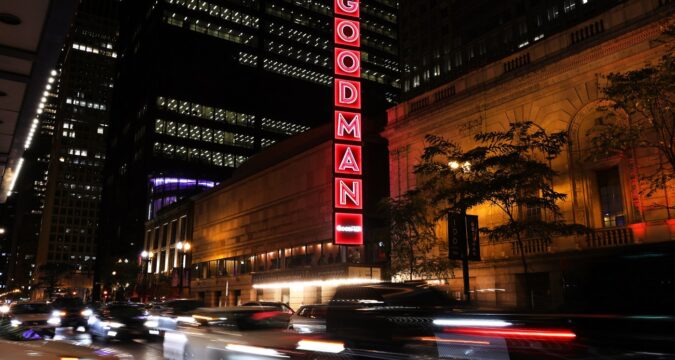
Still, that makes the Goodman older than its peers in Chicago, such as the Steppenwolf or the Northlight Theatre, both creatures of the 1970s. The Goodman Theatre, which moved to its current home at 170 N. Dearborn St. in 2000, now stands alone as it begins its second century as the most important theater in America’s second most important theatrical city. (Or, in its own mind, the first most important.)
Interestingly, the Tribune rarely covered the Goodman in its first decades. There were some two dozen commercial theaters in the Loop in the first half of the 20th century and, in the decades that followed, Claudia Cassidy, the paper’s famous mid-century theater and music critic, spent her time covering those professional entertainments; the student productions at the Goodman were of little interest to her, let alone to her predecessors. But come the 1960s, Chicago was newly busting with homegrown creativity.
The exterior of the Goodman Memorial Theatre in Chicago in an undated photo. (Chicago Tribune historical photo)
The Second City had arrived in 1959, making Chicago the ground zero for a blend of improv and sketch comedy that would change the face of American culture. Indeed, the man who would become one of the Goodman’s most prominent writers, David Mamet, worked at the seminal comedy theater. Director Bob Sickinger had been attracting attention with his amateur, hyper-naturalistic theater at a Hull House Theater on Chicago’s North Side in 1963. (Sickinger’s old theater on North Broadway is now a climbing gym.) A director named George Keathley was staging interesting shows at the Ivanhoe Theatre (now a Binny’s) in Lakeview. Arts benefactor Bruce Sagan was trying to get more theater going on the South Side. Bill Pullinsi and Tony D’Angelo had invented dinner theater at their Candlelight Dinner Playhouse in suburban Summit. And further shoots were sprouting in Old Town and elsewhere.
Finally, after years of hosting tours from Gotham, Chicago was paying attention to developing — to paraphrase the title of a book by the late Tribune critic Richard Christiansen — a theater of its own. And by now the Goodman had itself graduated scores of well-trained theater professionals, many of whom wanted to stay in Chicago and create, well, theater of their own.
John Reich, the architect of the Goodman’s professional identity, had been working at the school since the late 1950s. Like many college professors after him, he craved professional respect and, by 1969 he was running a professional theater alongside the actor Douglas Seale (the students now did their shows in a small theater, on the other side of the lobby). The first production was “Soldiers,” a now obscure World War II drama by Rolf Hochhuth, although one of the leading actors was Douglas Campbell, a noted Shakespearean star.
Reich also knew how to lose money. In just two seasons, he was some $200,000 (a huge sum at the time) into the hole. So he was out, too.
After the brief leadership of Kenneth Myers, the Goodman hired William Woodman as its next artistic director, transferring its first show to Broadway — Brian Friel’s “The Freedom of the City” in 1974. By 1977, the theater had wrangled loose from its Art Institute bosses and stood alone as a nonprofit. Woodman hired Greg Mosher as an assistant artistic director and gave him the reigns to something called Stage 2, which rented space inside what is now the Ruth Page Center at 1016 N. Dearborn St. And in 1978, the Goodman transferred its school to DePaul University, whose Theatre School, formerly the Goodman School of Drama, really has a better claim to a 100 year history than the Goodman itself.
But the 1970s were foundational for the young/old Goodman. In 1975, Mamet brought Mosher a play that would become, inarguably, one of the most important works of the latter half of the 20th century, “American Buffalo,” a Chicago-set play that did more than any other drama to cement the city’s soul into the nation’s. The show was a massive hit and suddenly the old Goodman was hip, able to stand with the city’s growing list of cool, off-Loop theaters like Body Politic, Wisdom Bridge and the exploding Second City. By 1978, Mosher had taken over entirely, even though he was still in his 20s. He programmed a broad variety of shows from Edward Albee to Tennessee Williams and, in 1980, hired a young man named Roche Schulfer to work in the box office.
Wisdom Bridge was the early training ground of one Robert Falls, a great Chicago artist whose aesthetic and ambition would shape the Goodman Theatre for 35 years. After Mosher made his exit in 1985 to become artistic director of New York’s Lincoln Center Theatre, the theater’s young board took a huge risk on Falls, a maverick rock-thrower with a healthy ego and an outsized talent. He was not the kind of low-risk hire most arts consultants would today suggest. But he worked out spectacularly well. Falls took over in 1986 and the Goodman slowly became the leading regional theater in America.
Falls’ achievements were legion: a collaboration with the actor Brian Dennehy that spanned numerous works by Eugene O’Neill, including a phenomenal production of “The Iceman Cometh” also starring Nathan Lane; a relationship with Arthur Miller that spawned a brilliant revival of “Death of a Salesman” and the world premiere of “Finishing the Picture,” Miller’s last play; a commitment to producing the entire canon of August Wilson; and a system of artistic associates that was much copied by other theaters and took the pressure off Falls himself.
Falls struck out for a kind of personal independence at times, but as he aged, he came to see that his legacy would be his work at this theater and that the work was part of a broader evolution in the city’s theaters and was key to the city’s cultural identity.
Falls saw himself as a maximalist auteur and the Goodman, rather than rail against such individualism on the part of its artistic director, heavily promoted a notion that also had the advantage of being mostly true. And unlike many of his short-lived predecessors, Falls had the benefit of Schulfer, a superb fundraiser and the epitome of a steady hand at the wheel, however turbulent the waters.
Under Falls and Schulfer, who had ascended to the role of executive director, the Goodman built a Black audience that was the envy of its peer theaters, a consequence in part of its association with the veteran director Chuck Smith and its relationship with Wilson, who memorably premiered both “Gem of the Ocean” and “Seven Guitars” at the Goodman, simultaneously straining and thrilling audiences with their unedited running times.
Playwright August Wilson at the Goodman Theatre in 2000. (Bill Hogan/Chicago Tribune)
The Goodman also embraced musicals and (unlike Steppenwolf) was willing to work with commercial producers ready to drop enhancement money on its shows. In 2001, New York theater gold in the form of Stephen Sondheim and John Weidman’s “Bounce,” later “Road Show,” arrived at the Goodman, replete with the director Hal Prince and the actors Richard Kind and Howard McGillin. The Goodman had snagged Sondheim’s first new musical since “Passion,” some seven years prior, and he would still be tinkering with the title 14 years after its Goodman bow. The show meant more to Sondheim, it has felt since then, than any other.
New relationships grew with writers championed by Falls, including John Logan, who became one of America’s most successful screenwriters, and Rebecca Gilman, a heartfelt writer of mostly realistic dramas with vulnerable, mostly Midwestern characters. And although she was also an ensemble member at the Lookingglass Theatre, the director-writer Mary Zimmerman staged some of her most successful adaptive work at the Goodman, including “The Notebooks of Leonardo da Vinci,” among the most unlikely hits of the Goodman’s history.
Falls took on William Shakespeare with a memorably nihilistic 2006 production of “King Lear,” starring Stacy Keach, pushing the theater into territory that had hitherto been reserved for Chicago Shakespeare Theater. And, donning his metaphorical hairshirt, he directed several deep dives into the works of Anton Chekhov, following a sojourn in Russia. Over the years, his works attracted actors like William Petersen, Carla Gugino, Calista Flockhart and Elizabeth Franz, as well as such Chicago-based regulars in Steve Pickering and Mary Beth Fisher.
Mary Beth Fisher, left, and her husband, veteran producer Roche Schulfer, are given applause during the ceremonial placement of Schulfer’s star on the “Walkway of Stars” outside the Goodman Theater, where Schulfer is executive director, Sept. 4, 2013. (Chris Walker/Chicago Tribune)
In 2021, Falls told the Tribune he intended to retire after his 35-year run, effective the following August. “It feels right,” he said. And although Schulfer said he planned to stay through the transition, no one doubted he was also on his way out. Falls’ final 2022 production was, aptly enough, “The Cherry Orchard,” with the subtext of his own exit.
The Chicago flag was baked into the set. In a coup de theater, Falls appeared to cast himself not just as Lyubov Ranevskaya, a woman dealing with an agonizing exit, but also as Firs, the old butler who gets left behind under a dust cover. But in this show, Firs suddenly reappeared.
If it had not been clear that Falls was not going to go quietly, it was clear then.
He had run the theater for more than half of its professional existence.
A search for new leadership followed. There were strong applications from at least three of the artistic associates, either as individuals or as a pair. Other, more Falls-like options also were available to the board from young artistic directors making a splash elsewhere but hardly making Goodman-level compensation. But in the end, the theater’s board chose Susan Booth, a woman who had not only effectively raised the profile of the Alliance Theatre in Atlanta but had herself worked at the Goodman as its literary manager under Falls and who was well versed in its role and its history.
Booth is just underway at the helm. Much of her impact will be counted in the next 100 years.
The Goodman Theatre in downtown Chicago is celebrating its 100th anniversary, Oct. 15, 2025. (Chris Sweda/Chicago Tribune)
Where does the Goodman stand? Pretty tall, all things considered, even if it’s hardly immune to the economic and cultural forces that have buffeted the regional theater movement and undermined its traditional reliance on the subscription model, now a victim of variable pricing and the preference for last-minute purchases. It commands respect throughout the theater world for the long-haul quality of its work, even if Steppenwolf is, and always will be, the sexier spot. And the Goodman survived the pandemic far better than most, not least because the board of directors chose not to lay off its full-time employees and thus it was able to return quicker and more nimbly than most of its peers.
The Goodman, for better or worse, remains the establishment, the cornerstone of the Midwestern theater, the general interest theater, the institution. For the radical, it can seem like a parental proxy.
But it has always taken care of the Chicago artist, far more than many people realize. It has had its failings but never landed in real trouble. It has never insulted or attacked its audience, even when peers were coming close. And it has never disavowed its own history, even when some loudly demanded that it do so.
Theaters often falter when they create new buildings for themselves; some have over-reached and created facilities that are costly to run or turn out to be less artistically satisfying than the old places. The Goodman, thanks in no small part to the skills of Maggio, its late associate artistic director, avoided all those traps with its Dearborn Street complex, now a crucial anchor in the North Loop with a mainstage that has similar dimensions to Broadway theaters, making transfers a breeze.
But that has never been the main thing. The Goodman always has known where it lives. Far more than many realize, so goes the Goodman, so goes Chicago.
TIMELINE: “Death of a Salesman,” “Gem of the Ocean”: The big moments and most significant plays.
Chris Jones is a Tribune critic.
cjones5@chicagotribune.com
https://www.chicagotribune.com/2025/10/20/goodman-theatre-100-anniversary/