Sanaz Toossi’s five-character ensemble drama/comedy “English” is about the precision of describing things exactly and using language in its clearest and most efficient manner. Its real power, however, comes from showing us how we also communicate through our emotions.
Its characters can be anxious, annoyed, upset, smug, resentful, suspicious and incensed. We celebrate watching them succeed but the path to those successes, and the choices they make in their personal lives, are much more interesting.
The play, which won the 2023 Pulitzer Prize for Drama, is opening the 2025-26 season at TheaterWorks Hartford, where its run has been extended through Nov. 8. The same production, directed by Arya Shahi, will also be brought back a few months from now by New Haven’s Long Wharf Theatre in the Kendall Drama Lab at Southern Connecticut State University from Jan. 16 through Feb. 1, 2026.
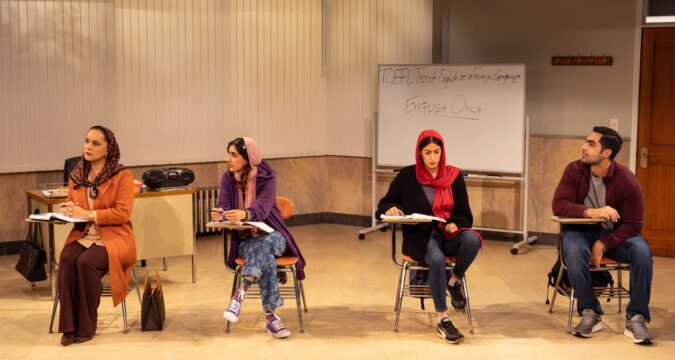
“English” is set in a classroom in the Iranian city of Karaj. Four students, who range from a teenager to a grandmother, are studying to pass their Test of English as a Foreign Language exam. Some need the test to increase their work prospects, and others need it to travel or help settle in a new country. In a nice bit of mirroring, Toossi makes the teacher someone who has returned to Iran after years of living in England. While the students foster dreams of learning a new language and gaining new opportunities, we sense the teacher’s reluctance at having not had her own experiences elsewhere work out.
As with her much more expansive view of Iranian life and culture, “Wish You Were Here,” which the Yale Repertory Theatre produced in 2023, Toossi doesn’t hit you with facts and figures to teach you about Iran. Nothing about her plays feels like a history lesson or a documentary. The culture aspects are embedded in the characters. Reactions to their country, and to other countries, emerge gently and naturally. “English” is to some degree about Iran, but it’s really a play about people who are in Iran and have their own full lives.
Neagheen Homaifar as the teacher Marjan in Sanaz Toossi’s “English” at TheaterWorks Hartford. (Curtis Brown)
Each character has a backstory that gets revealed as “English” winds on. As the characters become more comfortable with speaking English, and more comfortable with each other, they share more of their inner selves. The ability to unburden themselves more openly and bilingually doesn’t necessarily mean that they are enjoying the class. The students snipe at each other and at the teacher. They express frustration with curses and insults.
The most outspoken and impatient student is Elham, a character whose outbursts could easily be overacted but are handled here with admirable restraint and depth by Sahar Milani. Pantea Ommi plays Roya, whose emotional arc shifts more suddenly than the other character with the careful control the role requires. As the sole male student Omid, Afsheen Misaghi carries himself in a way that distinguishes himself from his classmates even further, with a somewhat annoying air of self-confidence and swagger that fits the character neatly. Anahita Monfared is Goli, the youngest, sweetest and cheeriest student who by default provides a lot of comic relief.
As the teacher Marjan, Neagheen Homaifar pushes individuality and compassion and avoids falling into schoolteacher tropes. You see her becoming convincingly closer to her students, befriending them or withstanding their rebukes.
The play is set in 2008. A key cultural reference of the period is Ricky Martin. The pre-show music leans toward mainstream soft pop like John Denver’s “Take Me Home, Country Roads.” As with the other aspects of “English,” Toossi doesn’t overplay a time period or an historical event. She concentrates on the minutiae of daily life and draws you in more deeply that way.
Creative choices bring about one of the most exciting CT fall theater seasons in years
“English” has been done at a number of regional across the country following its Pulitzer win and a noteworthy New York production. This production is more overtly theatrical than it is naturalistic. It starts with one of those bright flashes of light that open so many dramas these days. It uses a theatrical device where, when the characters are speaking Farsi, the actors speak English but in a more fluid manner than they use when struggling with English. It’s a technique that has worked well in theater for decades in plays such as Brian Friel’s “Translations” or Peter Shaffer’s “Royal Hunt of the Sun” or recent Yale Repertory Theatre productions like “Manahatta” or “The Far Country,” where English speakers represent a conquering force. In “English,” some of the student decide that they don’t much care for or understand the English language, and in some cases this extends to a distrust or dislike of English speakers.
Arya Shahi, who was involved with previous productions of “English” in San Diego and New York City, is able to maneuver the theater conventions and also heighten the emotional content. There’s no broad humor or big tableaux that would distract you from the human honesty of the play.
Every scene takes place in the classroom, so both the playwright and director must be creative in how they get the characters up and about and not stuck in their seats the whole time. There are show and tell activities. There are private conversations. There’s a game that involves tossing a ball. There’s a whiteboard the teacher can write on. Some of the students lug backpacks. There’s still a lot of talking, but with welcome variety. Toossi is also very good at showing how the students’ grasp of another language improves over time.
“English” is not one of those plays that seems particularly intimate on the TheaterWorks stage. That’s because it’s so brightly lit and the room is so clearly defined that the set seems separate from the auditorium, like you’re gazing through a window rather than in the room. This observation is not meant as a criticism of Sadra Tehrani’s smart set design, which avoids presenting the classroom straightforwardly as many other designers would, but from a slightly different angle and perspective. Tehrani also pays attention to the room’s deliberately unflashy walls and windows. The blinds are closed on the classroom windows for most of the play, then opened a bit at key moments. It’s a simple and low-key effect that is highly effective.
“English” fits the longtime TheaterWorks Hartford model of a small-cast drama with ample humor that is propelled by the quality of its dialogue but can also be dressed up nicely for the cosy TheaterWorks thrust stage. Last year’s example was “Primary Trust.” TheaterWorks Hartford knows exactly what to do with this kind of material, and it knows its loyal audiences will get something out of it.
“English” spends much of its classroom time showing the distinctions between words like “good,” “well” and “OK.” This is a fine play about language, one that makes you feel OK about your own struggles to fit in and do well, a great display about how many different ways people can communicate, and a very good start to TheaterWorks Hartford’s 2025-26 season.
“English” runs through Nov. 8 at TheaterWorks Hartford, 233 Pearl St., Hartford. Performances are Tuesdays through Fridays at 7:30 p.m., Saturdays at 2:30 and 7:30 p.m. and Sundays at 2:30 p.m., with added daytime shows Oct. 25 at noon and 4 p.m., Oct. 29 at 10:30 a.m. and Oct. 30 at 1 p.m. $33-$78. twhartford.org.