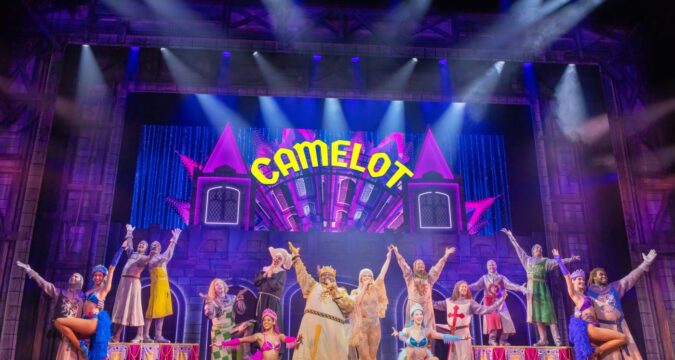
“Spamalot” can be a lot. The first national tour of the recent Broadway revival of the musical based on the classic film “Monty Python and the Holy Grail” is overloaded with projections, animations, elaborate costumes and high kicking dances. Yet there’s plenty of raw human hilarity in between all the extravagant and largely unnecessary technical extras.
The Bushnell is just the second stop on the tour playing in Hartford through Dec. 14. From its casting to its staging, this rendition is purposely distinct from both the 1975 film, written, performed and directed by members of the Monty Python comedy troupe, and the original 2005 Broadway production of the musical directed by the great Mike Nichols.
Josh Rhodes, who directed both the 2023 Broadway revival and this tour, has made some interesting and not unfunny choices that test the comedy material without disappointing Python purists. As with Nichols’ production, a lot of the fun is in seeing how some big moments from the film, like the catapulting of a cow or the dismembering of a Knight in denial about his fatal injuries or a vicious rabbit attack, can be accomplished live on stage. The answer? With extreme silliness, which makes the high resolution projected backdrops and confetti cannons all the more pointless.
As to the age-old question of whether anyone besides the original six members of the Monty Python troupe should be attempting to perform these routines, the debate still rages. Nichols’ production 20 years ago came closer to mimicking the movie. This one has made a point of casting several actors who bear little or no resemblance to the originals, chief among them the star player Major Attaway as King Arthur.
Attaway’s New York roles have included the Genie in Aladdin and Audrey II in “Little Shop of Horrors.” He tones down the brassiness that those parts suggest in his portrayal of Arthur, King of the Britons, but there’s certainly none of the repressed stiff-upper-lip Britishness that either of the actual Brits who played Arthur — Graham Chapman on film and Tim Curry onstage in 2005 — brought to the role. Attaway brings other talents to bear, such as a genuinely stirring singing voice. As a straight man to the loons around him, he doesn’t play the oblivious or self-centered card and goes with good-natured and patient instead. It works.
In any case, this critic is among the first generation of Python fans who, like all 15-year-old boys of the 1970s, memorized every routine and could recite them with friends as if they came out of a comedy textbook. To us, the idea that Python sketches could only be performed by the troupe’s founding members Chapman, John Cleese, Eric Idle, Michael Palin, Terry Jones and Terry Gilliam was a theory worth testing. Idle obviously felt the same way since years before Spamalot, he toured with an evening of Python sketches where he was the only real Python.
The tour of Spamalot is dangerously overdressed at times, but it’s very good at trying to please Python purists and traditional musical theater fans at the same time. Familiar routines like the French guard taunting King Arthur (“I fart in your general direction!”) or the gory song about what grisly fates “Brave Sir Robin” is fleeing from are faithfully rendered.
In one of the musical’s major deviations from the film, the Lady of the Lake responsible for making Arthur king by bestowing the sword Excalibur on him (only to be mocked as “a watery tart” by a politically aware peasant named Dennis) is given a major role in the show. Amanda Robles, who grew up in Orange, brings not just femininity but ethnic diversity to the overwhelmingly white male cast. She also has extraordinary vocal range and the confident style of a Las Vegas performer. These dancers also fill out the crowded plague scenes and expand on a foolish gag about the Lady of the Lake having her own Later Girls cheerleading squad.
CT native takes on the Lady of the Lake role in ‘Spamalot’ revival coming to The Bushnell
Attaway, Robles and an agile dance ensemble are the ones who lift “Spamalot” to a high Broadway musical level above just being a comedy show with songs. Among the Knights who are more about wacky comedy than musical theater, Sean Bell as Sir Robin (and a few smaller roles) is a standout. Bell rethinks lines originally uttered by Idle so that they are naturally funny and not parroting the originals. The same is true of Blake Segal as Arthur’s loyal coconut-clapping servant Patsy. Segal, a Yale School of Drama graduate, is particularly good at creating full-bodied reactions to Arthur’s dismissive attitude toward him. There’s a whole song, “I’m All Alone,” in which Patsy makes his resentment felt, and Segal plays it skillfully.
Nuance and emotional depth may not be what you think when you think of “Spamalot.” When “Monty Python and the Holy Grail” was released 50 years ago, it was truly outrageous, with some jokes largely based on the actors ‘ability to swear, discuss bodily functions or spurt blood. Set in the Middle Age, the plot makes fun of the plague, religion, royalty, France, Finland, rabbits and shrubbery. Yet this raucous irreverence now seems rather tame, not because the movie is 50 years old or because the musical is 20 years old but because “Book of Mormon” came along in the time between Spamalot’s two Broadway productions and stole its thunder.
What “Spamalot” succeeds most at in this revival is in parodying traditional Broadway musicals. There are tap dances and kick lines and romantic duets that serve the plot and structure but also openly mock those purposes. One of the show’s most popular songs, “The Song That Goes Like This,” is a deconstruction of an incessant type of showtune. There’s also a long song about how “You Won’t Succeed on Broadway” if your musical doesn’t have enough Jews in it. There’s a self-awareness to the whole show that adds a fresh, live theater layer to the frivolity. It also fleshes out characters in a way that only musical theater can do.
The backdrop projections (a deep forest, a thunderstorm, etc.) remain a distraction, as pristine and soulless as the technological backdrops in another musical musical adaptation of a comedy film, “Mean Girls.” There are similarly over the top animations (God, a plummeting Trojan Rabbit) which evoke the style but not the refined comic artistry of the Pythons’ resident cartoonist Terry Gilliam. But there are some worthwhile small attempts to make some of the comedy current. An otherwise outdated gay coming-out number is mired in ’70s disco and Village People tropes until it adds a brief and much welcome tip of the hat to “RuPaul’s Drag Race.” In another scene there’s a George Santos joke. Robles impersonates a number of contemporary pop stars.
What should be clear from this rundown is that “Spamalot” will try anything to make you laugh. There are big physical gags, subtle political observations, jokes about spurting blood and widespread disease, puns, funny names, silly noises, pratfalls and so much more. Some of it comes directly from Monty Python. Some of it comes from musical theater forms and traditions. Some of it comes from an engaging group of actors who are eager to please. It lacks a certain coarseness that marked the movie, but you will likely still laugh loudly, and it doesn’t take a decree from a king or an enchanted prophesy from a lake to make that happen.
“Monty Python’s Spamalot” runs through Dec. 14 at The Bushnell, 166 Capitol Ave., Hartford. Remaining performances are Thursday and Friday at 7:30 p.m., Saturday at 2 and 7:30 p.m. and Sunday at 1 and 6:30 p.m. $36-$162.50. bushnell.org.