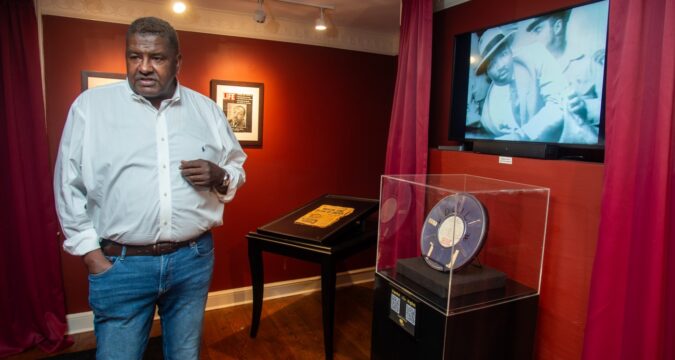
At this Connecticut museum, when the executive director says no question is stupid, he really means it.
You can ask questions about African-American history, the enslavement of people and the truth of the Black experience in the United States, and museum staff or leaders will answer with knowledge, sharing information with honesty and showing of real artifacts and art.
At The Ruby & Calvin Fletcher African American History Museum in Stratford, education about the history of slavery in America continues amid the focus President Donald Trump has placed on review of the exhibits at the Smithsonian’s National Museum of African American History and Culture, said Jeffrey A. Fletcher, president, of African-American Collections, Inc.
Trump said recently, on Truth Social, that the Smithsonian is “where everything discussed is how horrible our Country is, how bad Slavery was, and how unaccomplished the downtrodden have been — Nothing about Success, nothing about Brightness, nothing about the Future…”
Public access to items showing artifacts of African American history at federal sites may be restricted or prohibited under Trump administration rules seeking to bar what the president calls “divisive” ideology that acknowledges the outsized role racism has played in American history and culture, the Associated Press has reported.
The Smithsonian says it has “two sources of funding — federal appropriations and income generated from gifts, revenue-generating activities, and investments.”
But while the Smithsonian could be a target of budget cutting, the museum in Stratford does not receive any federal money, according to Fletcher.
“It gives me more strength to do what I am doing,” said Fletcher, of the targeting of education about certain aspects of American history on the national level. “It empowers me.”
Fletcher named the museum, which opened in 2021, in honor of his parents. Fletcher grew up in Colchester. His late mother was a collector of items related to slavery, the Black experience in America and the Jim Crow era, and many of her items are on display.
The museum is housed in a historic home that the museum leases from the town of Stratford, and draws students, tour groups and many others interested in learning about this part of the nation’s history, Fletcher said.
Since 2024, the museum has received $2 million from the state Department of Community and Economic Development and $1.2 million from the town of Stratford to expand into a bigger museum in town, which is expected to go out to bid soon, Fletcher said. The building targeted for the museum is on Main Street and is larger. The hope is to be in it around March of next year, he said.
Fletcher said the support the museum has received in Stratford has been bi-partisan and he speaks highly of it, including that of Mayor Laura Hoydick.
Stratford also has several other museums looking at history, such as those operated the Stratford Historical Society and the Stratford Veterans Museum.
“Denigrating diversity and pulling federal funding for cultural institutions that uplift marginalized voices in American history is the epitome of stupid,” said U.S. Sen. Richard Blumenthal.
“As the Trump Administration attempts to rewrite and whitewash history, I am proud to see (the Ruby and Calvin Fletcher Museum) expand their African American Museum. I will keep fighting for strong support for Connecticut’s museums and cultural treasures.”
The letter to the Smithsonian posted by the White House notes: “This initiative aims to ensure alignment with the President’s directive to celebrate American exceptionalism, remove divisive or partisan narratives and restore confidence in our shared cultural institutions.”
A walk through history
In the museum, nestled into a quiet Stratford neighborhood not far from its main road through town, visitors begin in a room that helps to explain how Africans were enslaved and sent to the Americas beginning in 1619.
“Keep in mind that this history to many has been swept under the rug,” Fletcher said.
Next comes a room, during which visitors get a look at, and hear what it was like, for Africans during what is known as “Middle Passage,” when millions of people were enslaved and crossed the Atlantic in chains on crowded, filthy and disease ridden ships.
Jeffrey Fletcher, executive director of the Ruth and Calvin Fletcher African American History Museum, discusses the traveling conditions featured in the Trans-Atlantic Slave Trade exhibit at the museum in Stratford, on Tuesday, Aug. 26, 2025. (Aaron Flaum/Hartford Courant)
“This where they slept, this is where they ate, this is where they gave birth, this is where they died,” Fletcher said, speaking of the museum exhibit that shows people shackled into bunks, where they would have stayed for months as ships crossed the Atlantic.
The U.S. Department of the Interior National Park Service estimates that, from the 1500s to the 1800s, approximately 12 million Africans were trafficked across the Atlantic as human property.
“Slave ships were a stew of human misery and terror,” according to the Slavery and Remembrance site.
A 2022 report by The Equal Justice Initiative also confirmed that at least 12.5 million African people were trafficked to the Americas during the Transatlantic Slave Trade, with a profound economic impact on a number of states, including Connecticut. The initiative said that the report is intended to show the relationship between Connecticut and other states and the Transatlantic Slave Trade.
The next room in the Stratford museum contains real shackles, whips, chains, a ball and chain and spiked instruments of torture used to punish people who were deemed to be threats or did not follow orders, Fletcher said. Some items are hundreds of years old.
“This is tough history,” he said.
Another room contains a collection of artifacts from an era when everything from advertisements to games and from food to bric-a-bac belittled and demeaned Black Americans with stereotypes and “micro-aggressions”; yet another displayed a Ku Klux Klan robe and hood and actual doors from businesses with signs depicting who could use a restroom, including “colored men only.”
“You can’t talk about American history without involving the Klan,” Fletcher said.
Other rooms contain items more likely to inspire, including one devoted the the work and life of Dr. Martin Luther King Jr., and yet another that depicts a room intended to be that of a Black family in the 1950 and 1960s, with the magazines Jet and Ebony on a coffee table.
Jeffrey Fletcher, executive director of the Ruth and Calvin Fletcher African American History Museum, shows a cast-iron bust of the Rev. Martin Luther King Jr., on loan from the Hood Museum of Art at Dartmouth College, at the museum in Stratford, on Tuesday, Aug. 26, 2025. (Aaron Flaum/Hartford Courant)
Other areas show the broad achievements of Black Americans in many aspects of modern life, including in the military and judiciary, and “the trailblazers.” as Fletcher notes. This includes the evolution of music and the impact of Black artists, shown through a display of record albums collected by Ruby Fletcher and the guitars of Calvin Fletcher.
Jet and Ebony publications are displayed at the Ruth and Calvin Fletcher African American History Museum in Stratford, on Tuesday, Aug. 26, 2025. (Aaron Flaum/Hartford Courant)
Fletcher said he wants African-Americans “to be proud of who they are.”
Supreme Court Justice Lubbie Harper, who has mentored generations of young people of all races and is named in the museum as a trailblazer, noted that it was created with support from both Republicans and Democrats who saw its value.
“I think what Jeffrey Fletcher is doing should be a national model for what can be accomplished to understand and appreciate the value of everybody’s history and culture,” Harper said.
He said it is in contrast to what is occurring on the national level as it shows the importance of state and local funding and shares education and “the value of the African-American story in this country,” meaning also “the struggle, the sacrifice and the triumph.”
“There is no downside to knowledge,” he said. “The issue is what do you do with it, how do you use it … to uplift and show the beauty. In Connecticut, we understand the value of humanity.”
“Politics is not going to stop us,” Fletcher said.
“We are a country of immigrants,” Harper added. “This museum is our vehicle in which the true story of American history is told.”