Here’s a look back at what happened in the Chicago area on Sept. 17, according to the Tribune’s archives.
Is an important event missing from this date? Email us.
Weather records (from the National Weather Service, Chicago)
High temperature: 93 degrees (1955)
Low temperature: 37 degrees (1984)
Precipitation: 2.42 inches (1927)
Snowfall: None
George Halas, center in front row, and the 1920 Decatur Staleys. They moved to Chicago and became the Bears. (Chicago Tribune archive)
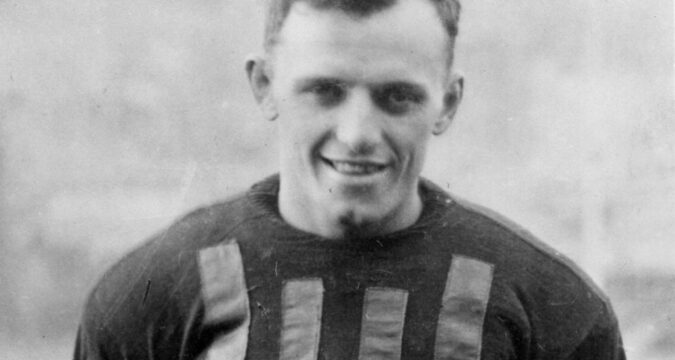
1920: George Halas of the Decatur Staleys (precursor to the Chicago Bears) and representatives from nine other teams met in the showroom of Hay’s Hupmobile Agency in Canton, Ohio, and formed what would become the National Football League.
Chicago Cubs manager Phil Cavarretta, center, familiarizes recruits with Wrigley Field, including outfielder Bob Talbot, from left, shortstops Gene Baker, Ernie Banks and pitcher Bill Moisan on Sept. 14, 1953. Talbot, Baker and Moisan played for the Los Angeles Angels of the Pacific Coast league and Banks was a member of the Kansas City Monarchs of the Negro American league. (Chicago Tribune historical photo)
1953: Shortstop Ernie Banks made his debut with the Chicago Cubs and broke the team’s color barrier. But Banks’ first game with the franchise was “unimpressive,” the Tribune reporter Edward Prell wrote. Banks made an error and failed to get a hit in three at bats.
“Mr. Cub,” however, became the first to have his jersey retired by the Cubs. Banks is the all-time franchise leader in games played (2,528), at-bats (9,421) and total bases (4,706). He won two MVP awards, made 14 All-Star teams and blasted 512 home runs.
A crowd attends the groundbreaking ceremony for McCormick Place on Sept. 17, 1958, at 23rd Street and Lake Michigan in Chicago. (George Quinn/Chicago Tribune)
1958: Rain pelted Illinois Gov. William Stratton and Chicago Mayor Richard J. Daley when they broke ground on the $34 million, more than 300,000-square-foot McCormick Place — which also included a 5,000-seat theater — at 23rd Street and the lakefront.
Vintage Chicago Tribune: How McCormick Place’s Lakeside Center came to be on the lakefront
Due to the conditions, Stratton said he would make a short speech and he did. He celebrated the “fruition of faith and determination” to put the facility “on this magnificent site.”
Witnesses described explosions, screams, high flames and then billowing clouds of jet fuel after a Northwest Orient Airlines Electra crashed about one minute after takeoff from O’Hare International Airport on Sept. 17, 1961. (Chicago Tribune)
1961: An improperly installed device to boost power to the wing ailerons, which control flight, caused a Northwest Airlines Electra to crash on takeoff from Chicago’s O’Hare International Airport.
Vintage Chicago Tribune: Plane crashes that stunned our city
“Turning in … no control,” were the last distinguishable words from the cockpit, the Tribune reported.
All 37 people aboard died.
Mayoral candidate Harold Washington speaks at a memorial service for Rev. Martin Luther King Jr. at Operation PUSH Headquarters on April 4, 1977, in Chicago. Washington was the first successful sponsor of a bill to create a legal holiday for MLK in Illinois. (Walter Kale/Chicago Tribune)
1973: Illinois became the first state to designate the birthday of the Rev. Martin Luther King Jr. (Jan. 15) as a holiday. Illinois Gov. Dan Walker signed the measure. The bill was sponsored by then-Rep. Harold Washington, who was elected Chicago mayor 10 years later.
Thousands of White Sox fans celebrate on the field at Comiskey Park after the White Sox clinched the American League West on Sept. 17, 1983, after a 4-3 win against the Seattle Mariners. (Charles Cherney/Chicago Tribune)
1983: The Chicago White Sox clinched the American League Western Division with a 4-3 victory over the Seattle Mariners before 45,646 fans at Comiskey Park. Harold Baines’ sacrifice fly drove in Julio Cruz with the winning run in the ninth inning.
Vintage Chicago Tribune: The White Sox’s wild ride into the team’s 125th season
The win put the Sox into postseason play for the first time since 1959, when they lost four games to two to the Los Angeles Dodgers in the World Series.
The Sox lost to the Baltimore Orioles in the first-round of playoffs when their bats suddenly turned cold, baserunning gaffes prevailed, designated hitter Greg Luzinski and rookie Ron Kittle were injured by pitches, and the team dropped three straight after winning the opener in the best-of-five series.
Oprah’s Book Club logo is on the cover of a book at a Borders Book store in Norridge. (Tim Boyle/Getty)
1996: Oprah’s Book Club launched.
“When I was growing up, books were my friends,” Winfrey told her audience. “One of the greatest pleasures I have right now in life is to be reading a really good book and to know I have a really, really good book after that.”
Her first selection was “The Deep End of the Ocean” by Jacquelyn Mitchard, a first-time novelist and columnist for the Milwaukee Journal Sentinel.
Mitchard’s gripping novel centered on the baffling disappearance of a 3-year-old from a crowded hotel lobby during his mother’s high school reunion. The idea for the book came to Mitchard in a dream.
Vintage Chicago Tribune: Oprah Winfrey — 10 moments from her Chicago years
“The real story is not the disappearance but how the family — parents, grandparents, siblings — can learn to live a full life around a wound,” she told the Tribune.
The book sold 100,000 copies before Winfrey recommended it, but leapt to the top of The New York Times’ hardcover list in Chicago and nationwide soon afterward. Some criticized Winfrey’s book choices, but others praised her for encouraging Americans to read more often.
“People with a wide public influence, like Oprah, giving opinions on books is a promising development for educators, even if we may want to quarrel with her opinion,” Gerald Graff, director of the master of arts program in humanities at the University of Chicago, told the Tribune in 1997. “We shouldn’t gripe about the Oprah phenomenon. We should take advantage of it.”
A Metra train derailment on Sept. 17, 2005, killed two people at almost the same spot where a speeding commuter train leapt from the tracks two years earlier. (Chicago Tribune)
2005: Two riders were killed and 117 were seriously injured when a Metra train, traveling the Rock Island District Line from Joliet to the LaSalle Station, left the rails as it crossed a set of switches near 48th Street and the Dan Ryan Expressway.
A Metra engineer’s failure to heed a crucial signal and the commuter rail agency’s lack of a system to override human error were cited as key reasons for the derailment, according to the National Transportation Safety Board report on the crash.
The train was going 69 mph when the locomotive and five cars left the tracks.
The Illinois Veterans Home on Feb. 16, 2022, in Quincy, Illinois. (Brian Cassella/Chicago Tribune)
2015: After the first case of Legionnaires’ disease was identified in late July 2015, at the Illinois Veterans Home in Quincy, the waterborne illness killed the facility’s 12th resident. Another 40 were sickened in the outbreak of the disease, which was likely spread by an aging water system at the 129-year-old facility.
In 2016, two volunteers and three residents had symptoms of the disease. In 2017, five residents were sickened by the disease and one died.
The federal government gave the state $4.1 million in 2018 to renovate the home’s water system.
Want more vintage Chicago?
Subscribe to the free Vintage Chicago Tribune newsletter, join our Chicagoland history Facebook group, stay current with Today in Chicago History and follow us on Instagram for more from Chicago’s past.
Have an idea for Vintage Chicago Tribune? Share it with Kori Rumore and Marianne Mather at krumore@chicagotribune.com and mmather@chicagotribune.com
https://www.chicagotribune.com/2025/09/17/chicago-history-september-17/