Here’s a look back at what happened in the Chicago area on Sept. 15, according to the Tribune’s archives.
Is an important event missing from this date? Email us.
Weather records (from the National Weather Service, Chicago)
High temperature: 99 degrees (1939)
Low temperature: 39 degrees (2007)
Precipitation: 1.38 inches (1936)
Snowfall: None
The U.S. Army World Fliers during their circumnavigation of the globe in 1924. (Chicago Tribune historical photo)
1924: The Douglas World Cruiser “Chicago” landed in Chicago as part of the group’s circumnavigation of the globe by air. The flyers were feted at The Drake amid pleas for the plane to “rest permanently in the Field Museum here.”
In 1924, Chicago was a victory leg stop for the first aviators to circle the globe
Instead, it became the first aircraft installed in the National Air and Space Museum, which was dedicated on July 1, 1976. It remains on display there today.
A view from One East Wacker Drive on Sept. 26, 1961, shows progress in the construction of Marina City. The core for the east tower had risen 46 stories, with 14 more to go, and the west tower core was beginning to rise. (Luigi Mendicino/Chicago Tribune)
1961: Three carpenters plunged 43 floors to their deaths when the elevator they were riding inside at the core of the east tower of Marina City — which was then under construction — fell.
Pelé, soccer idol of Brazil, heads the ball on Sept. 15, 1970, at Soldier Field in Chicago. (Ray Gora/Chicago Tribune)
1970: Though almost 30 years old, Pelé — then the world’s greatest soccer player — provided a thrilling climax in the last two minutes of a match between his Brazilian club Santos and a group of North American League All-Stars before more than 13,000 fans at Soldier Field.
“Picking up the ball midfield, Pelé maneuvered past several defenders and was off toward the goal, with (John) Cocking in pursuit,” the Tribune reported. “Forced toward the right touch line, Pelé took a hard grass-cutting shot from a difficult angle. Goalie (Vic) Rouse was unable to hold and it was deflected out of the goal line, only to have (Mandel) Maria tap the loose ball in for the winning goal.”
Before the match, the three-time World Cup champion, born Edson Arantes do Nascimento, was playing canasta in his Chicago hotel room due to rain — and enjoying a little bit of obscurity.
“Before I come over here I prepare myself to know the people will not recognize me the way they do in other places,” he told the Tribune through an interpreter. “It does not bother me. I know that if an American baseball player were to come to Brazil he would not be recognized there, either. Yes, it is good to be free.”
Pelé returned to Chicago on Aug. 4, 1971 — where he enjoyed playing on AstroTurf for only the second time in his career; June 23, 1976, before 28,000 fans in a 4-1 loss to the Chicago Sting; and May 11, 1977, where a snafu between Sting goalie Mervyn Cawston and teammate Clive Griffiths led to an own goal. Pelé failed to score in these Chicago matches.
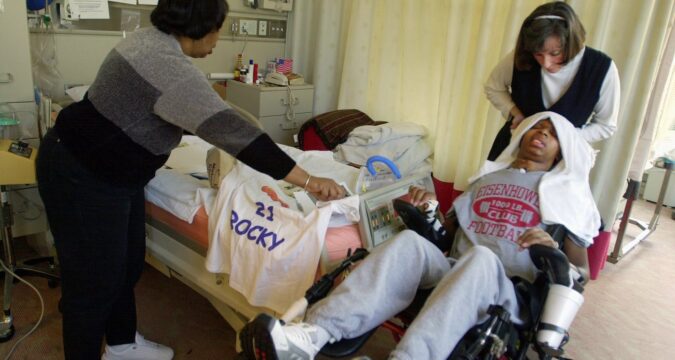
Rasul “Rocky” Clark in his home in Robbins on Jan. 27, 2010. Clark was paralyzed from a high school football injury. His mother, Annette, provided for the majority of his needs and was forced to make supplies, like gloves and gauze, last beyond their recommended use. (David Pierini/Chicago Tribune)
2000: Sixteen-year-old Eisenhower High School football player Rasul “Rocky” Clark was paralyzed from the neck down after he suffered two broken vertebrae in his neck and a spinal injury when he was tackled during a game at Oak Forest High School.
Clark used his injury to call attention to football safety. He helped found the Gridiron Alliance, which supported athletes in a similar position. He also lectured at local high schools and volunteered at his former alma mater in Blue Island as an assistant.
But Clark waged the battle of his life when in August 2010 he lost the private health insurance that paid for his meticulous care. After 10 years of having access to the best medical resources, the policy ended. He used his experience to advocate for unlimited health insurance coverage for athletes.
Clark died in 2012 after suffering from lung and kidney complications and undergoing surgery. A portion of the street where he grew up has been named in his honor.
One year after his death, Illinois lawmakers passed “Rocky’s Law,” requiring high school districts throughout the state to provide catastrophic injury insurance to cover up to $3 million worth of medical costs over a five-year period if a student is injured while involved in school sports.
Want more vintage Chicago?
Subscribe to the free Vintage Chicago Tribune newsletter, join our Chicagoland history Facebook group, stay current with Today in Chicago History and follow us on Instagram for more from Chicago’s past.
Have an idea for Vintage Chicago Tribune? Share it with Kori Rumore and Marianne Mather at krumore@chicagotribune.com and mmather@chicagotribune.com
https://www.chicagotribune.com/2025/09/15/chicago-history-september-15/