Here’s a look back at what happened in the Chicago area on Sept. 1, according to the Tribune’s archives.
Is an important event missing from this date? Email us.
Weather records (from the National Weather Service, Chicago)
High temperature: 101 degrees (1953)
Low temperature: 45 degrees (1949)
Precipitation: 2.92 inches (1977)
Snowfall: None
1880: Rome designated the Diocese of Chicago an archdiocese, raising it to preeminence among all dioceses in the region and established Bishop Patrick Feehan as the city’s first archbishop.
In a phenomenon known as “Chicagohenge,” the sun sets over West Madison Street on the final day of winter on March 19, 2021, in Chicago. Twice a year, during the spring and fall equinoxes, the rising and setting sun lines up with Chicago’s east-west street grid as the sun is framed within Chicago’s skyline. (John J. Kim/Chicago Tribune)
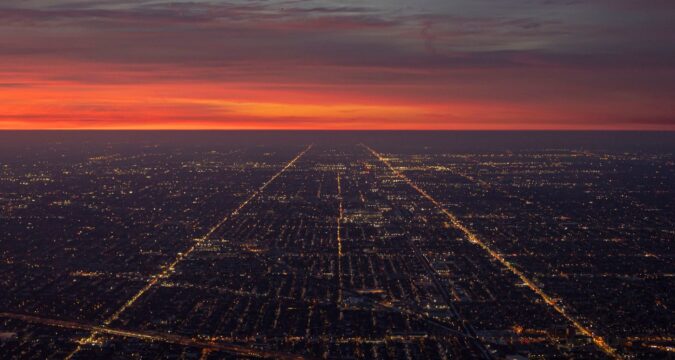
1909: State and Madison streets became the baseline — or ground zero — of a new citywide grid system that changed virtually all addresses and also formed the basis for the street systems of many suburbs.
Passion for Chicago’s honorary street names leads to a guide book
Numbers rose in logical fashion, 100 block, 200 block, etc., about eight blocks to a mile. Anything west of State was “West;” east was “East;” North of Madison was “North” and south was “South.” The east and south sides of streets got odd numbers; north and west sides of streets got even numbers.
The idea, suggested by Edward Brennan in 1901, means anyone armed with the numbers and N, S, E, W directional signals, can navigate anywhere in the city.
The Chicago Bears practice at the University of Notre Dame during their first-ever training camp away from the city, circa September 1933. The front row, from left, are Charley Malone, George Musso, Joe Kopcha, Ookie Miller, Zuck Carlson, Link Lyman and Bill Hewitt. In the back are Johnny Sisk, from left, Bronko Nagurski, George Corbett and Carl Brumbaugh. (Chicago Tribune archive)
1933: The Chicago Bears headed out of town for training camp for the first time — with “Red Grange conspicuously absent,” the Tribune reported. The University of Notre Dame hosted the team.
A policeman with a megaphone stands near the landing gear of the crashed Trans World Airlines plane in a cornfield just before dawn as a victim lies covered in a sheet in the foreground on Sept. 1, 1961. (Chicago Tribune historical photo)
1961: A loose bolt caused one-third of the tail section of a TWA Constellation plane to fall away minutes after takeoff from Chicago’s Midway International Airport and crash into a farm field near southwest suburban Clarendon Hills. All 78 people aboard died.
1984: Smoke detectors became required in all multi-unit dwellings in Chicago. The new ordinance — approved unanimously in April 1984, by the City Council — imposed a fine up to $1,000 an six months in jail for violators. The deadline to install the devices in single-family homes was Dec. 1, 1984. Though the ordinance was the subject of heavy lobbying efforts by the smoke detector industry, Chicago Fire Commissioner Louis Galante said more than 90% of the city’s fire deaths in 1983 were in dwellings without them.
The Tully monster’s discoverer, Francis Tully, at a Field Museum Members’ Night in 1987. (Ron Testa/The Field Museum)
1989: After an almost two-year delay, Gov. Jim Thompson finally signed legislation making the Tully monster the official state fossil in Illinois.
Astronauts Mae Jemison, left, and Jan Davis, in background, work in the Spacelab aboard the space shuttle Endeavour on Sept. 13, 1992. Jemison is the first Black woman in space. (Donna Carson/AP)
1992: Chicago-raised astronaut Mae Jemison became the first Black woman in space. She was aboard Endeavour as part of the STS-47 Spacelab J mission.
Melodie Gliniewicz exits the Lake County Courthouse in Waukegan with her legal team following a hearing on Feb. 3, 2016. Gliniewicz was indicted on charges of money laundering and misuse of charitable funds. Gliniewicz is the widow of Fox Lake Lt. Charles Joseph Gliniewicz who staged his suicide to look like a homicide in September 2015. (José M. Osorio/Chicago Tribune)
2015: Fox Lake police Lt. Charles Joseph Gliniewicz was believed to have been shot dead by a few suspicious people in the morning in a remote, marshy area of the village.
Known as “G.I. Joe” in the community, he was well liked for his work mentoring kids, including running the Police Department’s Explorer Post for young adults interested in a career in law enforcement.
Investigators said Gliniewicz, who had a troubled history in the department and had allegedly been stealing from the youth policing group he ran, tried to make his death appear to be a murder amid fears the thefts would come to light
Melodie Gliniewicz, his wife, pleaded guilty in February 2022, to a charge connected to her husband’s financial crimes. She was sentenced to probation.
Chicago Bears pass rusher Khalil Mack holds up a jersey during a news conference on Sept. 2, 2018, at Halas Hall in Lake Forest. The Bears acquired Mack in a trade for several draft picks, including two first-rounders, and signed him to a six-year, $141 million extension with $90 million guaranteed. (Erin Hooley/Chicago Tribune)
2018: The Bears traded for Khalil Mack, the Raiders’ 27-year-old, two-time All-Pro edge rusher. Ryan Poles’ first major move as Bears general manager signified his willingness to tear down the Bears roster in a rebuild.
The Bears sent 2019 first- and sixth-round picks and 2020 first- and third-round picks to the Oakland Raiders to acquire Mack. The team, who also got a second-round pick and a conditional pick that became a seventh rounder in the deal, then signed Mack to a six-year, $141 million extension through 2024, with $90 million guaranteed.
In March 2022, the Bears traded the six-time Pro Bowl edge rusher to the Los Angeles Chargers for a second-round draft pick in 2022 and a sixth-round pick in 2023.
Mack left Chicago having totaled 36 sacks, 35 tackles for a loss, 52 quarterback hits, 14 forced fumbles and two interceptions in 53 games over four seasons.
Want more vintage Chicago?
Subscribe to the free Vintage Chicago Tribune newsletter, join our Chicagoland history Facebook group, stay current with Today in Chicago History and follow us on Instagram for more from Chicago’s past.
Have an idea for Vintage Chicago Tribune? Share it with Kori Rumore and Marianne Mather at krumore@chicagotribune.com and mmather@chicagotribune.com
https://www.chicagotribune.com/2025/09/01/chicago-history-september-1/