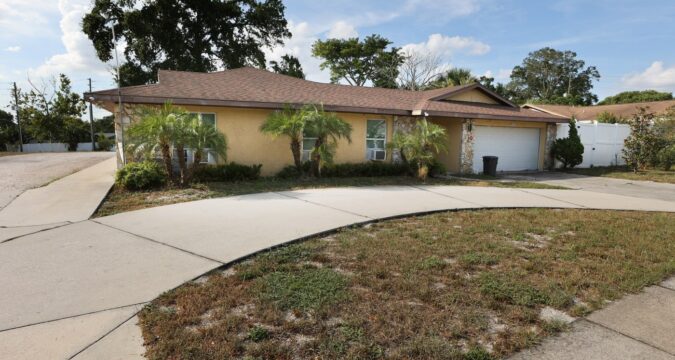
The U.S. Department of Justice informed Orange County leaders this week its civil rights division will review a county commission decision to prevent the Orlando Torah Center from building a three-story worship center in a residential neighborhood.
The federal inquiry follows a second-guessing of the board’s July 1 decision by Florida Attorney General James Uthmeier, who warned commissioners in a letter last month against allowing religious “animus” or discriminatory bias to factor into land-use decisions.
The two-page notice of inquiry, dated Sept. 9, was signed by Harmeet K. Dhillon, who heads the DOJ’s civil rights division, and Gregory W. Kehoe, U.S. Attorney for the Middle District of Florida. It invokes the Religious Land Use and Institutionalized Persons Act of 2000, which bars land use rules that “substantially burden religious exercise absent a compelling governmental interest.”
The letter said the investigation will focus on Orange County’s zoning laws and practices regarding religious land uses, including the denial of the Orlando Torah Center‘s application for a special use permit in Sand Lake Hills, a neighborhood near the Bay Hill Club & Lodge.
“Our investigation is preliminary in nature,” it read, noting no determination had been made about whether a law was violated.
The letter does not say what sparked the investigation.
A spokesperson for the justice department told the Orlando Sentinel, “No comment. Thank you.”
Orlando Torah Center’s appeal for bigger synagogue fails
Orange County Attorney Jeffrey Newton replied to the Justice Department, acknowledging the letter of inquiry and noting the Orlando Torah Center has a lawsuit pending in federal court to overturn the zoning denial.
Newton said the county was aware of its obligations under federal law and asserted the zoning decision was based on fair and neutral criteria. “It was in no way,” he said, “based on religious animus, discriminatory bias against religious institutions or this specific applicant or on antisemitism.”
The Orlando Torah Center alleged in its federal court complaint that commissioners were likely influenced by antisemitic bias expressed by neighbors toward the growing congregation of Orthodox Jews who worship in a single-story, three-bedroom home on Banyan Boulevard.
The 83-page federal complaint alleged both zoning board and commission proceedings “were characterized by false statements from the public demonstrating animus toward Orthodox Jews, and the county decisionmakers were responsive to those statements.”
Lawyers for the Torah Center contend the neighborhood synagogue is critical to its congregants’ observance of Orthodox Jewish tenets, which prohibit driving on the Sabbath and Jewish holidays. Many members reside in Sand Lake Hills or within walking distance of the synagogue.
Neighbors objected to the proposed expansion, saying they considered it to be oversized for its three-quarter of an acre lot.
Some put up signs reading: “Stop the Skyscraper.”
Most of the 845 homes in the Sand Lake Hills neighborhood are single-story structures with a few split-level exceptions.
But lawyers for the Torah Center contend the plan to add 9,300 square feet would still be “similar and compatible” with other structures in the vicinity, including the Learning Center of Dr. Phillips, which is located on a larger parcel at the opposite end of Banyan Boulevard.
They also noted the neighborhood is located near a stretch of Apopka Vineland Road known as “church row,” where a variety of Christian faiths have built houses of worship. But all occupy larger parcels and four sit on nine or more acres, including the 25-acre site of Holy Family Catholic Church, about a mile and a half away.
shudak@orlandosentinel.com