For nearly two years, Voice of America, a federal news agency dedicated to projecting U.S. values around the world, provided intensive Persian-language coverage of Israel’s war with Hamas. The service regularly reached viewers inside Iran, Hamas’ state sponsor, with the kind of reporting and expert analysis that Tehran typically suppresses.
But Iranians who tuned to VOA in June to learn about Israel’s attack on their country got something different: a two-hour live broadcast of the U.S. military procession in Washington that the Trump administration held to celebrate the 250th anniversary of the Army.
“U.S. President Donald Trump has invited Americans to participate in this once-in-a-lifetime celebration that is free to the public,” an anchor declared in Persian.
It was a striking moment for the storied news agency, which was founded in 1942 to fight Nazi propaganda and has won dozens of journalism awards for reporting around the world — but has been targeted for destruction by President Donald Trump.
Trump, who has called VOA “a total left-wing disaster,” signed an executive order in March effectively dismantling its parent organization, the U.S. Agency for Global Media, putting nearly all of VOA’s 1,400 journalists and support staff members on paid leave. Now, amid the government shutdown, all VOA programming is off the air.
But while the Trump administration has largely succeeded in its efforts to permanently shrink parts of the federal bureaucracy it doesn’t like, the battle over VOA and other federally funded global news outlets is far from over.
Courts have ordered the administration to resume news broadcasting at VOA and disburse federal dollars to Radio Free Europe/Radio Liberty, Radio Free Asia and the Middle East Broadcasting Networks, private nonprofit news groups that are fully dependent on government funding and share VOA’s mission of using journalism to advance U.S. interests abroad.
And some Republican lawmakers, reflecting a rare bit of bipartisan resistance to the Trump administration, have warned that ceasing their news broadcasting is ceding ground to Russian and Chinese propaganda networks that have moved aggressively to fill the vacuum.
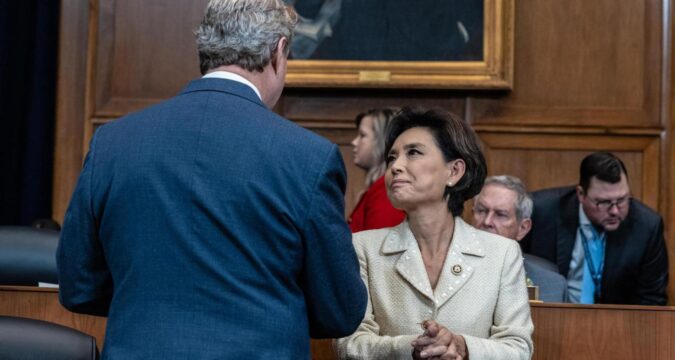
“Without a robust replacement,” eliminating federally funded news groups is “reckless and shortsighted,” Rep. Young Kim, R-Calif., said during a House committee meeting in September. “They provide credible local language reporting that builds trust with audiences.”
VOA previously ran broadcasts in 49 languages for 360 million people across the globe every week, while the three other news groups collectively reached around 150 million people weekly.
Until the government shut down this month, VOA maintained only four language services that each broadcast around an hour per day to signal the administration’s compliance with judicial orders. While appeals courts have generally upheld the orders to keep VOA alive, litigation has also stalled, in part because government lawyers have not filed any briefs since the shutdown began.
The impasse has tapped into a broader debate over the role of government-funded newsrooms: Should they promote American values through independent journalism or should they be tools to promote administration policy?
Kari Lake at the Helm
VOA and Radio Free Europe/Radio Liberty, born after the Soviet takeover of Eastern Europe, were widely credited with helping the United States win global support during the Cold War. But the Trump administration has attacked independent journalism at home and has signaled that if VOA survives, it could adopt a more MAGA-friendly approach.
Kari Lake, the former Arizona television anchor and two-time statewide political candidate appointed by Trump to oversee the government newsrooms, said in sworn court testimony that the administration had reached an agreement with One America News Network, a right-wing news channel, to share content and was “engaged in ongoing discussions” with Newsmax, another conservative network, for a similar arrangement.
A Newsmax spokesperson, Bill Daddi, disputed Lake’s testimony, saying the network was “flattered” that she would consider using its content but that “there has been no conversation or discussion” about it. A representative for OAN did not respond to a request for comment.
Testifying before the House in June, Lake called VOA “a rotten piece of fish.”
“What is going out on VOA airwaves — it’s outrageous, and it has to stop,” said Lake, who would not agree to be interviewed for this story and did not respond to specific emailed questions.
Abigail Jackson, a White House spokesperson, said in a statement that VOA spreads “left-wing propaganda” and that Americans are “better off not being forced to waste money on that garbage.”
Some Republicans have pointed to editorial guidance sent a few days after Hamas’ 2023 attack on Israel as evidence of VOA’s left-leaning bias. The email guidance advised reporters to “avoid calling Hamas and its members terrorists” except in quotes, though VOA later updated the guidance to require journalists to note which groups have been designated as terrorist organizations by the State Department.
The news group also faced criticism in 2020 after its Urdu service aired a two-minute video that featured footage from an advocacy group in which Joe Biden, then a Democratic presidential candidate, urged Muslims to vote for him. VOA determined that the video did not meet its standards and took it down.
But for some Republicans, such controversies are outweighed by the national security benefits of news groups like VOA. To these lawmakers, the Persian-language broadcast of the June 14 military parade on Trump’s birthday — rather than covering what was then the day after Israel’s initial assault on Iran — marked a symbolic low point.
A New York Times review of the broadcast found the anchor occasionally mentioning the bombing but focusing on the history of the U.S. Army and weapons presented at the parade. One Iranian activist sent a text message to a VOA journalist asking why “is Voice of America not covering the news since yesterday?” according to a copy of the message reviewed by the Times.
“We need America’s voice in Iran right now,” Rep. Michael McCaul, R-Texas, and a former chair of the House Foreign Affairs Committee, said during a hearing on the state of government-funded newsrooms held three days after the United States bombed Iran’s nuclear facilities.
A ‘Weapon’ Against U.S. Adversaries
A core source of tension around the future of U.S.-funded international journalism comes from its history.
VOA and the other government-funded news groups were created by Congress with two potentially contradictory mandates: to enjoy editorial independence and advance American foreign policy as a “weapon” against U.S. adversaries.
“How do you both be a government broadcaster and operate by the required rules of journalism?” said Nicholas J. Cull, a historian at the University of Southern California who has studied government-funded news groups.
In the 1970s, Congress and political appointees from the White House complained about VOA’s candid reporting on the Watergate scandal and sought to cut its funding.
After Watergate, in 1976, Congress codified VOA’s charter to require objective coverage. Nonetheless, President Ronald Reagan’s appointee to run the agency pushed for overtly anti-communist programming and reined in reporting that could shed negative light on the United States.
Trump’s first administration tried to upend the global news agency. His appointee to run the agency rescinded a provision that prohibited government officials from meddling in the editorial decisions of federally funded newsrooms. A federal judge later ruled that the move violated the First Amendment rights of the outlet’s journalists.
Lake initially appeared supportive of VOA and rebuffed calls from Elon Musk to abolish it. In February, after the president picked her to lead the news group, she said that it could “spread the values of freedom all over the world.”
But she soon shifted her stance, as Musk’s team swept across the government, gutting agencies and orchestrating mass layoffs.
By late February, instead of leading VOA’s news operations, Lake learned that she would become the senior adviser to its oversight agency. She then received a mandate from Trump to “eliminate” the news agencies. A day after his March executive order, she put the staff on leave.
Some national security experts expressed alarm that Russian and Chinese state broadcasters would attract the millions of listeners that VOA once had.
The two U.S. adversaries each spend billions of dollars a year to disseminate content favorable to their governments, including disinformation, according to a recent State Department assessment, compared with around $850 million that the U.S.-funded newsrooms received in 2024.
China’s state radio has added more than 80 new frequencies to expand its coverage and to jam some of the radio waves that had been used by Radio Free Asia, said Rohit Mahajan, a representative for Radio Free Asia.
“Why would the Trump administration want to unilaterally disarm ourselves in the battle over the information space?” said Lisa Curtis, the board chair of Radio Free Europe/Radio Liberty and a former CIA analyst who served as an adviser to Trump at the National Security Council during his first term.
The federally funded news networks have garnered widespread recognition, including awards for reporting on China’s human rights abuses of Uyghurs, the Russian military’s death toll from its invasion of Ukraine and antigovernment protests in Iran that began after a young woman was detained for not wearing a hijab and died in police custody.
Russian and Chinese state media networks have celebrated VOA’s near demise.
The Global Times, a Chinese state media outlet, said VOA was “discarded by its own government like a dirty rag.” Margarita Simonyan, the editor of Russia Today, celebrated VOA’s closure as “a holiday for me and my colleagues.”
The one federally funded news group that has maintained full programming, even during the shutdown, is the Office of Cuba Broadcasting, which is aimed at Cuba’s communist government. The office’s broadcasting went off-air in March but resumed after concerns mounted and a federal judge enjoined further cuts.
Patsy Widakuswara, who led Voice of America’s White House coverage until March and has joined other employees in suing the administration, said funding quality journalism was the most effective way to argue for free speech, regardless of an administration’s short-term policy interests.
“It is worth spending our taxpayer dollars to speak up on the global stage to hundreds of millions of people,” said Widakuswara, a naturalized U.S. citizen who was raised under Indonesia’s formerly authoritarian government.
The Pushback
Trump’s axing of federally funded newsrooms met with swift resistance.
Within days of his executive order, five separate lawsuits were filed, brought by VOA’s director, Mike Abramowitz, its reporters and three other newsrooms that rely on federal funding.
By late March, a court halted further staffing cuts at VOA and its parent agency. And in April, Judge Royce Lamberth of the U.S. District Court for the District of Columbia ordered Trump officials to resume operations at VOA so that it would “fulfill its statutory mandate” that it serve “as a consistently reliable and authoritative source of news.”
Still, Lake kept most of VOA’s news operations closed, fired nearly all of its employees and tried to remove Abramowitz as the network’s head, irking Lamberth. She and other Trump officials could face jail time or fines for defying his orders.
House Republicans, meanwhile, have indicated that they are not on the same page as the White House. In June, they advanced spending legislation that would provide more than four times as much funding as Trump had requested for international broadcasting activities.
Kim, the California Republican who had long supported VOA and Radio Free Asia’s service targeting North Korea, demanded that Lake lay out her exact plans to continue U.S.-funded journalism in countries with repressive governments.
“Did you and your team have any concerns about how these terminations would severely limit the U.S. government’s ability to support the flow of accurate information abroad?” Kim asked during a June hearing.
Lake, referring back to her time working in a newsroom, said reporters would respond when breaking news occurred. “We can do it with a smaller staff,” she said.
This article originally appeared in The New York Times.
https://www.courant.com/2025/10/28/under-trump-voice-of-america-is-down-but-not-out-2/