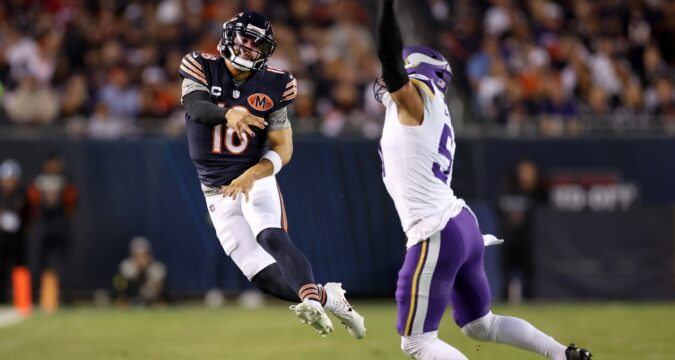
The Ben Johnson era got off to a good start early as the play sheet he designed produced a touchdown on the opening drive — the first time the Chicago Bears have had one in a season opener since 2018.
But it was a messy slog from there as the Bears fell apart in all phases, botching an 11-point lead going into the fourth quarter and losing to the Minnesota Vikings 27-24 on Monday night at Soldier Field.
Here are 10 thoughts following the Bears’ ninth loss to open a season in the last 12 years.
1. It felt like you saw J.J. McCarthy, the local product from La Grange Park, mature over the course of four quarters in his first NFL start.
At the same time, Caleb Williams looked a lot like the same player from 2024.
There will be an avalanche of reaction — and overreaction — from the frustration of a poorly played opener in the national spotlight. One game is the starting point for the season, not something that sets the arc for the remainder of the schedule. But unless you’re grading Williams on some sort of curve to prop up mediocre quarterback play, it was an underwhelming start under Ben Johnson and the new staff.
Williams completed 11 of his first 14 passes but finished 21 of 35 for 210 yards and one touchdown. He was 6-of-6 for 51 yards on the opening drive. He played turnover-free ball and was most effective against a talented Vikings defense running. He gained a team-high 58 yards on six rushes, including a 9-yard run to cap the first possession of the game.
His footwork remained frenetic. He still leaves the pocket voluntarily. He didn’t get the ball out on time with regularity. In the second half, his accuracy fell off a cliff. It’s tough to put an opponent away while completing 9 of 19 passes in the second half when there were throws to be made. He turned down shot plays, something that was a consistent trademark of his rookie season.
There was a corner/post to Rome Odunze and he didn’t let it go. He had a corner route to DJ Moore and didn’t cut it loose. He has to make those throws in a bid to create more explosive plays, something the Bears had a critical lack of last season. Williams missed Moore on fourth down and a possible big play to Cole Kmet in the middle of the field. Those were four potentially big plays. There were also too many misses and some of those throws were way off the mark.
Bears quarterback Caleb Williams throws a pass for a first down to wide receiver Rome Odunze as Vikings linebacker Blake Cashman defends on the play in the first quarter at Soldier Field on Sept. 8, 2025. (Chris Sweda/Chicago Tribune)
“We worked on this play all week, was hitting it,” Williams said of the play for Kmet. “We kind of did it twice today. Missed both in the same spot. Missed it right in front of him. It’s frustrating because we did everything perfect all the way up to that, then just missed. That happens. Just being able to come back from that and keep punching, keep fighting.
“But those are big moments in the game. Both times, I believe we were either high red zone or in the red zone. Just missed right in front of him. Frustrating. Something that you practice, you hit throughout the whole week. Move the backer, whip it in there. Just miss.”
And the fourth-and-3 play for Moore: “Same thing, just missed right in front of him. Wide open. Moved the backer, came back, missed the same spot, same route. Like I said, it’s frustrating, something you practice on throughout the whole week, something that I’ll be better with, something you have to hit in those moments. I think I set too far in front of it and tried to lead him. Led him a little bit too far.”
Maybe the coaching staff chalks many of those misses up to poor footwork, but it was alarming because, again, plays were there to be made. Williams is going to have highlight plays every week — and he had a handful in Week 1 — but there weren’t enough to turn the tide after the Vikings stunned the Soldier Field crowd and grabbed control of a game they appeared destined to lose.
“I thought he started off really well,” Johnson said. “I’ll have to go back and look at exactly where those incompletions came in. It certainly felt like it dried up a little bit. Probably a credit to (Vikings defensive coordinator Brian) Flores and the Vikings, as well, making some adjustments on their end. Some things tightened up, as well.”
Stay current with the latest Bears news all season by subscribing to the Chicago Tribune. $1 gets you 1 year of standard digital access — or you could do $1 for 6 months for premium digital (ad-free).
Penalties played a major part in the loss. The Bears committed 12 (their most since a Nov. 8, 2021, loss at Pittsburgh) for 127 yards. The revamped offensive line struggled to find a groove running the ball against Minnesota’s rebuilt defensive line. The offense struggled to stay ahead of the chains, and McCarthy eventually settled down and found a way to win, becoming the first quarterback to lead a fourth-quarter comeback in his first start on the road since Baltimore’s Tyler Huntley rallied the Ravens to a victory at Soldier Field on Nov. 21, 2021.
As poor as McCarthy looked early — he was skittish and his eyes were bouncing around the pocket — things got worse in the third quarter when he fell into a perfect trap laid by Bears defensive coordinator Dennis Allen. The defense sent an all-out blitz and cornerback Nahshon Wright, who spent last season on the Vikings practice squad, jumped an out route for Justin Jefferson and returned the interception 74 yards for a touchdown and a 17-6 lead.
“Every rep for him is an unbelievable experience,” Vikings coach Kevin O’Connell said of McCarthy. “It’s an experience for me with him. It’s an experience for our offense. There were times when J.J. had to overcome some things around him and he just kept playing. He didn’t necessarily alter the way he was playing. There would be a play out there, they’d tip the ball – it was just for a while there, just felt like everything that could go wrong kind of did. Many, many times, teams will wilt in those circumstances. Ours did not.”
In the end, McCarthy outplayed Williams when the game was on the line. He was the better thrower. He was calmer in the pocket. He was quicker to get the ball out.
The Vikings caught a little spark running the ball with Jordan Mason (15 carries, 68 yards) and that helped open things up for an offense that went three-and-punt seven times. McCarthy was the big concern for the Vikings. He’d struggled against Flores’ defense in training camp. He’d been running around a lot over the summer and his accuracy, one of his real strengths at Michigan, was troubling.
Vikings coach Kevin O’Connell dialed up some well-timed and schemed passing concepts. There was a double-dig touchdown throw to Jefferson to bring the Vikings within 17-12 with 12:13 remaining. Then he came back to running back Aaron Jones on a rail route. Jones was isolated on linebacker Noah Sewell. The ball floated a little, but there wasn’t time for safety Jaquan Brisker to get there and it was a 27-yard touchdown to put Minnesota ahead.
McCarthy, who finished 13 of 20 for 143 yards, provided the game-deciding score on a zone read. On third-and-1 from the 14-yard line, defensive end Dayo Odeyingbo crashed inside and why wouldn’t he? McCarthy didn’t have a designed run all game or in preseason. Odeyingbo took the back and McCarthy was out of the gate, needing only a block by tight end T.J. Hockenson on Brisker to score.
And just like that, the Vikings, who had five first downs entering the fourth quarter, secured an improbable victory.
Vikings quarterback J.J. McCarthy runs in for a touchdown in the fourth quarter against the Bears at Soldier Field on Sept. 8, 2025. (Chris Sweda/Chicago Tribune)
“We looked like we were in big trouble,” Minnesota safety Josh Metellus said. “You could see it with J.J. The big part of that was the anticipation. He’s been waiting to get this first game off since he was drafted, and the anticipation, the reps in practice, you can never simulate what it’s going to be like. They had a good plan defensively against our offense. The things we thought were going to be there for him weren’t there.
“He threw the Pick 6 and he came over the sideline and he still had great energy. He was trying to dab up the DBs. I grabbed his hand, I looked in his eyes and I said, ‘One play at a time. We got you. Don’t feel like you have to be Superman. One play at a time.’ You could just see it in his face. He knew he could do it and he did.”
McCarthy became the first quarterback in NFL history to account for three touchdowns in the fourth quarter of his debut and the first to overcome a deficit of 10 or more points in the fourth quarter in his first start since Steve Young in 1985.
Both quarterbacks can get a lot better in Week 2. Coaches have said for ages that’s the biggest jump players take all season — from the opener to the second week — and it’s probably even more true in this era with only three preseason games.
“The best part about Week 1 victories like this is there’s so much correctable tape on there,” Pittsburgh quarterback Aaron Rodgers said on Sunday. “It’s like a coach’s dream journal right there to win, but also to have some correctable moments.”
There’s good tape for the Bears with Williams too. The challenge will be avoiding an 0-2 start in the NFC North for the fourth consecutive season with Sunday’s trip to Detroit.
2. In retrospect, the turning point came at the end of the third quarter when the Bears were poised to put the game away and came up empty.
Bears quarterback Caleb Williams runs behind the block of offensive tackle Braxton Jones in the third quarter against the Vikings at Soldier Field on Sept. 8, 2025. (Chris Sweda/Chicago Tribune)
They were leading 17-6 and the Vikings had still mustered nothing offensively. A 13-yard scramble by Caleb Williams and a 13-yard run by D’Andre Swift, maybe his best run of the night, got the Bears to the Vikings’ 24-yard line in the final minute of the quarter. If they had scored a touchdown here, the Vikings would have been cooked.
That’s when everything that went wrong can be encapsulated in a span of five snaps:
1st and 10 at MIN 24: A 12-yard pass to Swift was negated by a holding penalty on right tackle Darnell Wright.
1st and 20 at MIN 34: Williams badly missed Kmet on one of the plays described in the first item.
2nd and 20 at MIN 34: Williams was penalized for intentional grounding when he was flushed out of the pocket and failed to get his pass attempt to the line of scrimmage.
3rd and 30 at MIN 44: Williams got back 12 yards with a completion to Olamide Zaccheaus.
4th and 18 at MIN 32: Cairo Santos missed a 50-yard attempt wide right.
Penalties, errant throws and special teams miscues piled up all night and eventually turned the tide in the game.
“The lesson there is to get the ball past the line of scrimmage,” Williams said of his penalty. “I was trying to throw the ball away because I knew we were in field goal range. I think I’ve been able to have a couple of those moments. I’ve come up here and spoke to y’all about learning from those moments. Just being able to get the ball past the line of scrimmage, in that position, trying to throw it away, trying to keep us in field goal range.”
Good teams know how to win, and at the end of a game, that comes down to executing at a high level on a small number of plays that are the deciding factors. It’s difficult for coaches to teach players how to win during the offseason and training camp. It’s something that needs to be seized in the moment and this is something the Bears — in all phases — will need to learn from.
“The start of the game felt good,” defensive end Montez Sweat said. “It felt like a fresh start. We just didn’t finish. We’ve got to learn how to win. We’ve got to learn how to choke people out.”
The missed opportunity proved to be just the opening the Vikings needed as they scored touchdowns on their next three possessions.
“I think you certainly feel it when you’re on the sideline there,” coach Ben Johnson said. “You got it moving, got it going, then all of a sudden it starts going backward. Negative plays are happening, whether it’s penalties or the intentional grounding, things of that nature. It cost us some points big-time.”
3. The 127 yards in penalties are the most the Bears have ever had in a season opener.
Chicago Bears guard Jonah Jackson (73) stands on the field during a break in the action in the second quarter at Soldier Field on Sept. 8, 2025. (Chris Sweda/Chicago Tribune)
The last time they had more than 12 penalties in Week 1 was in a 24-14 victory at Green Bay in 1952 when they overcame 15 infractions.
This has to be fixed right away. There were four false starts (two by right guard Jonah Jackson, one by right tackle Darnell Wright and one by wide receiver DJ Moore) and that’s something that plagued the team in 2024 when the Bears tied for the second-most false starts in the league with 28.
Both cornerbacks — Nahshon Wright and Tyrique Stevenson — got tagged for pass interference and there was even a holding call on rookie running back Kyle Monangai on a blitz pickup that was declined.
“We said going into Week 1 that the team that would make the least number of mistakes would win the game,” coach Ben Johnson said. “Unfortunately, we were on the wrong side of that. We made too many there late in the game, myself included. When you look down at the stat sheet and you see 12 penalties, that’s got to get cleaned up in a hurry, yet we’ve been saying that all training camp, as well. We’ll find a way to get that done. It’s going to be a collective effort. No one’s pointing fingers.”
Some of the pre-snap stuff was problematic during training camp. It got better as camp went along, but it was there in Week 1 along with false starts.
“There’s a lot of communication going on,” Jackson said. “When you shoot yourself in the foot too many times, you’re not able to capitalize on offense and score points. We just have to be better. We can’t have self-inflicted wounds and things like that. It starts with me.”
The offense was 3 for 12 on third down. The Bears got to third down six times in the second half, needing 10, 13, 30, 19, 14 and 10 yards in each instance. The only time they moved the chains was on the final attempt when Vikings cornerback Byron Murphy was flagged for illegal contact.
“Of course, when you have the penalties, hard to establish the run game quite like we wanted to,” Johnson said. “It felt like we were behind the sticks most of the time. Second-and-long, third-and-long is where we lived, which was a struggle for us offensively.”
4. Twice in the last week, Ben Johnson talked about finding situations in which the offense gets the perfect look pre-snap.
Bears head coach Ben Johnson looks on in the in the first quarter against the Vikings at Soldier Field on Sept. 8, 2025. (Chris Sweda/Chicago Tribune)
I found it particularly interesting because that was a topic an AFC general manager mentioned recently in regard to Johnson and quarterback Caleb Williams.
“Tempo varies,” Johnson said last week. “There will be times where we want to go at warp speed, really fast, and then at other times where we want to slow it down and maybe we’re in more of a perfect-play mentality where we want to get a premier play versus a premier look.”
When I talked to Johnson about his foundational beliefs for running the ball, he referenced the idea again: “We’ve got to be able to run off the ball every single play. At the same time if we can accelerate, ‘Hey, we’ve got a premier look here, let’s get into this play so we have better angles,’ that’s good football.”
It’s really good football when you can have a good idea what the defense is showing and make a late change to a play that thwarts it. This is the very topic the AFC GM broached when I asked him how you can judge progress for Williams this season.
“That’s hard for the naked eye and it’s hard for any of us to really see unless you’re in the building and in it, like actually in it,” the GM said. “He’s got to be able to show growth to do the things that they were doing in Detroit — all the menu-based stuff. All the ‘check-with-me.’ Getting to the right play is something Ben does a really good job of, so it’s growth in that and running everything at the line of scrimmage.
“There’s no throw-away plays where, from your perspective, you say, ‘That looked like a bad play call into that defense.’ You never saw that in Detroit because the Lions were so menu-based, they could get into whatever they wanted. All of that stuff takes a lot of time. You’ve got to find ways to simplify it from the beginning. It’s hard, and who knows what Caleb was coached last year too.
“But some of it will be very telling. You will have a front-row seat from Day 1. The coach will tell on himself in a manner of, ‘What are they doing?’ That’s going to tell you what he thinks he can do. And what they’re not doing is something that’s probably, ‘Well, we can’t get into this.’ And it will be fascinating.
“Is it going to be USC where it’s going to be tempo and one-worders and boom — ‘I’m just going to get the ball to you’ — and we’re just going to try to make a play. Or is it going to be, ‘Ah, we’ve got to slow this thing down,’ and it’s run, run, run, run, boot just to limit the read. It’s one, two, three and progression-based. It’s Week 3 and you’re saying, ‘Dude, I haven’t seen this guy check a play at the line of scrimmage since July.’
“You know Ben is a smart guy. He’s only going to do what he thinks he can do and what he thinks he can do well. The evolution of this is what people will be following. The two things to watch are, what are they doing? Everything is going to have a reason to it. Why are they doing this? And then what are they not doing? Because there’s a reason for that too.”
It’s a challenge for a quarterback — especially a young one — to consistently make checks at the line of scrimmage, even off a menu. That’s why the coaches talked so much about huddle mechanics and getting to the line of scrimmage in the offseason and training camp. It was a struggle. It was clunky. There would be delays. Pre-snap penalties. It got better as camp went on, but this is graduate-level stuff for even quarterbacks with more experience than Williams.
“Extremely difficult, especially for a quarterback like Caleb who doesn’t see the line of scrimmage well,” former Bears center Olin Kreutz said. “You saw (Jared) Goff was doing it Sunday too. He was checking them in and out of plays the whole game. They weren’t as successful. It’s going to be hard for Caleb.”
The GM said he’s curious to see how it comes together. He holds Johnson in high regard.
“From a league perspective, that is one of those teams that everyone is going to be keeping an eye on,” he said. “It might sound weird because this was a five-win team last season. But everyone had an opinion on the quarterback. He was a polarizing guy. Everyone had an opinion on that kid, and everyone knows how good of a coach Ben is.
“Can he make it work with this quarterback, who is totally different than Jared Goff? That whole dynamic, I think everyone is going to be keeping an eye on.”
5. I couldn’t finish the question before Pat Mannelly cut me off.
Bears; Patrick Mannelly during training camp in Bourbonnais on July 29, 2013. (Scott Strazzante/Chicago Tribune)
“Huge,” Mannelly said. “Huuuuge.”
I called the former Bears long snapper to pick his brain about the underpublicized (before opening weekend) change to NFL rules that allows teams to possess “K balls” in advance and work them in.
Mannelly isn’t the only one who believes the rule change could have a major impact on games this season. Pat McAfee, a former punter and kicker, posted on social media Thursday night that a well-broken-in ball potentially can travel 10 to 15 yards farther than one fresh out of the box.
Results from one week won’t tell much of a story, but Chris Boswell drilled a 60-yarder with 1:03 remaining Sunday to lift the Pittsburgh Steelers to a 34-32 victory over the New York Jets. It was a career-long kick for Boswell, 34, and had the distance to be good from 65 yards — perhaps more. He crushed it. The Philadelphia Eagles’ Jake Elliott, who was 1 of 7 on kicks from 50-plus yards last season, nailed a 58-yarder Thursday night.
K balls are the ones used only on kicking plays — kickoffs, punts, field goals and extra points — during the course of a game, and the league has tightly controlled them since 1999 to ensure uniformity and prevent teams from manipulating them to gain an advantage. Teams always have been allowed to work in balls used in regular play, with officials checking them pregame — as made famous in the Deflategate controversy for Tom Brady and the New England Patriots in 2015.
Mannelly was a rookie in 1998, so he can remember what it was like in the Wild West days for footballs used on special teams.
“They would take them into the steam room, the dry sauna,” Mannelly said. “Our punter, Mike Horan, had a board that he would roll the balls with to get it to a certain diameter. All the veterans had a formula and they all had different ways of doctoring up the footballs to feel and look and perform the way they wanted them.”
Some specialists would put footballs in a bag with wet towels and throw the bag in a drying machine. They’d use different techniques to push in the ends of the football, trying to get a rounder ball with a larger sweet spot.
The league instituted K balls in 1999 with a goal of promoting more kickoff returns. The challenge was that balls taken out of the box two hours before a game and only lightly worked in by officials didn’t perform as well.
Footballs straight out of the box have a wax coating that can make them slippery to handle, and when Dallas Cowboys quarterback Tony Romo, holding for a potential game-winning field goal in a January 2007 playoff game against the Seattle Seahawks, had a snap go through his hands, the league tweaked the rules for the next season. Equipment workers for each team were given 20 minutes to rub down the K balls before kickoff.
“I would tell (former Bears equipment man) Carl Piekarski, or whoever was doing it, I wanted this side of the ball just next to the laces for my index finger, my ring finger and my middle finger so I would be gripping real leather,” Mannelly said. “Then, ‘This is where my thumb goes. Make sure you spend extra time on the area for the thumb.’ So when I gripped the ball, I didn’t have to deal with the wax.”
Bears long snapper Patrick Mannelly twirls the ball while practicing before a game on Oct. 7, 2012. (John J. Kim / Chicago Tribune)
There wasn’t enough time to rub down the entire football, and kicker Robbie Gould and whoever the punter was at the time also had their requests. The equipment workers could get one ball in really good shape and a second ball in pretty decent shape. It was a race against the clock to get anything done with a third football. There simply wasn’t enough time.
If for some reason the specialists didn’t like K1 — the balls were numbered — Gould sometimes would try to boot it over the net on an extra point and into the grandstand with the hope it would be removed from play.
Teams were delivered an allotment of K balls during training camp this summer, so specialists were able to begin prepping them, sorting through the selection and picking the ones they like. No ball can be used in more than three regular-season games, so the process will play out over the entire season.
What exactly are they doing? Well, that’s a trade secret just like the shenanigans back in the 1990s.
“We can’t put it in the sauna,” Bears long snapper Scott Daly said. “We can’t put water on it or change the texture of the leather, that kind of thing. We can’t put it in a drying machine. There are rules. It’s definitely a new area.”
Said kicker Cairo Santos: “There’s a fine line between a ball straight out of the box and one that, after a couple days of kicking it, already starts to be like an unrealistic ball that is unlikely to be approved by the NFL. So we have to manage how much we kick with them and how much we do to them so they still conform. We don’t know what the perfect ball is going to look like in the eyes of the NFL, so we’re just kind of learning how to go about it.
“The memo says they will randomly inspect balls. We’re all learning. It’s fun to know what the ball is going to look like going into the game versus the previous procedure when the balls are straight out of the boxes and sometimes it’s a good batch and sometimes they weren’t broken in at all.”
Chicago Bears place kicker Cairo Santos (8) runs to the field for warm-ups before the Bears play the Buffalo Bills at Soldier Field Sunday Aug. 17, 2025, in Chicago. (Armando L. Sanchez/Chicago Tribune)
Santos recalled a 2022 game in Atlanta in which he missed a 56-yard field goal in the second quarter that bounced off the crossbar. That was with K2 after K1 had been taken out of the game as a souvenir for Falcons returner Cordarrelle Patterson following a 103-yard kickoff return.
“To get the perfect ball, usually it took the full 20 minutes, and with the rest, they wouldn’t be as good as K1,” Santos said. “On that kick, the feeling I felt on my foot after K1 was taken out was the ball was very hard. It didn’t absorb off my foot and it just kind of knuckled and it didn’t fly great. We got that a lot when we didn’t have K1.”
Special teams coordinators are being tight-lipped about what the rule change will bring.
“I think it’s a really good rule in terms of marrying with the quarterbacks and what they do (preparing game balls),” Bears coordinator Richard Hightower said. “We’ll see. K ball, still to be determined. Not a real big deal to me right now.”
A coordinator for another team texted: “It’s a good change. We’ll probably see an uptick in field-goal percentage.”
No one is saying precisely what and how much they’re doing now that teams possess K balls. Santos believes the new rule could add about “5 to 7 yards” of distance on field goals with all other factors — primarily wind — being the same.
It was a good opening weekend for most kickers around the league. Entering Monday night, kickers were 57 for 66 on field goals. The Bears and Vikings combined to go 3 for 4 (Cairo Santos connected from 42 yards and was wide right from 50) so kickers were at 85.7% for Week 1.
Chicago Bears All-Quarter-Century Team: Which players made our list of the best of the 2000s?
Kickers were super accurate on long kicks, making 12 for 14 (85.7%) on attempts from 50 plus yards. The ball was flying and it should also help distance and placement on kickoffs.
Former Bears punter Brad Maynard was wistful discussing the subject. He played two seasons for the New York Giants before the K ball rule was instituted.
“I was young and dumb,” he said. “I didn’t know anything about it, but I heard stories of Sean Landeta getting the footballs wet and putting them in drying machines and doing all sorts of stuff. I was too young to go to the equipment guys and say, ‘Hey, let me have those footballs.’
“The only thing I ever remember doing, if the guy with the K balls on the sideline would let us, we’d get the footballs and punch in the ends. I’d go to the corner of the metal benches and punch those ends in to make it a little more round instead of a pointy edge you’d have when you just got them out of the box.
“Kicking a K ball straight out the box is like trying to play shortstop with a brand-new glove you just bought at the sporting goods store.”
The new rule that no one was discussing before Thursday night could have a real impact on the season.
“This is a huge deal,” Mannelly said.
6. One of the guys Nahshon Wright shadowed regularly last season as a member of the Vikings practice squad was Justin Jefferson, one of the premier wide receivers in the league.
Bears’ Nahshon Wright runs to score a touchdown against the Vikings during the second half on Sept. 8, 2025. (AP Photo/Kamil Krzaczynski)
That had to make Wright’s Pick 6 early in the third quarter a little more special. Wright knew the situation; Minnesota was facing third-and-8 on its own 32-yard line and the call.
“Reading my keys,” he said. “Knowing the ball had to come out fast, obviously, because we were in zero. Going to make the play.”
Wright jumped the out route and took the touchdown to the end zone for just the second pick of his career. It was a great pressure call by defensive coordinator Dennis Allen and well executed in what was an up-and-down night for Wright.
“He learned how to play pretty good vision zero coverage here,” quipped Vikings coach Kevin O’Connell, referencing Wright’s season under defensive coordinator Brian Flores. “And credit for making that play. What a huge play.”
Wright has been a good find for the Bears. He had a relationship with secondary coach Al Harris from their time together in Dallas and was a quick learner with what the team wanted to do on defense. With all the time Jaylon Johnson has missed, Wright has capitalized with first-team reps.
“At the end of the day, individual accolades don’t matter once you don’t win,” Wright said. “You want to come out on top by any means necessary. Honestly, it was a great play, but you want to finish.”
Just as Wright had a bumpy preseason finale at Kansas City, there are some plays he will want back in Week 1. Vikings’ Jalen Nailor got an inside release at the very end of the second quarter for a 28-yard completion from quarterback J.J. McCarthy to set up Will Reichard’s 59-yard field goal, which is tied for the longest field goal made at Soldier Field. Matt Prater hit a 59-yarder for the Detroit Lions on Jan. 3, 2016.
Then, there was the 42-yard pass interference penalty when Wright got tangled up with running back Aaron Jones.
“That was one of those where the ball was underthrown, and I kind of felt him kind of stop and just kind of pull me in a little bit,” said Wright, who had four tackles, one for a loss. “So, smart play on his end.”
7. Special teams miscues contributed to the loss. The Bears lost this phase decisively.
Bears’ Cairo Santos misses a field goal in the fourth quarter against the Vikings at Soldier Field on Sept. 8, 2025. (Chris Sweda/Chicago Tribune)
Not only did reliable Cairo Santos miss wide right on a 50-yard field goal, he didn’t get the final kickoff through the end zone for a touchback. The Bears drew within 27-24 with 2:02 remaining and had one timeout left.
Ben Johnson could have attempted an onside kick — a low percentage play (the recovery rate was 6.4% last season) — or opted to try to use the two-minute warning as a stoppage. To do that, the clock couldn’t run on the kickoff. The Vikings’ Ty Chandler hesitated when he caught Santos’ kickoff 7 yards deep in the end zone. On the sideline, Vikings coach Kevin O’Connell was waving for his return man to come out. Chandler did, got to the 26, and the play took seven seconds off the clock.
“The intent was for the ball to go out of the end zone,” Johnson said.
A touchback would have given Minnesota the ball at its own 35. The Bears could have kicked the ball out of bounds and that would have accomplished a similar goal. The clock wouldn’t have run and the Vikings would have started at the 40.
As it was, with only one timeout, the Bears didn’t get the ball back until only nine seconds remained.
“We felt like if we would have kicked it out of the end zone, gotten the three-and-out, we’d have gotten the ball back with about 56 seconds,” Johnson said.
Then, there was a deflected punt. Eric Wilson got his right hand on Tory Taylor’s kick in the fourth quarter. His punt traveled only 25 yards, giving the Vikings the ball on their own 32 before their final touchdown drive.
Minnesota rookie Myles Price had 68 yards in punt returns too, so it was a rough game in the third phase.
8. Wide receiver Jahdae Walker was the only undrafted rookie to make the initial 53-man roster.
Bears wide receiver Jahdae Walker (20) and Vikings wide receiver Myles Price (4) exchange words during the first quarter Monday, Sept. 8, 2025, at Soldier Field. (Armando L. Sanchez/Chicago Tribune)
While he has a ways to go to have a chance to contribute, a lot more went into the decision to keep him than just his acrobatic catches on the game-winning drive in the preseason finale in Kansas City.
Walker had multiple calls with Bears wide receivers coach Antwaan Randle El during the predraft process and felt like Halas Hall was a place where he’d have a real shot. Randle El told him he liked what Walker put on film during two seasons at Texas A&M and two before that at Division II Grand Valley State.
There wasn’t a ton to go off from last season. The Aggies had changed coaches and quarterbacks, and Walker had 345 yards and two touchdowns as a senior — not exactly the kind of numbers that grab the attention of pro evaluators. It was disappointing for Walker, who totaled 416 yards and a touchdown over the final five games of 2023, his first season in College Station, Texas.
“I saw a football player,” Randle El said, “and when you see guys like that — like, he can play wide receiver — but, man, he’s going to go block his butt off … he’s going to do all of the little things that don’t really show up all the time. When I saw him, I was like, ‘Man, that’s doing the work.’ When you see his blocking, that’s why he struck a chord with me for being a guy we’d love to have.”
Walker was so aggressive blocking, he was ejected from a game against LSU last season for targeting, a rare call against an offensive player. The Bears saw a gritty receiver with athleticism (he ran a 4.43 40-yard dash at his pro day and had a high Relative Athletic Score) who was totally invested in doing everything needed to win.
Randle El was a recruiter in a sense because it’s a mad scramble to sign undrafted free agents, with the money offered relatively even between teams. Walker received a $20,000 signing bonus and the team guaranteed another $150,000, not uncommon for players they forecast as potential practice squad members. Relationships might be an even larger factor for UDFAs in the NIL era now that players usually have pocketed some money in college.
Why did Walker choose the Bears, who used a second-round pick on wide receiver Luther Burden III a year after drafting Rome Odunze in Round 1?
Bears wide receiver Jahdae Walker catches a touchdown pass in the fourth quarter of a preseason game against the Dolphins on Aug. 10, 2025,at Soldier Field. (Stacey Wescott/Chicago Tribune)
“I had a good relationship with Coach El throughout the process and I just felt this was the best fit for me no matter how deep the room was,” he said. “Even at A&M, I walked into a crowded receiving room. It’s kind of like everywhere I’ve gone, I’ve gotten used to a crowded room. I just have to stand out any way I can.
“I already had that connection, so I was like, ‘I might as well go there because I like the coach. I like how they’re building the program.’”
The Bears thought there was a chance Walker would stand out in training camp, but you never know with rookies once the competition is elevated and pads go on. Sometimes stars of the spring fade in an instant and quickly fall out of conversations about shaping the depth chart.
“Toward the end of his offseason, I don’t want to say he was peaking, but he had shown up,” Randle El said. “He’d flashed and then continued to flash, and then we started training camp, he started with that hamstring (injury) and we just didn’t know. This guy was sort of in the balance.
“He wasn’t really himself and then he just took off the last 2½ weeks and that was the guy we saw on film in college. The mental part in terms of learning the offense, all of that improved. His effort when he didn’t have the ball showed up a lot, which is real big for us.”
It’s still an uphill climb for Walker to find a niche and ensure he sticks around when injuries hit and the team is forced to start juggling the roster. But the Bears were intrigued enough to keep him over Tyler Scott, a fourth-round pick just two years ago.
It’s still an uphill climb for Walker to find a niche and ensure he sticks around when injuries hit and the club is forced to start juggling the roster. The Bears were intrigued enough to keep him over Tyler Scott, a fourth-round pick just two years ago. Walker was active Monday night, too, and played on special teams.
9. We’ll see how different the defense looks on Sunday at Detroit after three starters missed the game with injuries.
Bears cornerback Jaylon Johnson warms up before a game against the Vikings at Soldier Field on Sept. 8, 2025. (Chris Sweda/Chicago Tribune)
The Bears made the smart — and probably safe play — by deactivating Pro Bowl cornerback Jaylon Johnson. He didn’t return to practice until last week and was only limited, working his way back from groin and calf injuries. There is a long season ahead and the Bears likely want to see him be a full participant in multiple practices before he plays.
Nickel cornerback Kyler Gordon, who was sidelined with a hamstring injury just before the first preseason game and missed the bulk of practices in August, was a late addition to the injury report with … a hamstring. The Bears had some concerns about soft-tissue injuries when they engaged in negotiations to extend Gordon’s contract in the offseason. They haven’t plagued him too much in the regular season. He did miss two games last season with a hamstring, but the issue has been these soft-tissue injuries have cost him considerable time in the offseason and training camp.
Gordon missed three games as a rookie in 2022 with a concussion and four games in 2023 with a broken hand. But a hamstring issue that cropped up in training camp is now an issue.
Linebacker T.J. Edwards also missed the game with a hamstring injury suffered in the dead week between the end of preseason and Week 1. Johnson and Edwards both did minor work on the field with an athletic trainer and strength coaches before the game. That’s a good sign. I did not see Gordon.
10. This was the first of only three prime time games this season for the Bears, but Mike North, the NFL’s Vice President of Broadcast Planning and Scheduling, called them a “national brand.”
Bears fans try to motivate their team in the first quarter at Soldier Field on Sept. 8, 2025. (Chris Sweda/Chicago Tribune)
North was at the game and I asked him how the league arrived at three night games for the Bears when the schedule was created in the spring.
“This is a team that was 4-2 last year — right there until the Hail Mary at Washington and it kind of derailed from there,” he said. “Thanksgiving was awesome, right? Game (at Detroit) went to the wire and did a monster (television) number. This is a national brand and they had an exciting offseason with the new coach.
“So, I think hope is high and this is one of those national brands where if they have some success, it will resonate nationally, kind of like it did in Washington last year. You think about what we have now, and we’ve got so many more national windows and prime time games, so a team that maybe might have been looking at one or two now is looking at three or four. And a team that would have been looking at three or four now is maybe looking at five or six. Everybody kind of has to step up with one or two more than maybe we’ve been used to.”
I asked North if the Hail Mary and the dramatic ending last season in Washington was a critical factor in having that as the team’s next prime time game on Monday, Oct. 13. Of course, it pits No. 1 pick Caleb Williams against No. 2 pick Jayden Daniels again.
“That’s the kind of thing where everyone remembers it from last year,” he said. “To bury that at noon where only 14% of the country is able to watch it and it might be one of the more interesting games of the day … it felt like that was the kind of game that warrants national television. Kind of like tonight? Week 1, you are trying to feed a lot of mouths with Thursday, Friday, Sunday afternoon, Sunday night and Monday. An NFC North battle felt good for the book end of Week 1.”
The Bears also play at San Francisco in prime time on Sunday, Dec. 28. They have a game at Philadelphia on Nov. 28 (Black Friday) and that is a standalone game at 2 p.m.
“Technically, it’s not prime time, but it’s a holiday for most of us and it’s a day where we are watching football. The last couple years, we have shown as the audience has grown, the fans are finding us,” North said. “It’s turning into yet another NFL holiday, particularly on the heels of Thanksgiving, which so many people watch and the Bears have been a part of that over and over again.”
10a. We got a glimpse at Ben Johnson’s aggressive nature in the second quarter. The Bears had fourth-and-3 from the Minnesota 24-yard line. Caleb Williams’ pass for DJ Moore was incomplete. The alternative, with a 7-3 lead at the time, would have been a 42-yard field goal attempt.
“We like the call and we like the decision at the time,” Johnson said.
10b. Wish I could have caught defensive end Dayo Odeyingbo in the locker room. He made an impact with a sack, two quarterback hits and a pass deflection.
10c. Noah Sewell picked up where he left off in preseason — being active around the ball. He had a game-high nine tackles and it looks like the defense has decent depth with him behind T.J. Edwards, when healthy, and Tremaine Edmunds.
10d. The Fox crew of Kenny Albert, Jonathan Vilma and Megan Olivi will call the Bears-Lions game on Sunday at Ford Field.
10e. The Lions opened as a 4 1/2-point favorite over the Bears at Westgate SuperBook in Las Vegas.
Sign up for our Bears Insider newsletter for more Bears news all season.
https://www.chicagotribune.com/2025/09/09/chicago-bears-minnesota-vikings-brad-biggs-10-thoughts/