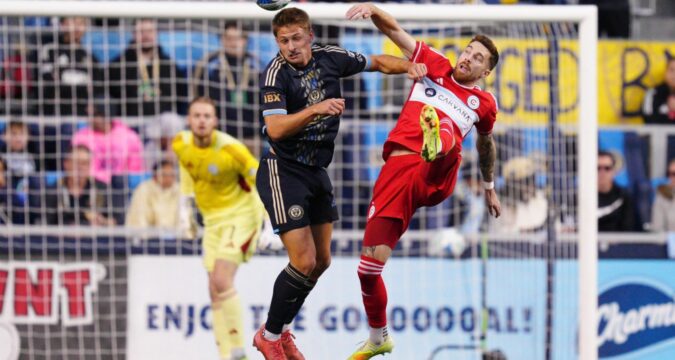
CHESTER — When the Chicago Fire picked up their first playoff win since 2009 a week ago, they picked apart Orlando City with a standard 4-3-3 formation.
When they visited Chester four days later for Game 1 of a best-of-3 playoff series with the Philadelphia Union, Fire coach Gregg Berhalter morphed them into what was listed as a 3-4-3 but looked functionally like a 5-4-1, with the wingbacks restrained in their ability to go forward.
That differed from the 4-3-3 the Fire used when the team got bludgeoned in Chester, 4-0, on Aug. 23. And it wasn’t the 3-4-2-1 — absent their prime playmaker, and with ostensible winger Maren Haile-Selassie bombing down the flank as a wingback — utilized in a signature 5-3 win at Inter Miami Sept. 30 to clinch their first playoff berth in nearly a decade.
All of that formational minutiae is to say that the Union, as they prepare for Game 2 of the first-round series Saturday at Soldier Field (5:30 p.m., Apple TV+), aren’t fixating on the Fire. Instead of getting trying to get into the mind of Berhalter, coach Bradley Carnell is focused on getting his team to do what has made them one of the most successful away teams in MLS this season.
“I thought a lot of things went our way,” Carnell said Thursday. “They defended really deep, and it’s always tough to break down a block, in any league, in any team in the world of soccer. To go 2-0 up, to show our strengths, that’s what we’re going to feed off of, and the way we got that advantage and built up those moments.”
The underlying principles will be largely the same from Berhalter’s bunch, the formation largely a matter of who is best positioned to close down what space.
In Chester last week, packing the center of the pitch with three centerbacks allowed the Fire to defend deep and wide, with a pair of stay-at-home midfielders to stanch moves through the center of the park. Haile-Selassie and Jonathan Bamba were free to launch counters from that platform, but the Fire wouldn’t commit numbers forward.
Especially once Philip Zinckernagel, the MLS Newcomer of the Year finalist who tallied 15 goals and 15 assists this season, was ruled out with a pregame injury, the mission was to frustrate first and look for opportunities second. Getting to penalties was the desired outcome. So was a stop-start affair that, Carnell shared Thursday, featured the third-least actual ball-in-play time for the Union all season.
The Union this week isn’t trying to divine what personnel the Fire might use, but instead fine-tuning a plan to get a result away from home.
“They have showed a real resiliency with three center backs, and they can defend deep, plug up space and catch you in the transition,” Carnell said of the Fire. “And they’ve shown that they can break you down. It’s something that they’ve been working on now towards the latter end of the season, and it gets them in into the playoff somewhat, in the play-in game against Orlando. So credit to them. But I think we’re a team who’s built on principles, as we’ve always spoken about and we’ve always trained with. So we’ll focus on us and our principles.”
More important than formation or personnel is the game condition within the three-game series. On their home field last week, the onus was on the Union to push the action, and the Fire’s mission was to defend and frustrate. Both teams have performed well in those situations.
On Saturday, Chicago will have to push the play, needing a win to survive in the series. The Union have been more proficient countering those kinds of teams this year than the Fire has been in imposing its will.
The Union’s eight wins away from home (8-7-2) tied for fourth in MLS this year. Chicago’s 6-5-6 home record is second-worst among the 18 playoff teams. They and Cincinnati were the only two Eastern playoff teams with more points on the road than at home, thanks to the Fire’s 9-6-2 mark away from home.
Part of that trend was the Union’s 1-0 win at Soldier Field on June 25, the Union getting three points despite missing four regulars to international duty and four to injury.
The Fire are coping with a big question mark over Zinckernagel, who was injured in warmups on Sunday. Berhalter listed him as day-to-day, though he was unable to get through a full practice session on Thursday, per reports out of Chicago.
This week, Carnell has a full roster at his disposal. The only lingering question last week was Mikael Uhre struggling with a knee knock picked up in training, but he’s cleared to go fully. Uhre was influential Sunday, with an assist that set up Indiana Vassilev’s opener.
As he has for most of the stretch drive, Carnell has three strikers to choose from for two spots. Uhre is the in-form choice, but he started Tai Baribo and Bruno Damiani in the first game.
Sunday’s start was just the third time that Baribo and Milan Iloski have started together. Baribo had a stop-start finish to the season, going without a goal or an assist in his last seven games around a suspension and a couple of sub appearances once Damiani and Uhre got hot.
Those are good problems for Carnell to have, especially given that Uhre has lately had an impact off the bench in moments they’ve needed him to.
“I like the way Tai applied himself in the game,” Carnell said. “I liked his movement, and I liked the movement of Bruno as well, complementing that early on. Indy and Milan, it’s almost like a street baller mentality, picking up the game between the lines and stuff like that. So, yeah, I was really happy with the combination, especially when you try to break down a block.”