Uranium Supply Crunch Worsens Amid Kazakhstan’s Plan For Strategic Reserve
Drawing further attention to the global uranium supply-demand mismatch that we’ve been pounding the table on since 2020, Kazakhstan has outlined plans to accelerate exploration and create a strategic reserve for the nuclear fuel.
We’ve repeatedly emphasized that the US is not moving fast enough if it hopes to secure fuel for its reactor fleet…
US Is Rapidly Expanding Its Nuclear Supply Chain: It’s Not Nearly Fast Enough https://t.co/gly9hVAKnr
— zerohedge (@zerohedge) February 19, 2026
The strategy, approved by President Kassym-Jomart Tokayev, calls for geological work on at least two new prospective deposits each year. The goal is to uncover high-potential resources while advancing development on already explored sites to refine estimates, extraction methods, and launch preparations.
Kazakhstan, the world’s top uranium producer with roughly one million tonnes of confirmed resources (14 percent of the global total as of early 2025), operates 14 extraction enterprises across multiple regions. 12 are joint ventures with partners from China, Russia, France, Canada, and Japan.
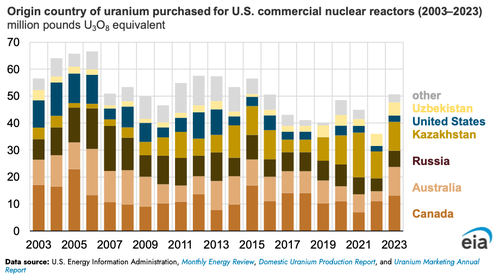
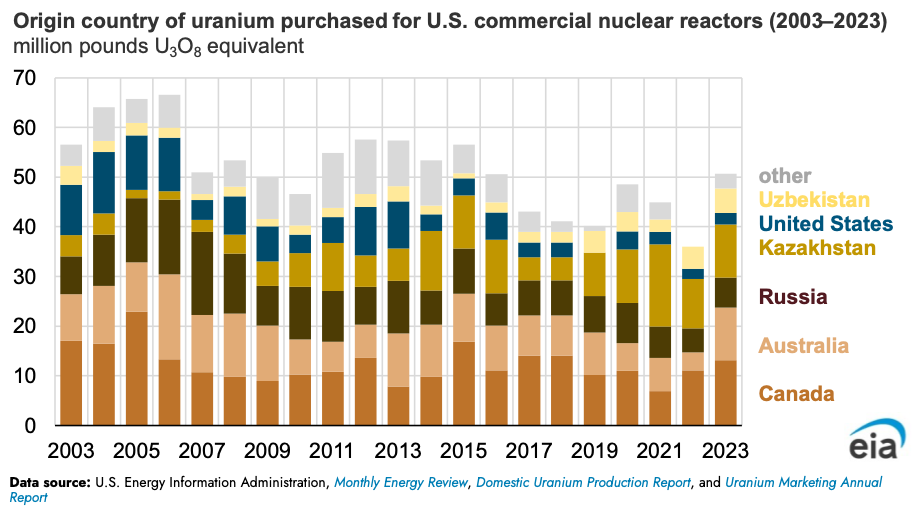
Kazakhstan stands alongside Australia and Canada as the main source of uranium ore imports to the US…
The document emphasizes guaranteeing long-term domestic supply for future nuclear power plants, strengthening export positions, and ensuring reliable sulfuric acid deliveries for in-situ leaching. It also envisions new alternative extraction technologies and full loading of future conversion, enrichment, and fabrication facilities with domestically sourced uranium.
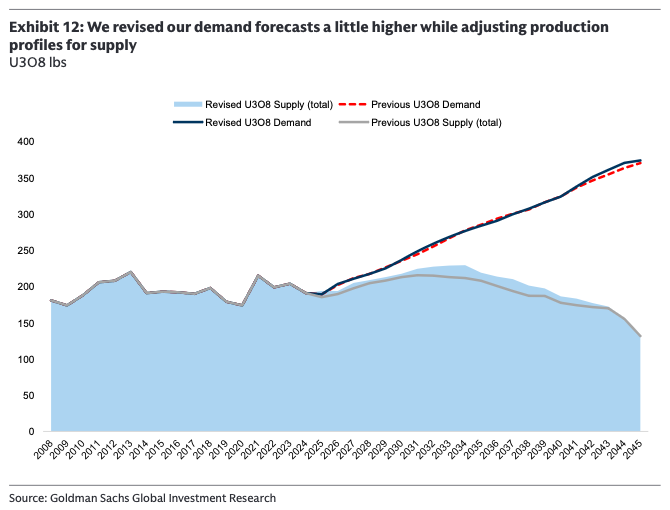
As we highlighted in “Why The Price Of Uranium Is About To Soar,” a widening cumulative net deficit of 211 million pounds between 2025 and 2045, driven by reactor builds in China, Russia, and the United States, is already pushing long-term prices higher. Spot uranium recently traded near $86 per pound, with Goldman Sachs models pointing to roughly $91 by year-end 2026.
We also covered earlier this year on how hyperscalers such as Microsoft are actively exploring uranium-backed projects to secure zero-carbon electricity. With data center capex nearing $1 trillion over the last six years, data center developers have decided now is the time to check for fuel.
The hyperscalers have already outspent the most famous US megaprojects pic.twitter.com/D54qD8kO61
— Fin Moorhouse (@finmoorhouse) April 17, 2026
More countries are likely to announce strategic uranium reserves as the supply outlook for the industry becomes more bleak by the week…
China is adding reactors at breakneck speed and India is now looking to catch up, but the US is still grossly behind the rest of the world when it comes to construction of large-scale grid-supporting reactor plants…
Four months later, China has added 9 more reactors and is now building a total of 39 nuclear power plants. Meanwhile the US has added 0 and is still building 0 https://t.co/TJ6BoMghNk pic.twitter.com/O4idOANNUr
— zerohedge (@zerohedge) April 15, 2026
With the US still nearly completely reliant on the import of raw uranium ore, domestic producers such as Energy Fuels and Uranium Energy Corp stand to be called upon and supported by federal and state governments to reduce what could be framed as a national energy security threat.
Tyler Durden
Sun, 04/19/2026 – 11:05