Boca Raton voters will tackle the hot-button issue of redevelopment — casting their ballot on a proposal to overhaul 30 acres of land near the downtown by adding many new homes, shops, restaurants and offices.
The proposal, known as the government campus redevelopment plan, has roiled the city this year: Save Boca, a group of residents opposed to it, gathered thousands of signatures aiming to defeat the changes, and have criticized city leaders at public meetings. In response to complaints, the plan has faced adjustments, the most recent changes unveiled just a few days ago.
Now, the city is readying for the issue to be on the ballot in the March 10 election, when voters also decide who their next mayor and council members will be.
“It’s just all about listening to everyone, and I am listening to everyone and getting all the information,” Deputy Mayor Fran Nachlas, one of the mayoral candidates, told the South Florida Sun Sentinel. “It’s important to remember that a decision has not been made yet. This plan we knew would evolve somewhat.”
City Council member Andy Thomson, who also is running for mayor, said “any approval of this government campus plan whenever it happens, it won’t happen in October.” It would hinge “upon it being likewise approved by the voters.”
A referendum question, especially about a high-interest issue, could indeed lead to increased voter turnout, possibly causing candidates to adjust their campaign strategy, said Aubrey Jewett, a University of Central Florida political scientist.
Often, local elections don’t garner much attention, save for the “super voters” who often are older and vote in just about every election, Jewett said. But a larger number of voters could hit the polls this March, given how polarizing the government campus redevelopment project has been.
Renderings illustrate Terra and Frisbie’s revised government campus master plan, which includes a reduction in residences, removal of the proposed hotel and increased green space. (City of Boca Raton)
The plan
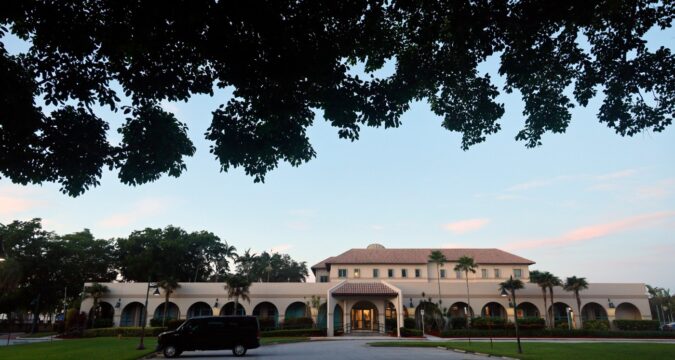
The redevelopment plan could significantly alter the 30 acres near the intersection between West Palmetto Park Road and Dixie Highway, which currently hold City Hall, the Boca Raton community center, the police department and the city’s softball fields. The government facilities are set to be completely rebuilt while the recreational facilities would be built over and new ones would rise elsewhere in the city.
The redevelopment project has the potential to become more of a destination than just a new-and-improved corridor, bringing in billions of dollars in revenue to the city, proponents say.
The city has partnered with developers Terra and Frisbie in trying to strike a balance between creating an active, alluring hub and preserving what many residents say must be saved.
Terra and Frisbie recently unveiled modifications to the plan, including a reduction in the number of planned residences, removing a planned hotel, keeping six of the original site’s banyan trees, designing a monument for Memorial Park, increasing green space and keeping tennis courts in the area.
“What we’ve been doing throughout this whole process is working really hard, spending a lot of our time, our energy, our resources on trying to come up with plans that do incorporate that feedback, knowing full well that at the end of the day, this very easily could go to a referendum,” Frisbie Group principal Rob Frisbie Jr. said at Tuesday’s meeting. “We would support that, honor that, and therefore we need to get the community to be behind this project. That’s our full intent.”
“We’re here to work with you, with all of your colleagues, with this entire city to try to get to that point where everyone says, ‘This is a really exciting plan.’ And that (residents) get to vote on it,” he said.
Renderings illustrate Terra and Frisbie’s revised government campus master plan, which includes a reduction in residences, removal of the proposed hotel and increased green space. (City of Boca Raton)
The opposition
Save Boca group members have argued the plan goes too far in altering what already exists on the public land, including Memorial Park and open fields.
Members of the group are trying to get ordinance and charter amendments passed into the city’s code that would require the City Council to hold elections for the selling or leasing of more than a half-acre of city-owned land, essentially giving voters significant clout over proposals such as the government campus redevelopment plan.
A petition for the ordinance amendment was filed with the city’s clerk on Aug. 26 after Save Boca founder Job Pearlman submitted what he said were more than 5,000 signatures. The required number is 3,676 signatures for an ordinance. The city clerk has since reviewed the signatures and sent them off to the county’s supervisor of elections, who also will verify them.
During a city meeting Tuesday, the developers’ changes led some people to even express appreciation for them.
“We’ve all seen this most recent iteration. It looks good,” city resident Yvonne Zum Tobel said during the meeting. “They’re keeping the banyan trees, they got rid of the hotel. There’s more green space.”
But Zum Tobel then discussed the conflict that is central to the Save Boca movement, and expands beyond just the government campus redevelopment plan: lack of voter control over land in the city.
“I think the problem is once you lease any portion of public land, we’re not going to have any more control. It’s in the control of the developers. … We do have a choice,” Zum Tobel said.
This is what motivated Pearlman to start Save Boca in the first place. In July, shortly after Save Boca began, Pearlman said the government campus redevelopment project highlighted how “the public in Boca Raton does not have any protection over their public land. … The public needs to have the power and control over its land, and it should be at a direct democracy where the voters vote on how to use public land because the public has no trust left in the City Council.”
After public comment at Tuesday’s meeting, City Council members agreed to scrap the original decision to cast a final vote on Terra and Frisbie’s proposal on Oct. 28, saying more time is needed.
“There’s no way this is going to be ready in October,” council member Marc Wigder said during the meeting. “This will be going to a vote. Let’s put it in writing.”
A man walks across a tennis court at Memorial Park in Boca Raton on the city’s government campus on Wednesday, July 30, 2025. (Amy Beth Bennett / South Florida Sun Sentinel)
The response
At the recent meeting, the city took matter into its own hands to have voters weigh in, separate from what Save Boca has been aiming to do with its signature-gathering.
On Tuesday, City Council members agreed that city staff should prepare a referendum question for the March election regarding resident approval of the government campus redevelopment project.
“The proponents were saying that the people should vote, and they’ll have an opportunity to do so after fuller discussion. The process can’t stop because a group of residents speaks during a City Council meeting,” Mayor Scott Singer said in a statement. “That’s not the representative government that we have, or the petitioners themselves seek.”
Singer is serving his final mayoral term this year as he will soon hit his term limit.
Council member Thomson said the referendum language could be something along the lines of: Should the city partner with Terra and Frisbie to adopt the government campus redevelopment?
Thomson said he thinks it makes sense for people to have a say on what the city does with land. The government campus redevelopment plan currently is the most obvious example, and people will have a chance to vote on it, he said.
“At the same time, I can see a situation where there are some unintended consequences of a charter amendment or an ordinance like this,” he said. Adjustments to the language could potentially be made to avoid those, he said.
“There was seemingly a lack of recognition that this was going to be a problem, from the residents’ point of view, and a lack of recognition that there are other ways for us to achieve what we’re hoping to achieve here — apart from disposing of significant amounts of city-owned property,” Thomson said.
Nachlas said increased communication will be crucial heading into the election. She noted how changes have been made as the process has unfolded.
“I am still proud of the fact that we chose the partners that came with the less dense, less intense (plan), staying within height limits, bringing recreation to the downtown. I’m still happy that we chose that partner to go through this process with.”
Regardless of the outcome of the election, Nachlas said the government campus “needs work.”
“We definitely need to do something, and I think that’s one thing everybody can agree on,” she said. “There’s a big amount of alternatives that it could be, and we would have to move forward, maybe getting earlier input from more people in the community, making sure everyone knows.”