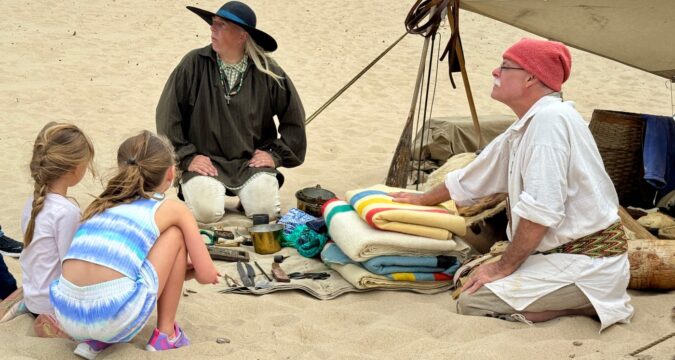
Camping on the beach at Indiana Dunes State Park with 30 mph winds was no picnic, but reenactors portraying French-Canadian voyageurs roughed it over the weekend to show what life was like for traders in the 1770s.
The living history program featured four members of the Ouiatenon Brigade from Lafayette.
Canvas over their canoe and trade goods, propped up by their paddles, served as their tent, just as it would have in the 1770s. “The most important thing, our backs to the wind,” Tom Johnson said. Otherwise, the sand would have been a brutal enemy.
Rebecca Wein, dressed in period clothing, sits among goods that French-Canadian voyageurs would have carried in their canoe in the 1770s on Saturday, Sept. 6, 2025, at Indiana Dunes State Park. (Doug Ross/for Post-Tribune)
The voyageurs wore clothing appropriate for the period.
“The sash I’m wearing is a Native American style,” said Tom Wozcinski, showing his outfit. “Shirts for the period are essentially the European version of underwear.” Dressing up to meet others would have meant wearing a vest and jacket.
Wojcinski went native from the waist down, wearing a loincloth and leggings the way Native Americans would have done.
The leggings would have dried faster than pants for canoeists getting in and out of the water frequently.
Although Rebecca Wein was camping with them, the fur traders in the 1770s wouldn’t have traveled with a woman. “This time period, there would be a bunch of guys. There’d be no ladies present,” Wojcinski said.
“Voyageurs were always a little uncouth,” Mike Murr said. Like the Native Americans they traded with, the voyageurs wore just one layer on top.
The shirts they traded for furs would have had patterns on them, something the Native Americans wouldn’t have made on their own.
Tom Wojcinski talks on Saturday, Sept. 6, 2025, at Indiana Dunes State Park, about the clothing French-Canadian voyageurs would have worn in the 1770s. The leggings would have dried faster than pants for canoeists getting in and out of the water frequently. (Doug Ross/for Post-Tribune)
“The Indians who lived here were basically a Stone Age culture at the time,” Murr said. “They went from the Stone Age to the Iron Age overnight.”
About 70% of the voyageurs’ trade goods were cloth, primarily linen and wool. “Linen was much better than wearing a leather shirt when it gets wet,” Murr said.
The voyageurs brought a birch bark canoe. “When you make a canoe, the inside of the tree becomes the outside of the boat,” Murr said.
“This canoe weighs 35 pounds and can carry just as much stuff” as a 200-pound wooden boat the Europeans would have made, he said. The voyageurs back then were happy to buy canoes from the Native Americans.
The voyageurs also hired them to help with difficult portages, like going the long way to avoid Niagara Falls en route to Montreal.
“There were no roads back then,” Wein said. Travel went along established pathways and rivers.
Chicago started as a trading post, she noted, and grew. “Any big cities are all on water. There’s a reason for that,” Murr said.
Like any experienced canoeists, the reenactors had their own tales of harrowing trips.
Murr told of traveling from Sault Ste. Marie to Thunder Bay on Lake Superior, about a 450-mile trip.
Near the end of the journey, they were at the Sleeping Giant peninsula when the weather got dicey. Eventually, they were so far from shore that they decided not to go back and just tough it out.
“The guy in front was blasted in the face by the waves,” Murr said, and another guy was bailing water nonstop.
When they got to the island they were headed toward, everyone and everything was soaked.
“We had all the island covered with our stuff lying on it, drying out,” Murr said.
They saw a freighter way off to the left. “We actually shot the flare gun twice,” he said, to alert the crew to their presence.
By the end of the journey, one guy was so eager that he got out of the canoe 20 feet from shore and waded. “The next morning, the lake was like glass,” Murr said.
They had life preservers with them, but didn’t want to get in the lake unless they had to. Up there, they call them “body recovery devices” because hypothermia sets in so quickly, he said.
Doug Ross is a freelance reporter for the Post-Tribune.