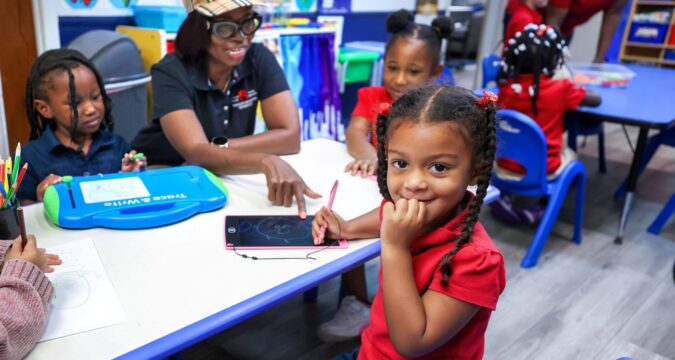
A DeLand preschool, perennially labeled “low performing” by the state, had reason to celebrate this year.
The House Next Door earned the highest possible rating — “excellent” — under Florida’s new rating system for schools taking part in its pre-kindergarten program.
“We have bragging rights now. The parents get bragging rights, too. Because their children have done well,” said Carrie Creese, the school’s principal.
For decades, Florida judged the quality of its pre-K program — contracted out mostly to private childcare centers and schools though some public schools take part, too — on how students did on a “readiness” assessment given when they started kindergarten.
Critics long argued that penalized schools like The House Next Door, which serve mostly children from low-income families. Those youngsters often start pre-K with more limited vocabularies and knowledge of the ABCs compared to children from more well-off families, and, even if they make strong academic gains during their pre-K year, they often still test “not ready” when they begin kindergarten.
And those low scores meant some preschools were labeled “low performing” and even faced losing its state contract.
A year ago, however, Florida debuted a new rating system, one that aimed to take into account preschoolers’ skills at the start of the pre-K year and then give schools credit for their growth.
The first batch of new ratings, released in August, were good news for many pre-K providers, as nearly 90% met or exceeded the state’s expectations. Orange County Public Schools, for example, announced that all 91 of its pre-K programs met state standards, and 96% earned an “above expectations” or “excellent” rating, a sign of its commitment to providing a “high-quality early learning experience.”
Preschool operators said the new system also provides valuable, real-time information. Under the old one, preschools did not get student test scores back until those children had moved onto kindergarten.
“It was very frustrating from an administrator’s point of view” to find out months later that students did not score well on the kindergarten readiness tests, said Jennifer Nadelkov, CEO of The House Next Door. “How do I fix that?”
Under the new system, students’ early literacy and math skills are tested at the beginning, middle and end of their pre-K school year, with scores quickly available to pre-K providers.
“We think it’s proving out to be a good concept. The next thing we want to see is, how does this scoring mechanism then translate to kindergarten?” said DJ Lebo, CEO of the Early Learning Coalition of Volusia County, which helps administer state-funded pre-K.
That answer will come when kindergarten readiness scores, another part of the state’s pre-K review, are released later this year.
In the past, nearly 40% of youngsters who completed a state pre-K program scored not ready when they start kindergarten. More than 158,000 children attended a state pre-K program last school year.
Steven Barnett, senior co-director of the National Institute of Early Childhood Education Research at Rutgers University, has long been critical of Florida’s pre-K program, which meets just half of the institute’s “quality standards” for state preschool initiatives.
And he has long disliked the state’s pre-K rating system.
“We’d worry not only wasn’t it accurate, but you might create incentive for programs to say, ‘No we don’t really want you because we are only going to take kids who already meet the expectations when they come in, and we’re golden,” Barnett said.
So he sees the value in the new system — but also won’t applaud it until it helps more preschoolers start kindergarten ready for academic lessons.
“If your readiness measurement means this is where we want all the kids to be, and you’ve got 60-something percent there, it’s hard for me to find that very persuasive,” Barnett noted, saying he would want to see higher readiness percentages than what Florida schools have typically produced.
The new ratings judge pre-K programs on the progress their students make on the assessments and on teacher-student interactions measured by evaluators who sit in on classes.
That data is shared with providers during the school year, giving them a chance to adjust their curriculum and provide extra support to children when needed.
Kimberly English, who owns Rising Kids Academy in Longwood, was frustrated with the old system, which judged her school low performing. Since 2021, it has been on probation.
But Rising Kids earned an “excellent” rating under the new system.
4-year-olds Kayori Clement, left, and Ka’Ori Sainvelous, work together during VPK at Rising Kids Academy in Longwood, Thursday, Sept. 18, 2025. (Joe Burbank/Orlando Sentinel)
English said the classroom evaluations helped her school improve.
When evaluators visited at the start of the year, they found students were having trouble behaving, with some having meltdowns.
So English worked with Seminole County’s Early Learning Coalition to get her teachers extra training on helping children regulate their emotions. And she created a “calming corner” in the class, where kids go when they get upset.
“You say to the child, ‘Let’s count 1-2-3. Let’s breathe in and out.’ That helps a lot,” said Charlotte Marshall, the lead teacher at Rising Kids.
When evaluators returned to the school for a follow-up later in the year, many of the behavioral concerns had been corrected.
Similarly, Marshall said, getting student assessment scores throughout the year helped boost academics.
“It lets you know, as they come in, where they start from. You may have one that started out not recognizing the letters. Knowing that helps us with our lesson planning,” Marshall said.
Lebo, of the Volusia coalition, said the new rating system should help pre-K providers figure out if there is a gap between what they teach and what is expected in kindergarten and then make changes.
But for now, she is celebrating a new rating system that encompasses more than how children tested one day soon after they started kindergarten.
“Because that data really captures the hard work providers are doing, and not just a single day in a child’s life, that really can be so influenced by a million other things,” she said.