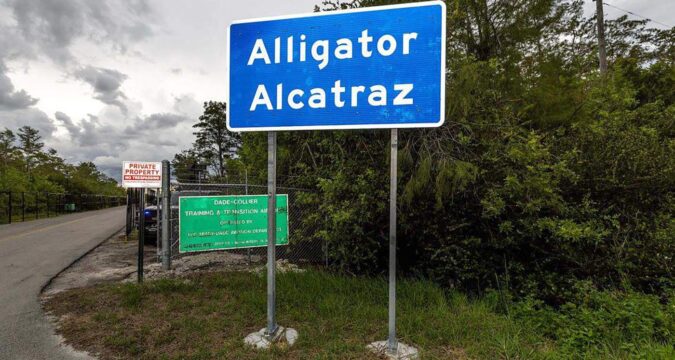
TALLAHASSEE — Almost as soon as Florida finished constructing the immigrant detention center in the Everglades dubbed Alligator Alcatraz, the lawsuits came.
The site has been holding detainees since early July after Gov. Ron DeSantis used his emergency powers to help get the center open in eight days. But its future is uncertain.
A judge in August ruled that the site needed to be effectively shut down. While an appellate court has put a pause on the order and cast doubt on the judge’s logic, the site still faces that case and at least two other lawsuits.
In the meantime, Florida has opened a second immigration detention facility and is eyeing a possible third.
Here’s everything you need to know about what’s going on at Alligator Alcatraz.
What is Alligator Alcatraz?
Attorney General James Uthmeier made the first mention of the idea of an “Alligator Alcatraz” in mid-June in an interview with Fox News.
Shortly after, construction began. Florida spent hundreds of millions of dollars on contractors who turned an airstrip in the Everglades into a tent facility that could hold up to 3,000 people.
DeSantis and President Donald Trump said the federal government would reimburse Florida for the costs of building and operating the detention center.
The funding question is a key point in one of the three major lawsuits about the facility.
Related Articles
Alligator Alcatraz detainees continue to face obstacles to meet with lawyers, court papers allege
DeSantis’ step toward victory on ‘Alligator Alcatraz’ sets up a funding dilemma for Florida
What was the lawsuit shutting it down about?
A group of environmental advocates filed a lawsuit in late June accusing state and federal officials of not conducting a required environmental review before building out the site.
The groups, later joined by the Miccosukee Tribe, argued that officials had not followed the National Environmental Policy Act.
But lawyers for Florida and the federal government argue that even though Alligator Alcatraz was set up to assist the Department of Homeland Security, it’s not a federal facility, and therefore isn’t burdened by the federal environmental act. They said in court filings that Florida controls the land, directed the construction and chooses who to detain.
And despite state and federal officials publicly saying the federal government would cover the costs, attorneys in the lawsuit noted that Florida so far has footed the bill.
The judge didn’t buy the state and federal governments’ arguments. In late August, U.S. District Judge Kathleen Williams ordered the state to stop bringing new people to the facility and to within 60 days remove all the lighting, fencing and generators that made Alligator Alcatraz functional.
She argued the facility was burdened by the federal law, saying that “if it walks like a duck, quacks like a duck, and looks like a duck, then it’s a duck.”
Her order was paused in early September by a federal appeals court panel. In its ruling, the appeals court said that the detention center is run by Florida and funded by Florida, and therefore isn’t a federal project and isn’t held to the environmental review requirement.
Plaintiffs are urging the appellate court to reconsider.
Will the federal government reimburse the state?
Running Alligator Alcatraz was initially estimated to cost about $450 million a year. The state has already put roughly $200 million into the facility, according to court filings.
If Florida does get federal reimbursement, then the government may need to conduct an environmental study, according to the appeals court. That could delay the operation of the facility.
And it could soon be a possibility. A Department of Homeland Security spokesperson last week confirmed that Florida submitted an application for reimbursement from the FEMA Detention Support Grant Program.
What is it like at Alligator Alcatraz?
Men being held inside Alligator Alcatraz have reported wildly varying temperatures, from hot to freezing, along with bugs, like mosquitoes, that enter the tented facility, according to the Miami Herald.
The detainees have also said their access to showers are limited. One man held at the facility, Cuban reggaeton artist Leamsy Izquierdo, told CBS News and NBC 6 in July that the facility’s lights are on constantly.
State officials have pushed back on reports about harsh conditions.
For weeks, the names of hundreds of men held at Alligator Alcatraz were not publicly viewable on U.S. Immigration and Customs Enforcement’s online locator. But a list obtained by the Times/Herald in mid-July shows that more than 95% of the detainees were from Latin American countries, with about 20% being from Guatemala and about 20% being from Mexico.
State and federal officials have said that Alligator Alcatraz is designed to hold “vicious” individuals. But the list obtained by the Times/Herald shows that hundreds of detainees had no criminal record in the U.S.
What are the other lawsuits challenging the site?
In mid-July, a group of Alligator Alcatraz detainees filed a lawsuit saying they were being unfairly denied access to legal counsel.
The complaint argued that attorneys were barred from in-person entry and were often unable to locate their clients on the U.S. Immigration and Customs Enforcement online detention system or establish contact with them.
The complaint also said the facility does not have information readily available about how detainees can contact their lawyers.
The plaintiffs said the state’s actions are illegal under the First and Fifth Amendments. A Southern District federal judge, who shifted the case over to the Middle District, dismissed the Fifth Amendment challenge.
The state argues that it has been fully complying with conducting video and in-person meetings between detainees and counsel, saying they have “granted every single request for a detainee to meet with legal counsel.”
Another lawsuit, filed in August, tries to challenge the state’s authority to run a detention facility.
The federal 287(g) program allows state and local law enforcement to be deputized by Immigration and Customs Enforcement, allowing officers trained in the program to question, detain and arrest people in violation of immigration laws.
The lawsuit says that while the program lets state officials help with some immigration enforcement tasks, it doesn’t give them the authority to set up their own detention facility and does not let the state delegate immigration detention to private contractors.
Critical Response Strategies, a company based out of Jacksonville, has been staffing Alligator Alcatraz and has an employee serving as the site’s warden, according to the lawsuit.
Attorneys note that the Florida Division of Emergency Management, which operates the detention center, isn’t a law enforcement agency and therefore can’t have any of its employees deputized under a 287(g) agreement.
The state has not filed its rebuttal to the plaintiff’s claims in that lawsuit.
Has Florida opened other immigrant detention centers?
Earlier this month, Florida opened up a North Florida facility DeSantis has nicknamed “Deportation Depot.”
It is Florida’s second state-run immigration detention center and operates out of a previously vacant prison in Baker County.
As of earlier this month, the state said there were about 115 people being held there. The site has capacity for about 1,300 people.
DeSantis has also said he’s interested in opening a third detention facility in the Florida Panhandle, but hasn’t shared specifics.
©2025 Tampa Bay Times. Visit tampabay.com. Distributed by Tribune Content Agency, LLC.
https://www.sun-sentinel.com/2025/09/17/what-to-know-about-whats-going-on-at-alligator-alcatraz/