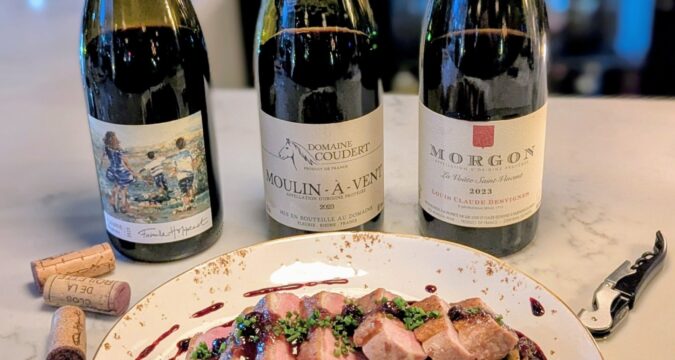
As we drive from our wine dalliances in Spain and make our way over the Pyrenees (and yes, we’ll get back to San Sebastián in another article, so no need for emails), we head toward our secret sommelier hideout: Beaujolais, home of the Gamay grape.
I’ll spare you the boring parts of the wine business like the tastings for people who don’t actually taste, but day drink, and the endless pushing of over-extracted juice made for grocery shelves and Instagram feeds. It pays the bills, sure. But it’s not why we do this. What keeps us going are those rare places that still hum with life — that smell like rain on stone and sweat on the vine.
Beaujolais. Real Beaujolais. The kind that doesn’t come with cartoon labels or party hats. Forget that bubblegum nouveau nonsense that floods the shelves every November. I’m talking about the best that can be offered here, which are the Cru-designated wines. Beaujolais is the rogue child of Burgundy, kicked out centuries ago for being too wild, too rough around the edges. But like every good outcast, it found its way and learned to make beauty from broken things.
Geographically, Beaujolais is situated just south of Burgundy and north of Lyon; it’s a patchwork of granite hills, schist slopes, and clay-limestone plains that change in character every few miles. Up north, the 10 Cru’s give this region its soul: Saint-Amour, Juliénas, Chénas, Moulin-à-Vent, Fleurie, Chiroubles, Morgon, Régnié, Brouilly, and Côte de Brouilly. Granite and schist rule the highlands, lending structure, spice, and mineral tension that keeps you reaching for another glass.
Further south, the soils soften to a mix of clay and sand, rounding the fruit and coaxing out its charm. The Gamay grape, that misunderstood little rebel, is the perfect mirror for this landscape. It can be bright and floral when it grows only one hill over, but deep and brooding on the next. It’s terroir that doesn’t whisper; it shouts, and the best winemakers here have learned to let the dirt do the talking.
These 10 little Crus have their own stubborn stories, but the three that speak the loudest to me at the moment are Fleurie, Morgon, and Moulin-à-Vent.
Suggested Bottle – Domaine Gregoire Hoppenot Fleurie ‘Origines’
Fleurie sounds delicate, perfumed, maybe a little high-maintenance, but don’t buy into the name. Beneath the violets and cherry blossoms is a woman who’s worked the rows since before dawn. Her hands are strong, her laugh a little rough, tobacco-scarred, honest. The wine opens softly with notes of wild strawberry, rose petal, and raspberry, but then evolves into something more profound, with hints of spice, dried herbs, and crushed granite weaving through the fruit. There’s a silky texture at first, but it finishes with that unmistakable granite snap. Serve it cool, and Fleurie becomes a quiet showstopper; It’s the kind of wine that can sit next to roast turkey, herb stuffing, or Nana’s 1950’s savory and shimmering Aspic and somehow pull the whole damn thing together.
Suggested Bottle – Louis-Claude Desvignes – Morgon La Voute Saint-Vincent 2023
Morgon’s a different animal; rebel of the bunch. It appears late, covered in dust, with a faint scent of smoke, black cherry, and wet stone. You can taste volcanic rock from the Côte du Py, that deep vein of iron and ash, ghosts of fire and rain etched into every sip. There’s a backbone of plum and dark berry, a flicker of leather and cocoa, and that unmistakable earthy grip that feels like shaking hands with the soil itself. Morgon doesn’t care if it’s poured into a crystal goblet or a chipped mug; it’s got weight and soul either way. It’s the one you reach for when the turkey’s gone cold and the family’s arguing about politics. It reminds you that beauty can rise from busted knuckles and black soil.
Suggested Bottle – Coudert Moulin-a-Vent 2023
Then there’s Moulin-à-Vent, the king. With its big shoulders, long finish, and serious bones, it doesn’t wear the crown lightly. The granite soil here bleeds straight into the wine, giving it power, patience, and that quiet authority you only get from age and hardship. You’ll find dark cherry and black plum wrapped in violet and crushed rose, a hint of pepper, graphite, and dried herbs whispering underneath. Give it air, and it flexes as the fruit deepens, the spice grows, the tannins stand at attention. It’s Beaujolais that knows it could stand toe-to-toe with Burgundy and isn’t afraid to grin about it. You pour it when the gravy’s thick and the candles are burning low, and suddenly that one finicky uncle who only drinks Napa Merlot becomes a Beaujolais convert after one sip.
Every November, America pretends to rediscover Beaujolais — the Nouveau kind, rushed to market like an afterthought. It’s a novelty act, a seasonal headline, and by December, it’s forgotten. But the real Beaujolais, the Cru, was built for Thanksgiving. It walks into that meal like it’s been waiting for a mic-drop moment. Bright enough for cranberries, humble enough for mashed potatoes, gutsy enough for gravy. It doesn’t fight with the food; it joins the band and enhances the sound. It plays rhythm, not lead.
And maybe that’s the point. Thanksgiving isn’t about perfection, it’s about the noise, the mess, the burned edges of pie crust, the laughter that turns to tears and back again. Cru Beaujolais belongs there, at that chipped old table with the mismatched plates, surrounded by stories everyone’s heard too many times. It forgives. It participates. It’s wine that understands what it means to be part of something bigger than itself.
Cru Beaujolais isn’t a marketing story. It’s a scar that healed kind of right. A glass that’s a little chipped but still holds the good stuff. It’s what happens when people refuse to quit. When they make wine, it’s in their blood, and they wouldn’t know how not to.
I recently sat down with chef and owner Bill Towne of Nouveau Monde Restaurant in Sandy Hook, Connecticut, with its quiet confidence and French backbone it’s one of those rare spots where food and wine speak the same language. Without drowning in adjectives or sounding like I fell face-first into a vat of Gamay, I’ll just say this: my night with Chef Bill and the moonlighting Sommelier Christophe Dumoulin was the kind of evening that makes the rest of the grind worth it. We drank Beaujolais like it was a secret language, pairing it with the beautifully plated recipe that the chef has submitted for this article. You owe it to yourself to eat here, and to drool over the world-class wine list, elegantly displayed on an iPad handed to you like a passport to paradise.
Here’s a gem of a recipe from the chef to pair with any Cru Beaujolais: Duck breast with huckleberry sauce and wheatberry salad
Ingredients:
4 6-to-8-ounce duck breasts
1 quart duck or chicken stock
1 cup wheat berries
1 small honeynut squash, ¼ inch dice
¼ cup white wine
3 tablespoons shallots, finely chopped
2 tablespoons chopped garlic
2 tablespoons fresh thyme leaves
1 tablespoon chicken base
1 teaspoon fresh sage, chopped
2 tablespoons dried cranberries
1 cup red wine
1 cup huckleberries (can use blueberries)
White sugar or other sweetener to taste
1 pound brussels sprouts, cleaned, cut in half
4 ounces thick cut bacon, chopped
2 ounces butter
1 firm apple such as honeycrisp, ¼ inch dice
Extra virgin olive oil, sea salt and freshly ground black pepper
Wheatberry Salad
In a large saucepan, place 1 tablespoon of chopped garlic, 2 tablespoons shallot, 1 tablespoon thyme and sweat on medium heat until the shallots and garlic are soft. You want to avoid getting color on the shallots and garlic. Add white wine to deglaze the pan. Add the wheatberries, chicken base and enough water to cover. Stir until combined and simmer until wheatberries are tender. Add salt and pepper to taste.
While the wheatberries are cooking, place honeynut squash on a sheet pan and roast @ 350 degrees until tender, about 10-12 minutes. Remove and let cool. Once cool, combine squash with chopped sage, dried cranberries and salt and pepper to taste. Drizzle with olive oil and set aside.
Duck
Score skin side of duck in a hash pattern being careful not to cut into the meat. Place skin side down in a cold pan on medium heat and sear until fat has rendered and skin is a golden brown. Set aside. Cast iron works best for this.
Huckleberry Sauce
In a medium saucepan, sweat 1 tablespoon chopped garlic, 1 tablespoon chopped shallots, 1 tablespoon chopped thyme. Once soft, deglaze with red wine and reduce by half. Add stock and reduce again by half. Once reduced, add the huckleberries and 1 ounce butter, stirring to melt the butter. Add sweetener to taste. Add salt and pepper to taste. Simmer until it starts to thicken, stirring occasionally. Remove from heat and let cool. Once cool, press reduction through a fine mesh to create a smooth sauce or leave with huckleberries for a more rustic presentation.
Brussels Sprouts
Blanch brussels sprouts in water until just tender. While the brussels blanch, in a small sauté pan, render the chopped bacon. Brown 1 ounce of the butter in a small sauté pan. Add brussels, bacon and apples and toss with the butter. Salt and pepper to taste.
Assembly
Place the four rendered duck breasts, skin side down, on a baking sheet and place in 375 degree oven and cook until duck has reached an internal temperature of 145 degrees for medium.
While duck is cooking, place the wheatberry and honeynut squash mixture in a large sauté pan and toss gently to warm through. Once warm, turn off heat and leave in the pan. Warm huckleberry sauce in a small saucepan on low heat. Warm the brussels sprouts in their pan if needed.
Once duck has reached temperature, remove and let rest for 5 minutes. Place ¼ each of wheatberry salad and brussels sprouts towards down the center of edges of 4 warmed dinner plates. Spoon 2-3 tablespoons huckleberry sauce in center of plate. Slice and layer one duck breast, skin side up, on top of the huckleberry sauce on each plate. Spoon 2-3 tablespoons huckleberry sauce over the duck. Circle plate with another spoonful of the sauce. Sprinkle Maldon salt over duck, brussels and wheatberry salad and serve.
A quick shout-out to my friend Christophe Dumoulin, regional sales manager at Slocum & Sons, one of Connecticut’s great wine importers and distributors, who generously supplied the chef and I with several sample bottles of Cru Beaujolais for this piece. Having industry friends put wine in front of me that are truly germane to my specific storytelling is an enormous benefit, and I’m genuinely grateful.
John Noakes, a certified sommelier has been an owner and consultant in the wine retail and hospitality industries for over two decades. He is also founder of Grateful Coffee & Wellness. You can find John and his coffee at Gratefulcoffeeco.com. Recipe by: Chef Bill Towne, owner – Nouveau Monde, Sandy Hook, Conn.