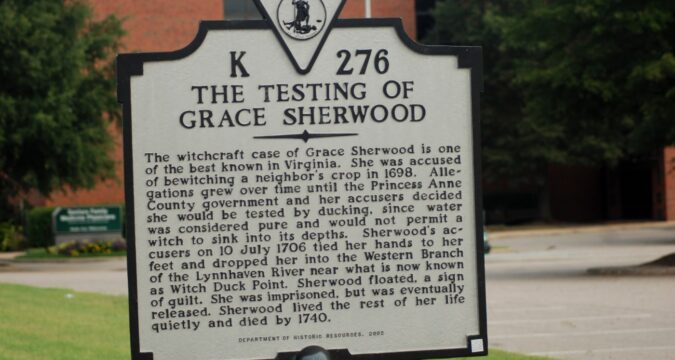
Grace White Sherwood, the “Witch of Pungo,” most certainly had a way with the neighbors. According to local legend and court records, she excelled at aggravating them.
At the corner of Witchduck Road and Independence Boulevard in the Bayside section of Virginia Beach, a bronze tribute stands in honor of the purported witch. Sculpted by Robert G. Cunningham, it depicts a young woman cradling a basket who is accompanied by an adoring raccoon.
Over the last three centuries she’s been arguably the most well-known figure in the annals of Princess Anne County and Virginia Beach history.
Sherwood lived on a small farm on Muddy Creek Road in Pungo with her husband, James Sherwood, and her three sons, James, John and Richard. She was unpopular with her neighbors, very likely because she was beautiful and independent.
In addition, Sherwood “supposedly danced naked in the moonlight” and sometimes was seen wearing men’s clothing. In her spare time, she was also fond, in her neighbor’s eyes, of bewitching their crops and souring the milk of their cows.
Something Sherwood did compelled the wife of neighbor Luke Hill to trespass on the Sherwood’s property. Mistress Hill, according to the suit filed in Princess Anne County Court, “assaulted, bruised, maimed, and barbarously beat her” neighbor. Sherwood won the lawsuit and was awarded 20 shillings.
After crops later failed inexplicably, livestock died without obvious cause and a local infant was stillborn, Sherwood’s neighbors decided — without conclusive evidence — that she was likely the proximate cause and publicly accused her of witchcraft.
Sherwood sued them for slander and lost the cases in court. It only fueled the discord in the community.
A statue of Grace Sherwood stands across the street from Old Donation Church on the corner of Witchduck Road and Independence Blvd. (L. Todd Spencer/The Virginian-Pilot, File)
A jury of women was assembled to examine Sherwood’s body for marks that indicated she was in league with the devil. The jury testified that they had found such marks. Sherwood refused to comment and offered no excuses or explanations.
Luke Hill took the case to Williamsburg, but was refused a hearing, and the matter was referred back to the county court.
Anxious to resolve the issue, the county court decided to subject Sherwood to a trial by water. She agreed and was stripped naked and cross-bound. Her right thumb was tied to her left toe and her left thumb was tied to her right toe. She was carried in a blanket to a boat in the Lynnhaven River and thrown overboard.
The trial was a no-win proposition. If she drowned, she was innocent. If she lived, she was guilty.
Sherwood, “unbowed and unrepentant,” survived the trial.
She was convicted of witchcraft and served seven years in jail.
Sherwood was released in 1715, and Gov. Alexander Spotswood granted her 140 acres of land adjacent to her own property. She returned home and by all accounts lived in peace on her own land with her three sons until her death in the autumn of 1740.
On July 10, 2006 — the 300th anniversary of her trial by water — Gov. Tim Kaine pardoned Sherwood posthumously.
The statue stands as a monument to Sherwood’s perseverance amid persecution, her good name restored centuries after colonial scandal and intrigue.
https://www.dailypress.com/2025/10/30/witch-of-pungo-history/