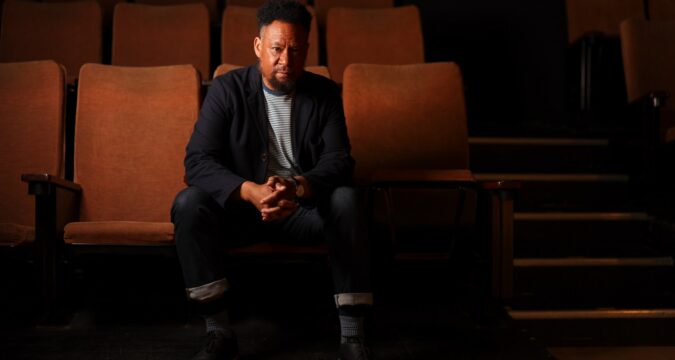
What kind of music, exactly, can you find at Constellation, nestled on a sleepy block on Western Avenue? Even club owner and drummer Mike Reed occasionally struggles to answer the question, except for one guiding credo: It should sound different.
“Contemporary classical music. Weird electronic music. We’re very jazz-heavy — mostly because it’s what I do, but also because that’s where a lot of adventurous music is coming from,” he rattles off. “I mean, if you pick up The Wire magazine, what are you going to call it? They say ‘Adventures in Modern Music.’ So, there you go.”
Adventurers, rejoice: From Sept. 10 to 14, Reed and his team will debut Sound & Gravity, a five-day, 50-act festival running in and around Constellation, and championing the same eclectic billing. Most of the acts have, at one point or another, played at Constellation — like Bill Callahan, the singer-songwriter with avant-garde bona fides, and Irreversible Entanglements, the free jazz collective.
The festival spans six stages — not just Constellation and The Hungry Brain, which Reed also owns, but Beat Kitchen, Judson & Moore Distillery, and two spots on the Rockwell on the River complex. All are a short walk away from one another on Belmont Avenue, on a stretch that intersects with the Chicago River.
This isn’t Reed’s first festival-planning rodeo. Far from it: He may be most famous beyond Chicago for founding the music festival that became Pitchfork in 2005. He remained involved in the festival’s planning and operations until last year, when media company Condé Nast, which acquired Pitchfork in 2015, abruptly announced that it would not produce another festival.
As Pitchfork’s operations ballooned in recent years, so did Reed’s ambivalence about staying involved. He found himself fantasizing about starting up another festival: something smaller, more bespoke. But juggling Pitchfork planning, his own musical projects and his two venues kept him busy enough that he had to punt on the idea.
Since Condé Nast pulled the plug on Pitchfork, however, Reed has viewed the concept with more urgency. Constellation, he says, is “in a decent spot” as far as live music venues go. But Pitchfork’s demise, as well as that of Links Hall — the dance venue that once operated out of the same storefront as Constellation — were grim reminders that the tide could change at any moment.
“I see the cyclical nature of the concert industry,” Reed says. “I was like, ‘Jesus Christ, all right, we need to do something to build reserves’ — not just get our head above water, but maybe our torso, too.”
Reed is, as he puts it, “not a gala type of guy.” So, with some reservations, he got back into the festival planning business—this time, as a benefit for Constellation. He says he’s modeling Sound & Gravity less on other mega-fests (though he acknowledges that Big Ears, in Knoxville, Tennessee, is an inspiration) than the neighborhood street fairs that are a Chicago summertime fixture.
“We’re not-for-profit,” Reed says. “Why don’t we just do our own street festival?”
He got immediate buy-in. He started inviting artists to perform on Valentine’s Day; by the summer, it was completely booked. He didn’t stop there: The Sound & Gravity team has already begun planning future festivals through 2027.
Mike Reed stands in front of the calendar in Constellation, a concert venue he owns in North Center, on Aug. 19, 2025. (Eileen T. Meslar/Chicago Tribune)
The hardest part has always been the elevator pitch for the music. (Reed says he’s caught some flak for the festival’s evocative name.) But he says the overwhelming interest — and enthusiastic “yeses” from festival talent — speaks for itself.
“Chicago has long been a place for genre-defying presentation and makers. I’m not even going to worry about that part of it,” he says.
Now that Reed is an old hand at festival planning, he’s laser-focused on logistics. Amplified, production-heavy acts — like Jeff Parker’s Expansion Trio and experimental guitar duo Body/Head — will take over Beat Kitchen, rigged for rock shows. Meanwhile, more intimate sets — like string players Lia Kohl, Macie Stewart and Whitney Johnson, who released their intricately textured “Body Sound [Stone Piece]” in August — can mostly be found at the tasting room-turned-stage at Judson & Moore Distillery. And Rockwell on the River’s event space, with its vast capacity, will host huge draws, like experimental ambient harpist Mary Lattimore and the lush grooves of Helado Negro. All the while, the same crew of Chicago musicians who assisted Reed every year at Pitchfork will help run venue support.
But with more freedom this time around. Right? Reed, per usual, sees it differently.
“I’m completely culpable for all of this,” he says, dryly. “There’s no one else to blame.”
Sound & Gravity, Sept. 10-14 at the Beat Kitchen (2100 W. Belmont Ave.), Hungry Brain (2319 W. Belmont Ave.), Constellation (3111 N. Western Ave.), Judson & Moore Distillery and Rockwell on the River (both 3057 N. Rockwell St.); festival passes $253, day passes $30-$103 depending on date. Ticketing and full lineup at soundandgravity.org
Hannah Edgar is a freelance critic.
The Rubin Institute for Music Criticism helps fund our classical music coverage. The Chicago Tribune maintains editorial control over assignments and content.
https://www.chicagotribune.com/2025/09/04/mike-reed-sound-gravity-festival/