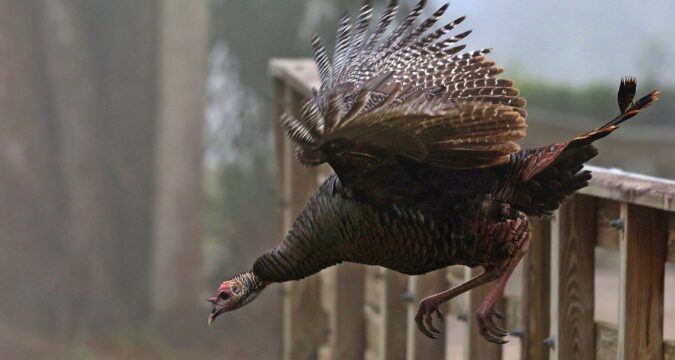
Turkey tourism is booming in Florida.
Who knew the state’s native wild turkey was such a draw, right up there with its high-profile manatees, panthers and gators?
Certainly the state’s Fish and Wildlife Conservation Commission, which says it needs more money to meet the “pressing needs of wild turkey management” as hunters from around the world descend on the state to bag the bird.
Florida’s wild turkey has “drawn increasing global interest in recent years,” the agency wrote in a budget request to lawmakers in September. That, along with “concern for the Florida wild turkey resource, calls for increased monitoring and research,” it said.
The agency is asking for $300,000 from the State Game Trust Fund to better staff its wild turkey management program, which has two employees, and expand the program to address the bird’s growing profile among hunters.
The Florida wild turkey, also known as the Osceola (scientific name: meleagris gallopavo), lives only in Florida and is one of two subspecies of turkey found in the state. It is named for the Seminole Tribe of Florida’s influential Chief Osceola, who died in 1838.
With pronounced gobbles and particularly long spurs, the Osceola stands out from other, more common turkeys because of a narrower white bar across its wing feathers, making it appear darker. The Osceola prefers Florida’s peninsula, dwelling only south of the Panhandle (any farther north and they’re breeding with other turkey species).
Heralded as a Florida conservation success story, the Osceola initially thrived in hard-to-access swamps and marshes, but more people and more hunting caused the bird’s population to disappear in some parts of Florida in the early 1940s.
Related Articles
What’s open on Thanksgiving? Not much, as many stores rest — or prepare — ahead of Black Friday
At The Gentle Barn, turkeys are for snuggling, not stuffing at Thanksgiving
The state created a turkey hunting license, which funds its wild turkey management program, and promoted the turkey population on private and public lands throughout the 1970s, leading to today’s larger turkey numbers. Most Osceolas today live on privately owned land.
Despite recent reports of population declines, the state’s Wild Turkey Summer Survey last year showed turkey productivity generally on par with previous years. Wild turkeys, including the Osceola, were spotted in 66 of 67 counties, according to the report.
Hunters are increasingly seeking the Osceola to complete a coveted “Grand Slam,” a quest to harvest all four U.S. wild turkey subspecies. Florida is the only place in the world where hunters can bag one, so with limited supply, local outfitters and the Fish and Wildlife Conservation Commission say demand for the trophy bird has soared over the last decade.
The number of turkey licenses issued each year has steadily grown, with thousands given to nonresidents, according to the Fish and Wildlife budget proposal. A better-funded and comprehensive turkey program could attract even more tourists to the state while supporting the private land owners who host them.
The National Wild Turkey Federation, a nonprofit dedicated to conserving and hunting the wild turkey, maintains a database of turkeys killed in pursuit of a slam, gives out certificates and publishes slam winners on its website, calling the achievement one of the biggest feats of the sport. The bird is considered the hardest turkey species to call in close enough to shoot, the group says.
Turkey hunts in Florida have brought in more than $800,000 each year since 2012, according to the agency, and more than $1.2 million since 2021.
Florida outfitters now routinely charge up to $4,000 for an Osceola turkey hunt, a price that has gone up exponentially.
“It’s tripled,” said Chris Santangelo, a hunting guide in Okeechobee who operates Seminole Prairie with his father. “The whole hunting world has gone into the species collecting-type deal.”
Social media has only amplified the bird’s allure. Most Florida outfitters have waitlists to get on a hunt, which are held in March and April. Right now, Seminole Prairie has a two-year wait, Santangelo said.
©2025 Tampa Bay Times. Visit tampabay.com. Distributed by Tribune Content Agency, LLC.