The Williamsburg-James City County school system wants to lead the state in how artificial intelligence is used in the classroom.
After creating a task force last fall to guide the ethical use of Generative AI, an artificial intelligence platform, the school system has launched a group to train educators at more than 16 of its schools.
The division has partnered with William & Mary’s School of Education and Computer Science department faculty to assist WJCC teachers. That allows teachers, administrators and staff to get guidance on using AI responsibly, said Meredith Kier, a School of Education science and education professor. This includes guidance on writing prompts and learning to use AI for designing lessons, she said.
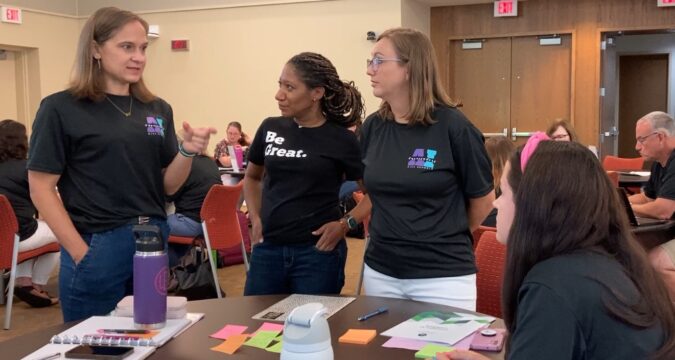
Called AI Ambassadors, the group shares information about what Generative AI is, how it’s used in individual roles within the schools and creates goals, said Kristin Barr, division supervisor of instructional technology, innovation and information literacy. The first session was held in June, along with additional summer sessions, she said.
Mike Hurley, Clara Byrd Baker Elementary School principal takes part in the AI Ambassadors group program with a staff member. Courtesy of Williamsburg-James City County Schools
Generative AI is a type of artificial intelligence that can create text, images, audio and video from information it was trained on previously. Examples include ChatGPT, Midjourney and Google Gemini. When used responsibly, Generative AI can be a tool to enhance the work of teachers, students and staff members in the classroom, Barr said. Currently, division teachers and students use MagicSchool AI while age-appropriate students use Microsoft CoPilot. Many of the division’s software programs, such as Canva and Nearpod, have AI features, she said.
With AI being integrated into a variety of digital platforms, Barr said, students are being introduced to it “whether we want them to or not.”
“When you do a simple Google search, the first result now is an AI generated summary, rather than Wikipedia or another website like what they would be used to,” Barr said.
Barr compares students’ use of AI to how calculators are used in math classes. Students might use calculators for some of their course work, or sometimes not at all due to teachers asking them to do the math work in their head. With AI becoming “unavoidable,” Barr said, schools are opting to use it responsibly as opposed to pretending it doesn’t exist.
The school division also uses a Generative AI Guidebook to provide guidelines on students using AI responsibly, such as fact checking AI-generated information and only using it as approved by their teachers. The school board also approved a two-year $43,000 contract with CopyLeaks, a plagiarism prevention and AI detection software, during its Sept. 16 meeting. The program will be used for students and educators in grades 6 to 12.
Barr, along with Superintendent Daniel Keever and Organizational Development Supervisor Alania Trott, also presented the division’s work on AI integration to the Virginia School Board Association. Barr said much of the conversation revolved around a “realistic approach” to AI use by students and how conversations would go if teachers and administrators had concerns of students inappropriately using Generative AI.
“How do we support our adults in the building to be able to better understand and address situations, so that it is an opportunity for learning and for growth as opposed to discipline or punishment?” Barr asked. “While that might be part of the response, not the entirety of it.”
William & Mary is also focusing on AI integration, which includes guidelines on how to use it appropriately. Instructors are allowed to establish polices related to their courses, with students encouraged to review their syllabus instructions for AI permission.
Kier said university faculty members collaborate to identify appropriate uses of AI to support their learning and brainstorming. In the School of Education, AI is primarily used to support teacher development and instructional design, she said.
The School of Computing, Data Sciences and Physics also launched a new minor in Artificial Intelligence this semester, which is available for all undergraduate students. Course topics include how to use AI tools such as ChatGPT and Gemini as well as using AI effectively in important environments, such as national security, said Douglas C. Schmidt, the school’s dean.
“It’s just so important nowadays for people to not just have the wonderful skills we expect from William & Mary graduates in critical thinking, analytical reasoning, but to also have fluency in AI,” Schmidt said. “So that they can compete in this brave new world of artificial intelligence and machine learning.”
The WJCC AI Ambassadors group will reconvene in October to review the progress they’ve made in each school, Barr said.
James W. Robinson, 757-799-0621, james.robinson@virginiamedia.com
https://www.dailypress.com/2025/09/20/wjcc-schools-prepares-teachers-to-use-ai-in-the-classroom/