Julie Xirau is suing her 11-year-old autistic son’s teachers and their employer for wrongful death, alleging that they kept him for hours in a corner of his classroom and failed to intervene as he sustained injuries to his brain that caused him to die days later.
Joshua Sikes was a fourth-grader with disabilities attending school in a classroom operated by Southeastern Cooperative Educational Programs, or SEPEC Public School Consortium. SEPEC, headquartered in Norfolk and formed in 1978, operates programs for children with special needs in schools in Chesapeake, Franklin, Isle of Wight County, Norfolk, Portsmouth, Southampton County, Suffolk and Virginia Beach.
SECEP did not respond to emails and phone calls requesting a comment.
The lawsuit, filed in Norfolk Circuit Court, is asking for $150 million in damages. It recounts a series of events that began Oct. 31, 2024, when Xirau got a call from her son’s teacher telling her he had misbehaved and needed to be picked up.
In the following days, the lawsuit says, Joshua appeared to his mother as increasingly lethargic and withdrawn.
Xirau took him to the emergency room on Nov. 2, where he was examined and discharged that same day. Xirau made arrangements to have him seen by a pediatric neurologist.
But the next morning she found Joshua dead in his bed.
Joshua’s death was the result of “complications of seizure disorder,” as the Office of the Chief Medical Examiner described it.
According to the lawsuit and his autopsy report, it was brain injuries sustained from repeated trauma to his head, said Matt Moynihan, Xirau’s attorney.
Carole Parker, a defendant in the lawsuit and teacher in Joshua’s classroom, showed up at Xirau’s home in the week following Joshua’s death and told her that she and her two colleagues had kept Joshua for over two hours in a back corner of the classroom, without intervening as he injured himself in attempts to escape.
The two other teachers employed by SECEP, Theresa Renvyle, Nicole Smrz, are defendants of the lawsuit, as well as Pembrooke Elementary principal Katherine Wynne.
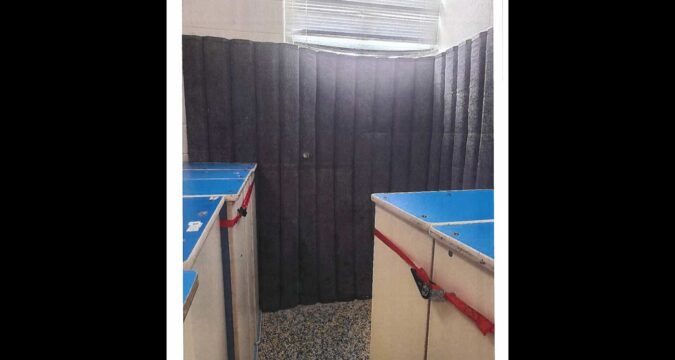
Photos filed with the lawsuit show tall filing cabinets and shelves, strapped together and placed perpendicular to the walls, with the hard floors exposed. It creates the small space in which the lawsuit says Joshua’s teachers put him for hours.
The lawsuit calls it “a makeshift prison” and alleges that Joshua’s teachers had restrained him there and many times prior. Joshua had special needs and challenges associated with diagnosed disabilities, all of which his teachers were required to be familiar with through his individualized educational plans.
The three teachers, according to the lawsuit, claimed that secluding and restraining Joshua in the corner would calm him.
“I want my mommy,” Joshua told his teachers, according to the lawsuit. “I don’t want to go to jail. No more angry bear,” he said.
The lawsuit says Joshua laid down on the bare floor and kicked at the walls of the “make-shift prison.” Every time he did so, his head rebounded, hitting the floor.
When Xirau picked her son up from school that day, no one informed her about what happened, except that he had misbehaved, the lawsuit says.
Limited in his ability to communicate verbally, Joshua could not tell his mother what had happened at school. As a result, Xirau could not tell medical professionals at the emergency room that her son had sustained trauma to his head.
“You have to trust that the people you drop your child off at school with are acting in their best interests,” said Moynihan, Xirau’s attorney. “We do not believe that was the case for Joshua.”
The lawsuit includes screenshots of what it describes as messages between Renvyle, Smyrz and Wynne expressing concerns with protecting themselves from litigation and keeping the truth about Joshua’s injuries away from his mother, in the months after his death.
Renvyle, Smrz and Parker left the 11-year-old secluded for the purpose of documenting a duration of behavioral challenges that would be long enough for him to be transferred to a different school, according to the lawsuit. Given the vulnerability of Joshua and his classmates, “the last thing they need are teachers agitating them in order to justify moving them to a different classroom or school,” Moynihan said.
Child Protective Services, in the days after Joshua’s death, received an anonymous complaint alleging that Xirau had physically abused and neglected him, Moynihan said.
Moynihan said CPS found the complaint to be false. The report found evidence that Joshua had experienced severe physical abuse and neglect, Moynihan read from a 2025 letter summarizing the CPS findings.
But CPS determined his mother had nothing to do with it and there was not enough evidence to determine if other people in Joshua’s life were at fault.
State law allows special education teachers to use seclusion and restraint, defined as “involuntarily confining” a student in order to de-escalate circumstances in which a student’s disabilities can lead to harmful or violent behavior.
The Consortium’s executive director, Laura Armstrong, told members of the Virginia Beach Special Education Advisory Committee in May 2025 that special education classrooms “can’t have an impromptu seclusion area,” like the one photographed and attached to the lawsuit, according to WHRO reporting. Armstrong did not respond to requests for comment on Xirau’s lawsuit.