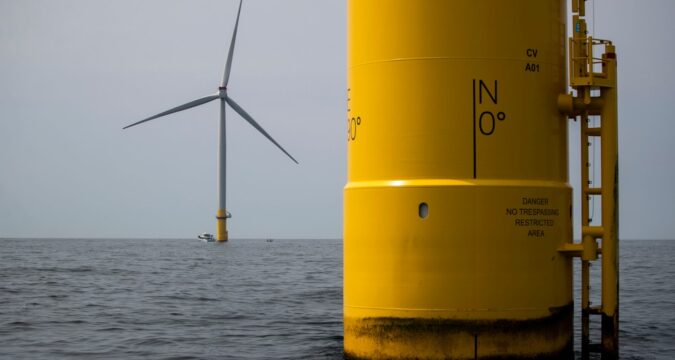
President Donald Trump has sought to halt the construction of five giant wind farms off the coasts of Maryland, Massachusetts, New York, New Jersey and Rhode Island — all states run by Democrats.
But there is one East Coast wind farm that has so far escaped the administration’s ire: a $10.8 billion project under construction off the shores of Virginia, where Gov. Glenn Youngkin, a Republican, has been its champion.
Youngkin has quietly pushed back against Trump’s war on wind energy. A supporter of the president, the governor has privately urged the Trump administration not to target the project known as Coastal Virginia Offshore Wind according to four people briefed on the matter who spoke on the condition of anonymity to describe private conversations.
Virginia Gov. Glenn Youngkin
Youngkin called Doug Burgum, the interior secretary, last month to voice support for the project, according to two of the people briefed on the matter. His office also called the White House in January to express concern about Trump’s executive order that paused permits for new wind farms on federal lands and waters, two of the individuals said.
The outreach by Youngkin, which had not been reported, highlights a rift within the Republican Party over how to treat offshore wind power. While Trump has called wind turbines ugly and inefficient, some conservatives have privately acknowledged their potential to lower household energy bills and add power to the electric grid at a time when electricity costs are rising nationwide.
Coastal Virginia Offshore Wind — about 27 miles off the coast of Virginia Beach — is about 60% complete, according to Dominion Energy, the utility behind the project. Once finished, the wind farm would be the nation’s largest, consisting of 176 turbines that could generate about 2.6 gigawatts of electricity, or enough to power up to 660,000 homes. It is on track to be up and running next year.
Demand for electricity in Virginia is growing at its fastest pace since World War II, in large part because of a boom in construction of data centers to power artificial intelligence. Northern Virginia is already home to one of the largest concentrations of data centers in the world, and Dominion has estimated that the state’s electricity use could double over the next 15 years.
That demand has threatened to push up electricity prices in the region and has left the utility scrambling for new sources of power. This year, Dominion has proposed rate increases for residential customers that could add $21 per month to electricity bills starting in 2027.
It is unclear whether Youngkin will prevail in his efforts to save Coastal Virginia Offshore Wind. Its fate could become clearer in the coming months, when Trump officials could indicate in a court filing whether they plan to revoke its federal permits, which were issued under the Biden administration.
A spokesperson for Youngkin, Rob Damschen, did not respond to several requests for comment. A spokesperson for Dominion Energy, Jeremy Slayton, declined to comment for this article.
Trump has disparaged wind energy ever since he failed 14 years ago to stop an offshore wind farm that was visible from one of his golf courses in Scotland. Since returning to office, he has taken the extraordinary step of instructing a half-dozen agencies to draft plans to thwart the country’s offshore wind industry.
Last month, the administration abruptly ordered construction to stop at Revolution Wind, a $6.2 billion wind farm off the coast of Rhode Island that is 80% complete. The company building that project is suing the Trump administration to restart construction. The states of Connecticut and Rhode Island, which were both to receive electricity from the project, are also suing.
Four months earlier, the Interior Department ordered a halt to work on Empire Wind, a $5 billion wind farm off the coast of New York that is 30% complete. After several weeks and negotiations with Gov. Kathy Hochul, a Democrat, the administration allowed Empire Wind to proceed. White House officials suggested they had relented only after Hochul agreed to approve new gas pipelines in the state. She denied that any such deal had been made.
In addition to targeting two offshore wind farms already under construction, the administration has suggested it plans to rescind permits for three other projects off Maryland and Massachusetts that are in the planning stages. A federal judge has given the administration until Sept. 19 to indicate its plans for Coastal Virginia Offshore Wind, although Justice Department lawyers could request more time.
The judge set that deadline in a case challenging the Virginia wind farm that was brought by three conservative nonprofit groups, including the Heartland Institute, which is known for attacking climate science. The groups accused the Biden administration of failing to consider the facility’s effects on endangered whales.
“We feel like we’re David versus Goliath” because of Dominion’s influence in Virginia politics, said H. Sterling Burnett, who directs the Heartland Institute’s Arthur B. Robinson Center on Climate and Environmental Policy.
Dominion, which has donated millions of dollars to Virginia politicians on both sides of the aisle, plans a mix of new gas-burning power plants and solar power to satisfy growing electricity demand. But the utility has also maintained that the offshore wind project would play a critical role in meeting the state’s needs.
“Offshore wind runs throughout the day and is an ideal hedge for a system with a decent amount of natural gas,” Bill Murray, Dominion’s senior vice president for corporate affairs and communications, said in February. “The fuel cost savings from 2.6 gigawatts of offshore wind are eye-popping.”
Because of term limits, Youngkin is not seeking reelection this November in a race in which rising costs — including those for electricity — are a top concern for voters. Abigail Spanberger, the former member of Congress and Democratic candidate who is widely seen as the favorite, and Lt. Gov. Winsome Earle-Sears, her Republican rival, have voiced support for offshore wind power.
Rep. Jen Kiggans, a Republican who narrowly won reelection last year in her suburban Virginia swing district, has been one of the most vocal champions in Congress for Coastal Virginia Offshore Wind. She told Politico in January that she had received “reassurance” from the administration that the project would not be affected by Trump’s executive order pausing wind energy development. Her office did not respond to a request for comment.
Youngkin has encouraged not only the Dominion project but also other manufacturing facilities in Virginia that could supply the offshore wind industry along the East Coast. In July 2024, he cheered a $681 million investment in a Chesapeake facility that would make the undersea cables that connect offshore wind farms to land.
Youngkin praised the Dominion project at an October 2023 event at the Portsmouth Marine Terminal commemorating the arrival of monopiles — the towering steel pipes that are driven deep into the seabed to support wind turbines. He called the structures “the biggest thing that ever comes through this port other than maybe an aircraft carrier,” and he commended Dominion for creating what he termed 1,000 “great, high-paying” jobs.
“This exciting chapter in the future of our energy and maritime industries is being written right here,” Youngkin said.
https://www.pilotonline.com/2025/09/09/youngkin-pushes-back-on-trumps-war-on-wind/