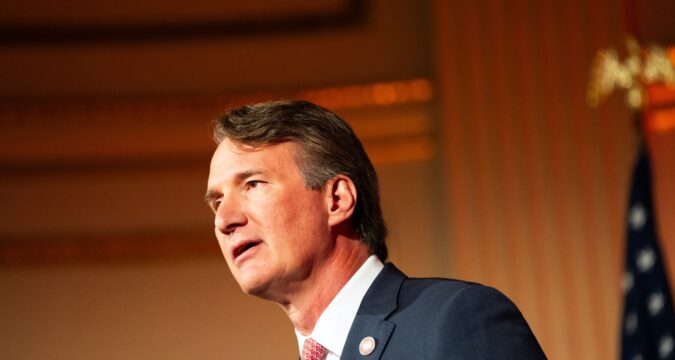
RICHMOND — Gov. Glenn Youngkin will present his final budget plan before the General Assembly’s money committees Wednesday. Unlike in the past, the governor is not suggesting eliminating the car tax, which he’s called the most hated tax in America.
The magnitude of meeting the commonwealth’s spending obligations next year was such that it crowded out other priorities, according to a senior administration official who briefed reporters about the proposal ahead of its rollout. Mandatory spending measures include $2.6 billion in critical Medicaid investments over three years and $543.8 million for recalibrating the state’s education funding formula.
Other topline items include $730 million in tax relief, including making permanent the increased standard deduction and the refundability of the earned income tax credit. Youngkin’s budget also mimics some of the measures in the federal spending budget bill, HR1, that made permanent President Donald Trump’s 2017-era tax cuts. Those conformity measures include a phased-in elimination of tax on tips and car loan interest.
But the two-year budget lawmakers adopt next year is unlikely to closely resemble Youngkin’s proposed spending plan. That’s because Youngkin, a Republican, leaves office next month and Gov.-elect Abigail Spanberger, a Democrat, will be sworn in. Youngkin, like all Virginia governors, is prohibited from serving a second consecutive term. Democrats swept Virginia elections in November, taking control of the top state elected offices and picking up additional seats in the House of Delegates. They will hold control of the General Assembly and have the votes to make drastic changes that fit their priorities.
Related Articles
Democrats’ trifecta in Virginia means a fresh look for previously vetoed bills
What will Youngkin do next? He’s keeping it close to the chest.
Youngkin’s last budget includes $50 million to improve Child Protective Service, foster care
Youngkin’s budget bill also calls for tax reform that would change its tax collection methodology from cost of performance to market-based sourcing, meaning that companies would be taxed where based on where customers are located as opposed to where the business provides service.
The budget also includes $1 billion for pay increases for teachers, support staff and state employees, including a 2% bonus in fiscal 2026 and a 2% salary increase in fiscal years 2027 and 2028. An additional $328 million would go to pollution reduction efforts. And, $2 billion, which includes $890 million from the state’s general fund and $1.1 billion in authorized debt, would go towards new construction projects. That includes resuming projects at Virginia universities that Youngkin paused back in May to prepare for economic uncertainty caused by federal policy.
Earlier this week, Youngkin also proposed the inclusion of $50 million in the budget to fund a three-year child welfare strategy that overhauls Child Protective Services intake process and increases pay for social workers.
In Virginia, the budget operates on a biennial basis — in odd years, the governor proposes a bill at the end of the year that dictates the commonwealth’s budget for the next two fiscal years, which start July 1. In even years, they propose a slate of amendments to that bill. That means Spanberger inherits Youngkin’s budget proposal. The legislature, which is controlled by Democrats, will vote to amend the budget, and Spanberger will sign off on it.
This article will be updated.
Kate Seltzer, (757)713-7881, kate.seltzer@virginiamedia.com
https://www.pilotonline.com/2025/12/17/youngkin-last-budget/