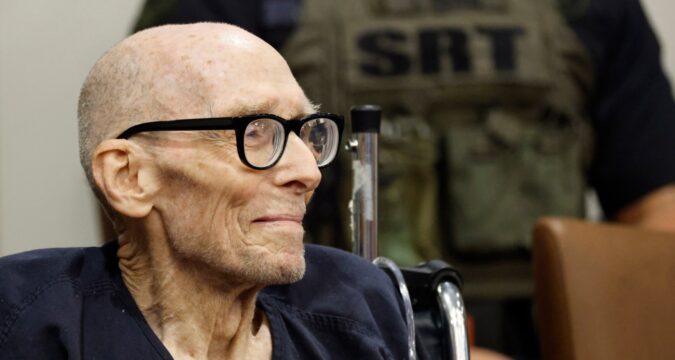
Convicted murderer Tommy Zeigler — who has been on Florida’s Death Row nearly 50 years, longer than any other inmate — listened intently on Monday as his attorneys laid out the case that recent DNA tests of blood samples taken at a gruesome crime scene prove the furniture store owner could not have killed his wife, in-laws and a customer on Christmas Eve 1975.
“They got the wrong person,” attorney Dennis Tracey said in the Orange County courtroom. “Tommy Zeigler was not the perpetrator, but the victim. … We believe that these DNA tests will show that Mr. Zeiger could not have committed these crimes.”
Tracey called Zeigler’s 1976 trial “a travesty of justice” in which he was found guilty in the shooting deaths of his wife, Eunice, and mother-in-law, Virginia Edwards, and in the shooting and beating deaths of his father-in-law, Perry Edwards, and store customer Charlie Mays.
Circuit Court Judge Leticia Marques agreed in August to hold the evidentiary hearing this week to consider 232 tests conducted over the past two years from 43 items of clothing and samples of blood smears taken at the crime scene decades ago. She will decide whether the new evidence warrants overturning Zeigler’s convictions, ordering a new trail and setting him free, as his attorneys want, or if his convictions should stand, as prosecutors contend.
Zeigler, who turned 80 years old this year, was brought into the courtroom in a wheelchair, although he did stand briefly during the hearing. He wore a dark blue prison jumpsuit and thick black-framed glasses. He breathed through a hose connected to an oxygen tank behind him. He smiled and shook hands with his team of attorneys and occasionally looked around the crowded courtroom. Zeigler later was brought a black blazer, which sheriff’s deputies in the courtroom helped him put on.
Zeigler — convicted and sentenced to death in July 1976 — has long argued that he’s a victim of a botched robbery attempt coordinated by Mays, who owed the store money.
But state prosecutors, led by state Assistant Attorney General Joshua Schow, said Monday that Zeigler is guilty and that his motive was money: He took out two life insurance policies worth a total of $500,000 on his wife nearly two months before the murders.
Schow also argued that Zeigler’s defense carefully selected which items to test for DNA “to fit their theory” that Zeigler is innocent.
Schow said a bloody rubber glove found at the crime scene “was never tested,” for example.
“The reason he’s on death row is because the evidence presented at trial clearly showed he was the murderer,” Schow said.
In a court filing last summer, Orange-Osceola State Attorney Monique Worrell’s office made the same point, saying the latest DNA tests are not enough to rescind Zeigler’s convictions and release him from state prison in Raiford.
“Nothing from this new round of testing changes the fact the jury got it right the first time around: Zeigler is guilty beyond a reasonable doubt,” the filing said.
Defense attorneys on Monday pointed out that Zeigler did not have any of his family’s blood or DNA on his clothes, which would have splattered on him if he had shot and beat them to death.
Two forensic scientists hired by Zeigler’s defense team testified as to how they tested samples of blood from each of the victims’ clothing.
Prosecutors did not address those findings on Monday. The hearing is to continue Tuesday.
Circuit Court Judge Leticia Marques during an aside with defense attorneys and prosecutors in an evidentiary hearing for Tommy Zeigler at the Orange County Courthouse, on Monday, December 1, 2025. (Ricardo Ramirez Buxeda/Orlando Sentinel)
Zeigler’s execution has been delayed several times over the decades because of appeals and evidentiary hearings. But this time, his attorneys say, is Zeigler’s last and best chance to walk out of state prison as a free man.
The winding case has drawn interest and scrutiny from around the world for decades, including civil rights advocates who have questioned the 1976 court proceedings.
On that Christmas Eve nearly 50 years ago, Zeigler was at his furniture store on Dillard Street when he called a friend, who was the Winter Garden police chief, to tell him that he had been shot. At the hospital, Zeigler claimed that he was attacked while entering the back of the dark store with an employee.
Police found the bodies of his wife, in-laws and Mays, along with several guns and pools of blood throughout the furniture showroom.
Prosecutors said Zeigler shot his wife, then his mother-in-law and then his father-in-law before beating the older man over the head with a metal pipe. The family had gathered at the store that night so Zeigler could gift his wife’s parents with a new recliner to take back to Georgia.
Zeigler later shot and beat his customer Mays to death after luring him to the store on the promise of selling him new TV set that night, according to detectives.
Detectives said Zeigler then shot himself in the stomach to make it seem he was assaulted.
Zeigler maintained that Mays was in the middle of a robbery with other men when the Zeiglers walked in.