Despite relentless urging from the DeSantis administration to slash property tax rates, cities and counties in Central Florida largely chose to ignore the pressure.
At least 20 local governments in the four-county area have decided to keep their same property tax rate as last year, according to a Orlando Sentinel review of decisions made as municipalities approached the annual Oct. 1 deadline to set their so-called millage. Nine increased their tax rate, while eight decreased it. But even most of those that lowered the rate at which they tax property will collect more money than last year, as a result of the continued surge in this fast-growing region’s property values.
That surge also ensures that the vast majority of Central Florida homeowners will confront higher property tax bills next year, regardless of what their local governments did to tweak the tax rate.
Property tax decisions – often closely watched by locals – are in sharper focus this year, as Gov. Ron DeSantis and his allies push to get an amendment on the ballot to slash or entirely abolish them.
Florida Republicans launched a #RollbackNOW initiative in May, urging counties to adopt a “rolled-back rate”, or the tax rate needed to collect the same amount of money as last year, in their upcoming budgets. Just three Central Florida cities — and no counties — did so among the 37 budgets reviewed by the Sentinel.
The most vocal GOP crusader on the tax-rate issue has been Chief Financial Officer Blaise Ingoglia, appointed to the post by DeSantis, who has held news conferences across the state accusing local governments of overtaxing and overspending.
Earlier this month in Orange County, he charged that the county was overtaxing by $148 per person and could “easily” slash about $200 million in “waste” from the budget, though he didn’t identify specific items. He also called for a property tax cut of $.86 per $1,000 in taxable value ahead of the county’s budget vote.
Florida Chief Financial Officer Blaise Ingoglia holds a press conference at Restaurant Equipment World, on Monday, Sept. 15, 2025. (Ricardo Ramirez Buxeda/Orlando Sentinel)
Orange County Mayor Jerry Demings blasted Ingoglia’s assertion and said the county spends its tax money on its residents and pays employees fair wages. Last week, Orange County Commissioners approved their $8.3 billion budget, and maintained the property tax rate of $4.43 per $1,000 in taxable value.
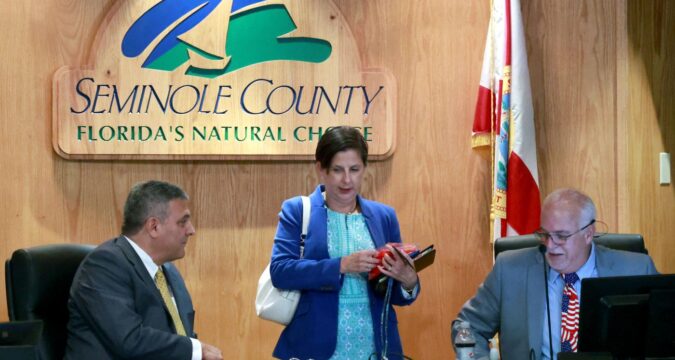
Seminole County drew a tidal wave of public input when it voted this week to raise its property tax rate 10% to $5.38 per $1,000 in taxable value. County officials cited the need to bolster its reserves, an account depleted after the COVID-19 pandemic, as well as higher costs for the sheriff’s office.
“A 10% tax hitting us so quickly is just too much,” said Peter Buis, of Sanford.
Others, though, were amenable to paying more if it meant protecting their quality of life.
“I value this county and am willing to contribute not only what you’re asking, but even more to sustain our quality of life, our natural resources and our infrastructure,” said Rafael Caamaño, of Oviedo.
Lake County slightly lowered its tax rate by about a penny per $1,000 in taxable value, from $5.0364 to $5.0254 per $1,000. On a home taxed at $300,000, it’s a savings of about $3.30. But even so, the lowered rate is above the rolled-back rate, which means the county will still pull in 5.58% more property taxes than last year.
Osceola County maintained its rate of $6.70 per $1,000 in taxable value for the 15th year in a row, but will see a $45.5 million spike in tax collections due to rising values and new construction.
And Orlando also kept its rate of $6.65 per $1,000 the same this year, projecting an increase of about $21 million in tax revenue.
Mayor Buddy Dyer said no one has approached him about lowering the tax rate in years. He said the increased revenue is needed to help the city hire more police officers and firefighters.
“When I started out, a fire station cost about a million and a half, and now we’re talking $12 million or $13 million for a fire station,” said Dyer, who has held his post since 2003. “So the cost of things has gone up substantially.”
Bay Lake, Lake Buena Vista, Winter Garden, Casselberry, Groveland, and Astatula also raised their tax rates.
Belle Isle officials are set to vote on a tax rate hike on Tuesday. Umatilla’s tax rate increased from last year, but oddly, is at the rolled-back rate, meaning the city will collect the same amount in property taxes as last year.
Only residents of Clermont and Howey-in-the-Hills will see lower tax bills, as their councils set rates below the rolled-back rate.
“I’ve never met anyone who says they love paying taxes,” said Bryan Bain, a Clermont resident and candidate for a city council seat.
“But I know plenty of people in Clermont that value our parks and rec, love our police and fire, and are incredibly thankful when public works shows up to fix that water main break, no matter what time of day or the temperature and weather outside,” he said at a recent meeting. “I think it’s reasonable, workable and it helps us taxpayers.”