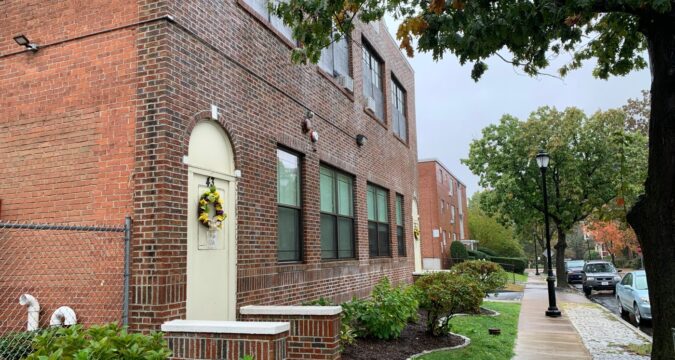
An apartment complex for low-income, senior residents — created in the early 1980s from a soda bottling factory — will be getting a $3.4 million upgrade, including new kitchens, bathrooms and windows.
Renovations at the 23-unit, Bacon Congregate housing — just south of downtown Hartford and in the Congress Street Historic District — are expected to start within the first three months of 2026 and take about a year to complete.
Bacon Congregate is part of the State-Sponsored Housing Portfolio.
Being part of the portfolio qualifies the Morris Street complex for funding for capital improvements “undertaken as part of a long-term plan to ensure the sustainability of high-quality housing affordable to moderate- and low-income families and seniors,” according to Emily Wolfe, executive director of Sheldon Oak Central, Inc. which created and owns the housing.
“It’s independent living, but because people take a meal together, it really encourages socializing and community life,” Wolfe said.
The low-income, senior housing at the Bacon Congregate complex in Hartford was created out of a former, soda bottling factory. (Kenneth R. Gosselin/Hartford Courant)
Sheldon Oak Central, the Hartford-based housing nonprofit, also is leading the $64 million redevelopment of the Martin Luther King Apartments near the Colt complex.
Apartments are subsidized — so tenants pay 30% of their income for rent.
The meal — prepared off-site because there isn’t a commercial kitchen at the complex — is subsidized by the state. There are recreational programs, private meeting space and on-site offices of the management company, Wolfe said.
Though focused on independent living, the complex also can provide some services of assisted living so residents can “age in place,” Wolfe said.
Wolfe said the complex is fully occupied except for a few units that will be used similarly to hotel rooms while renovations are completed on individual units.
In 1946, The Courant reported that the Bacon Bottling Co. established itself on Morris Street in the late 1870s, expanding with the public’s taste for carbonated beverages.
With the repeal of Prohibition in 1933, the company also became one of the largest liquor distribution businesses in Connecticut.
The company later relocated a large portion of its business to Homestead Avenue but kept bottling soda on Morris Street.
Kenneth R. Gosselin can be reached at kgosselin@courant.com.