Connecticut professors and leaders are concerned about a broad crackdown on free speech and academic freedom.
The concerns go beyond the immediate aftermath of the recent murder of conservative activist Charlie Kirk that saw firings and public hostility for various comments and extend to President Donald Trump’s orders to eliminate diversity, equity and inclusion programs.
It’s a stark contrast with the cultural atmosphere of inclusion following the death of George Floyd while handcuffed in police custody in May 2020 in Minnesota.
As a result, some college professors have been more cautious about what they will say in class in 2025 than they have in the past, officials said.
“Faculty are very nervous,” said Louise Williams, a history professor at Central Connecticut State University who serves as president of the faculty union at all four regional public universities in Connecticut that include Eastern, Western, and Southern universities. “Some of them — it’s been suggested that they change the titles of their courses and maybe not teach certain courses. There hasn’t been a really clear directive to that effect, but there has been more informal pressure. So faculty are very worried about it.”
This includes classes about Palestine, politics during the Trump era, and “anything that had to do with controversial subjects,” she said.
“That’s very disconcerting because that’s not freedom of speech and academic freedom,” Williams told The Courant in an interview. “We definitely believe in evidence-based learning, and we believe we should have the freedom to tell what the evidence says is the truth and to teach what is truth.”
But Williams declined to reveal details about specific classes or the titles of courses, saying that professors believe they could become the subject of retribution.
“We are too worried right now about people coming after us. I would be reluctant to give any more specifics. That’s where we’re at. We don’t want to get targeted, and there’s a big fear of being targeted. … It’s hard. We’re scared. Everyone is scared.”
Faculty members are “absolutely” concerned about what they can or cannot say in their classes, she said.
“Everyone is worried about it,” Williams said. “You have some students in classes who are asking you questions about what they can learn or not learn or whether the government is going to come down on them or not. People forget the students involved in all of this. Their educations are in jeopardy, and they want to learn the truth. They don’t want to not be sure that what they’re learning is true or not because we’re afraid to say something.”
After 28 years of teaching history at Central Connecticut State University in New Britain and more before she arrived there, Williams said she has not experienced a similar atmosphere in her decades of teaching.
“I have never seen anything like this,” she said. “This is unheard of — to have a government tell a historian what they can and cannot teach about the past is something that has never happened in my lifetime or I think in the country, ever.”
Among other things in recent months, the Smithsonian Institution changed an exhibit that temporarily deleted references to Trump being impeached twice and changed the language of the exhibit. Trump signed an executive order in March 2025 that he called “Restoring Truth and Sanity to American History” and called for deleting “divisive narratives” and “improper ideology” from various museums and sites.
The order specifically mentioned attorney Lindsey Halligan to work with Vice President JD Vance and top lawmakers “to seek the appointment of citizen members to the Smithsonian Board of Regents committed to advancing the policy of this order.” Months later, Halligan was appointed by Trump as the interim U.S. attorney in Virginia, and she signed the controversial indictment of former FBI director James Comey on charges of lying to Congress and obstruction of justice.
Faculty members at state universities are concerned about free speech and academic freedom. Here, they are shown protesting cuts to higher education in the past at the state Capitol complex in Hartford. They are, from left, Professors David Stoloff of Eastern CT state university, SCSU’s Stephen Tomczak and Julian Madison, Helen Koulidobrova of CCSU, Elena Tapia, President, CSU-AAUP, and CCSU’s Louise Williams and Jesse Turner, right, who all chanted “revise and resubmit” regarding the budget cuts.
At Sacred Heart University in Fairfield, longtime political science professor Gary Rose said he is not aware of any professors being pressured regarding free speech and academic freedom.
“At my university, there has not been a crackdown,” said Rose, a tenured professor who has been teaching at Sacred Heart for 44 years. “I do know that at some colleges across the country, speaking broadly, that a lot of the faculty has issues with bringing real conservative speakers on campus. There has been a chilling effect on particularly conservative speakers on college campuses these days. That, to me, is very troubling.”
About six or seven years ago, Rose said, some faculty members were strongly opposed to a plan for conservative Charlie Kirk to speak at Sacred Heart in the days when Kirk was little known around the country. Kirk eventually did not speak at the school.
“There were some far-left wing faculty members who were really up in arms over that,” Rose told The Courant in an interview. “But that was then. Since then, I have not seen any attempt to suppress speech on my campus since then. That was one incident that happened.”
At UConn, the university adopted a policy on free speech in 2017 that has been reaffirmed by administrators since then.
“Membership in this [university] community does, however, mean that we must be aware of the potential social consequences of expression that relies on negative stereotypes or abusive language that has concrete material consequences or silences those to whom the speech is addressed,” UConn said. “Free speech is not free when it is used to silence others.”
Jeffrey Dudas, professor of political science and president of the UConn chapter of the American Association of University Professors, said, “UConn AAUP is strongly in favor of the academic freedom of its members and of the principle of academic freedom.”
Nationally, there has been widespread concern about freedom of speech, according to the latest poll by Quinnipiac University in Hamden. The poll showed that 53% of voters are pessimistic that free speech would be protected in the United States, while 43% are optimistic.
The results represent a sharp change from six months ago when 54% responded that they were optimistic and 43% were pessimistic, the poll said. In late January, the numbers were even higher as 57% were optimistic and only 38% were pessimistic.
From the first day of his second term, Trump has been addressing the subject of free speech. On Jan. 20, he issued an executive order that said the government should not be involved in blocking free speech.
“Over the last four years, the previous administration trampled free speech rights by censoring Americans’ speech on online platforms, often by exerting substantial coercive pressure on third parties, such as social media companies, to moderate, deplatform, or otherwise suppress speech that the Federal Government did not approve,” Trump wrote, referring to President Joe Biden. “Under the guise of combating ‘misinformation,’ ‘disinformation,’ and ‘malinformation,’ the Federal Government infringed on the constitutionally protected speech rights of American citizens across the United States in a manner that advanced the government’s preferred narrative about significant matters of public debate. Government censorship of speech is intolerable in a free society.”
Historical perspective
The current threats to free speech, some officials said, are as severe as when Richard Nixon was president in the 1970s and some go beyond that.
“I cannot think of a time when free expression was more in jeopardy,” U.S. Sen. Richard Blumenthal told The Courant in an interview. “It really is a very dangerous time, and we all need to be on guard.”
A former U.S. attorney and state attorney general, Blumenthal, 79, says the atmosphere is more challenging than during the Nixon era. He cited the recent comments by Brendan Carr, chairman of the Federal Communications Commission, which issues broadcast licenses to television stations.
“It’s worse by many orders of magnitude,” Blumenthal said. “This administration says the quiet part out loud. ‘We can do it the hard way or the easy way.’ That’s the talk of mobsters as one of my colleagues, Senator Cruz, said. They are overt, unapologetic, and unashamed to bludgeon the broadcast stations, newspapers, media outlets, and critics into silence. It is the worst, I would say, in our history.”
Blumenthal added, “We never had as many outlets when there were pamphleteers, but nobody ever thought they could repress and bar Benjamin Franklin from operating his printing press. That’s where we developed all of our First Amendment law about prior restraint and free expression. … They have no respect for the law, and for them, might makes right. And if they can do it, they will.”
Besides the FCC, Blumenthal said he was concerned that the Trump administration might push for overruling the landmark libel ruling in The New York Times v. Sullivan, which has been the law of the land for decades since the U.S. Supreme Court issued its unanimous ruling in 1964 that public figures must show “actual malice” in cases involving libel and defamation.
“They overruled Roe v. Wade with barely blinking an eye,” Blumenthal said, referring to the landmark ruling on abortion rights that was decided in 1973 and overturned in 2022.
On Monday, Blumenthal will be holding a forum in Washington, D.C. with U.S. Sen. Elizabeth Warren of Massachusetts on Trump’s “unprecedented efforts to use the Federal Communications Commission and government authority to chill First Amendment-protected speech and independent, fact-based news reporting,” his office said.
U.S. Senators Richard Blumenthal and Chris Murphy have both spoken out in favor of free speech. Here, they are shown outside the state Capitol building in Hartford. (Photo by Douglas Hook)
Kimmel back on Channel 8
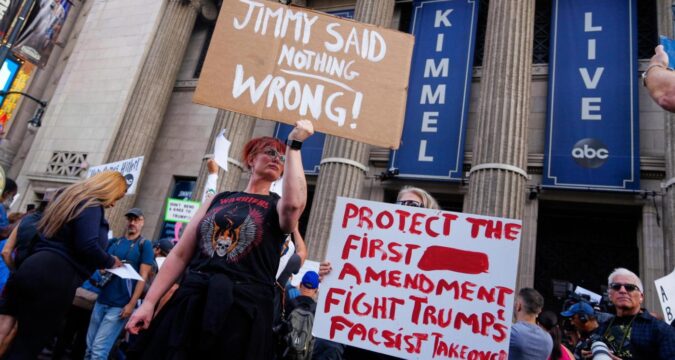
Free speech advocates protested the initial refusal by the owners of New Haven-based Channel 8 to broadcast the nightly comedy show by Jimmy Kimmel after comments that he made following the death of Kirk. The station owner had boycotted the show in the Hartford and New Haven markets, as well as others around the nation, until making the switch on Friday to resume broadcasting the show.
Gov. Ned Lamont had called for the New Haven station to put the comedy show back on the air.
“If you’re a champion of free speech, you want to make sure government does not get in the way,” Lamont told reporters last week. “Corporations can’t tell us what is appropriate political satire or not. I want WTNH to get them back on the air. I think that’s good for free speech in Connecticut.”
The Connecticut Citizen Action Group, a longtime backer of liberal causes, organized a protest outside Channel 8 last week as the station owner had blocked the showing of Kimmel’s show statewide.
“This is not just about one late-night show,” CCAG said. “It is about the dangers of media consolidation, censorship, and the growing impediment to free speech caused by right-wing corporate control of information. When one company controls what our communities see and hear, it undermines free expression, restricts access to diverse viewpoints, and gives a small group of corporate executives outsized influence over democracy. Nexstar’s latest $6.2 billion deal to acquire TEGNA Inc. would put even more Connecticut stations under its thumb.”
Another major station owner, Sinclair, reversed its position Friday and decided to resume broadcasting Kimmel’s show on ABC affiliates in St. Louis, Washington, D.C. and about 30 markets nationwide. Nexstar followed hours later, meaning that Kimmel’s entire audience is now restored. On his first night back, Kimmel attracted 6.2 million viewers for his highest ratings in more than 10 years.
In a social media video that was replayed nationally on Stephen Colbert’s late-night comedy show on CBS, U.S. Sen. Chris Murphy said the temporary suspension of Kimmel’s show and the planned cancellation of Colbert’s show are examples of “the systematic destruction of free speech in this country.”
A demonstrator waves a sign following a protest against the suspension of the Jimmy Kimmel Live show, held near the theater where the show is produced in Hollywood on September 22. A contingent of Hollywood union members, along with Democratic members of the House of Representatives, participated in the event to defend the constitutional right to free speech.
(Photo by Mario Tama/Getty Images)
Political pendulum
As political momentum has swung back and forth through the years, the administrations of President Joe Biden and Trump have highlighted the sharp differences in viewpoint on academic freedom and free speech.
Rose, the Sacred Heart professor who has taught classes on the First Amendment, said Americans have not seen such a crackdown in decades.
“It is reminiscent of the Nixon era,” Rose said. “I would say that these days, everywhere — whether on a college campus, on networks, on social media — there’s a challenge right now in this era that we’re in to sustain free speech. And it does concern me — very much so.”
Rose added, “For several years, it seemed more of the threat was coming from the left from the political correctness that was sweeping this country. But now, the pendulum is swinging, and it’s payback, and it’s coming from the right more. … The right is considering payback time now for what they went through with the political correctness era, which is now kind of off to the side. There shouldn’t be any pendulum on this issue, but there is. This is payback. That’s what’s going on here. Then if the Congress and the next presidential election changes, then it’s going to be payback that way. That’s the era we’re living in, which is unfortunate, and it reflects the polarized character of our system.”
Christopher Keating can be reached at ckeating@courant.com