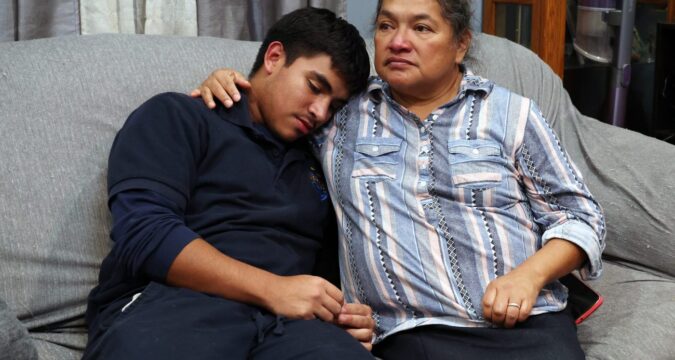
When Martha Ruiz returned to her Gary home on Nov. 13 after a couple of weeks in ICE custody in El Paso, she was ecstatic to see her children.
“When I left them back at the jail, I didn’t know if I was going to see them again,” said Ruiz, 57.
Her husband, Rosario Carrillo Lopez, who built fences, managed to escape U.S. Immigration and Customs Enforcement agents. The family alleges the agents rammed Carrillo’s vehicle on Oct. 13 on the way back from taking his son Eli Carrillo, then 14, to school at Gary Lighthouse.
Days later, immigration agents raided their Gary home near the Gary airport at around 6 a.m. Oct. 23.
Ruiz said she was sleeping on the sofa when agents with flashlights started banging on the front door.
“I got up, but they didn’t give us time to answer the door,” she said.
Agents rammed the door in. Her younger son, Eli, now 15, took his diabetic mother downstairs to hide. She hid near their furnace and heard a police dog.
“I’m afraid of dogs,” she said in a Spanish language interview. “When they saw where I was, I just raised my hands.”
Despite telling them she had a hurt arm, agents forced it behind her back. Handcuffed on the ground, she asked for help up to use the bathroom. They refused to assist, she said.
“You get up,” she recalled them saying.
Then, a dog bit her back.
“They were like, ‘Our dog doesn’t bite’,” she recalled, retorting, “Yes, your dog is biting me.”
An U.S. Immigration and Customs Enforcement spokeswoman was not in the office Wednesday for comment.
Martha Ruiz speaks about the raid on her Gary home by federal immigration enforcement agents and her time in detention in Texas. (Terrence Antonio James/Chicago Tribune)
Dragged up the stairs, they threw her on the ground, fracturing her ribs, her son, Arnoldo Carrillo said. She wasn’t treated for the ribs at the Broadview processing facility outside Chicago or in El Paso. When he took her to a doctor after her release, they said her ribs had started to heal on their own.
In the melee, Arnoldo, 26, was choked and left with a black eye. Their daughter Sarai Carrillo, 24, is charged in federal court with pushing a federal agent, which she denies. Eli spent a few weeks in Lake County Juvenile Detention after he admitted he threw a punch. Agents threw him across a porch, leaving him with a bleeding head.
Both Arnoldo and Sarai said previously when they asked for a warrant, agents showed them a folded-up piece of paper and didn’t give them a document to examine until the family was handcuffed outside.
Carrillo Lopez was taken to the Hammond city jail. Her son Arnoldo was released. Her daughter Sarai was taken to the Porter County Jail and released after a day, while Martha was put in ICE custody.
We’ve always been together as a family, Ruiz said emotionally.
She was taken to ICE’s Broadview processing center for two days, where she estimated she was in a room one day with about 170 people with only one window, with some sleeping on the floor. The women’s bathroom was open with “no privacy.” They got ham and cheese sandwiches with water. Ruiz’s daughter had grabbed her diabetes medication, so she had it with her in detention.
Then, Ruiz was taken by bus to the Gary airport for a flight to Texas. Once she arrived, she was told she would be deported to Mexico.
“I was afraid,” she said, “but I just said ‘well, if that’s the case, God, I give you thanks, just watch over my children’.”
In El Paso, she got an injection for her pain, but not much else medical care. There, she spent a total of three hours outside in three weeks.
“The routine for some women was just eating and going to sleep, because they didn’t want to get desperate thinking about their kids,” she said. “I thank God that I’m here.”
Her son paid a $5,000 bond for her release. When ICE released her on Nov. 12, they took her to a woman’s shelter, where she was still shackled until she walked through the door, she said. The conditions there were much better and the staff was kind.
Arnoldo went to El Paso to fly her back to Chicago, then took her home.
Arnoldo Carrillo Jr. shows a photo of his father, Rosario Carrillo Lopez, who is being held after federal agents raided the family’s home earlier this month. (Terrence Antonio James/Chicago Tribune)
She and Carrillo Lopez met in church in California in the 1990s. He was handsome, a calm and steady presence. When asked what would happen if her husband gets deported, she hoped the family could remain together. Their house is paid off.
“I honored this country,” Ruiz said, “by giving them (U.S. citizen) children.”
She still sleeps on the sofa at night, to make sure someone else isn’t outside. Her children have said the raid traumatized them. She was very proud of how they handled themselves. Arnoldo said in an interview he had no experience with what to do.
Eli said he was “very surprised” when she was released, thinking it would take over a week longer. In juvenile detention, he dreamed of his family together.
The family would have to decide if they want to sue for excessive force over the dog bites, said Ruiz’s immigration attorney Alfredo Estrada Wednesday.
“We think we have a good case,” he said.
Ruiz was able to get bonded out of immigration court because she originally came to the U.S. legally in the 1990s on an F-1 visa for her religious studies. That made her a relatively rare case, Estrada said.
Martha Ruiz still has a wound on her leg she says she suffered during a raid on her home by federal immigration enforcement agents. (Terrence Antonio James/Chicago Tribune)
ICE has always had the ability to grant bond, he said. By contrast, the Trump administration largely took away immigration judges’ ability to grant bond for those who crossed the border illegally and faced getting deported again. Previously, they had the judgment call to release people that weren’t a danger to the community or flight risk.
For Ruiz’s immigration case, they were looking for an “adjustment of status” – to hopefully get her green card within the next year or two. The fact that her son, Arnoldo, is a U.S. citizen over 21 also helps her case, Estrada said.
He confirmed she was released from ICE detention to a local El Paso shelter.
“That’s the value they have on human life,” he said. “They dropped her off and said, ‘Do your best’.”
His client was a churchgoing woman with three U.S. citizen kids and no criminal history.
“That’s how ICE is focusing taxpayer money,” he said. The notion they were going after “criminals” was a “farce” and a “lie.” People need to “talk to their representatives,” because “what they voted for” was using taxpayer money to “disrupt good families.”
Estrada is facing a state attorney disciplinary case after the daughter of a former client accused him of trying to start a sexual relationship. It is still under investigation.
When asked how it affected his current immigration clients’ cases, Estrada said the question was “inappropriate.” Moments later, he contacted a reporter back to clarify, later saying he was surprised by the question.
The disciplinary case was “being defended vigorously,” Estrada said, adding he was “looking forward for the process going through (and discovering) the truth of what really occurred.”
“If they ask, we tell them we are not really at liberty to discuss the ongoing process,” he said.
Ruben Garcia, Director of Annunciation House in El Paso, which oversees the Casa Papa Francisco shelter where Ruiz stayed for a night after her release, said they typically house 10-11 people per day who get released on bond from immigration custody.
Established in 1974, they had a “wealth of experience” caring for migrants and refugees who crossed the border, he said. What was relatively newer was people getting detained, then transported to the shelter from across the country.
We “have them feel at home, even if it’s for one night,” he said. “That they can breathe freely and eat (while securing transportation) to get back to their families.”